Nomae video feed

Watch the talk.Keep the signal.

Public engineering recordings paired with summaries grounded in their transcripts. Conference briefings are the first source; this feed will grow beyond them.

62videos with summaries
Latest source collection

Videos worth keeping

Newest first · Showing 26–50 of 62.

Introducing NVIDIA Cosmos 3: The Open Model That Thinks, Generates, and Acts
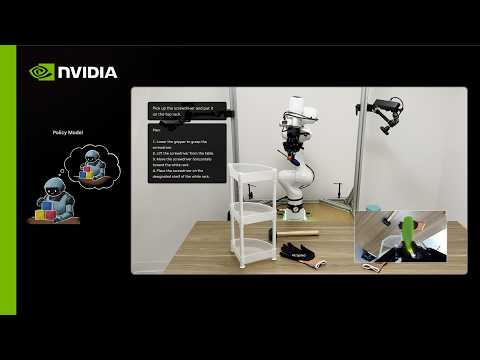
Physical AI faces an unbounded, unpredictable real world and real-world data cannot scale; the talk reframes this by treating compute as data. NVIDIA Cosmos is presented as an open omnimodel for physical AI built on a new mixture-of-transformers architecture: an autoregressive transformer that reasons, plans, and instructs, and a diffusion transformer that generates what comes next from pixels, action, sound, and language. Post-training across embodiments converts Cosmos into an action-conditioned world model that can describe scenes, generate physics-accurate synthetic video, close the loop for policy training and evaluation, and produce actions for robots; the approach trades data collection for compute-generated synthetic data and computer-generated teachers.

  • Problem statement: the real world is infinite and unpredictable, and real-world data is impossible to scale for physical AI.
  • Principle: 'compute is data'—use compute to generate the data and supervision needed for physical AI instead of relying solely on collected real-world data.
  • Model class: Cosmos is an open 'omnimodel' for physical AI built on a new mixture-of-transformers architecture.
Read full briefing

Key technical points

  • Problem statement: the real world is infinite and unpredictable, and real-world data is impossible to scale for physical AI.
  • Principle: 'compute is data'—use compute to generate the data and supervision needed for physical AI instead of relying solely on collected real-world data.
  • Model class: Cosmos is an open 'omnimodel' for physical AI built on a new mixture-of-transformers architecture.
  • Architecture decomposition: a pipeline of transformers including an autoregressive transformer and a diffusion transformer.
  • Inputs to the system: pixels, action, sound, and language are fed into the autoregressive transformer.
  • Role of the autoregressive transformer: reasons, plans, and issues instructions to the diffusion transformer (serves as the planner/instructor).
  • Role of the diffusion transformer: generates the next content (e.g., future frames or observations) conditioned on instructions from the autoregressive transformer.
  • Post-training workflow: developers post-train Cosmos across different embodiments and use cases to adapt it to specific robots or environments.
  • Vision-language capability: as a VLM, Cosmos watches the physical world, understands and describes scenes, and flags what matters.
  • World-model capability: Cosmos can generate physics-accurate synthetic video from an image, text, or video input.
  • Simulator capability and training loop: Cosmos can act as a simulator that closes the loop for policy training and evaluation (enables closed-loop, action-conditioned training).
  • Action-conditioned prediction: as the foundation of NVIDIA Omnidreams, Cosmos predicts future frames iteratively (frame by frame) conditioned on actions.
  • Deployment outcome: after post-training, Cosmos becomes a world-action model that perceives, reasons, plans, and generates actions for 'robots of every kind'—for everything that moves.
  • New data/teacher paradigm: Cosmos enables a new kind of data and a new kind of teacher generated by computer (synthetic data and computer-generated supervision).
Engineering relevance

For engineering teams, the talk signals a shift from costly real-world data collection toward heavy use of compute-generated synthetic data and simulation. Architecturally, plan for a two-stage transformer pipeline: an autoregressive planner/instructor and a diffusion generator, with multimodal inputs (pixels, action, sound, language) and multimodal outputs (descriptions, videos, actions). Expect development flows that require post-training across embodiments to adapt policies and perception to target robots, and closed-loop simulation to train and evaluate policies. The presentation does not specify evaluation metrics, safety guardrails, or detailed deployment mechanics, so teams must design their own validation, metrics, and safeguards around physics fidelity, sim-to-real transfer, and runtime action safety. Operationally, this approach implies substantial compute resources and orchestration for synthetic-data generation, post-training, and iterative policy evaluation.
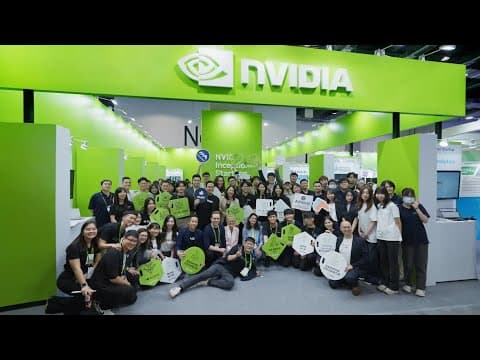
Meet the Featured Startups at GTC Taipei 2025

At GTC Taipei 2025 NVIDIA highlighted Inception startups applying GPU-accelerated stacks and simulation to domain-specific problems across healthcare, manufacturing, transportation, robotics, and sustainability. Examples include a drug-discovery pipeline that uses RAPIDS, CUDA, BioNeMo and TensorRT to screen millions of plant-based compounds and claims an 80% reduction in traditional timelines (years to months); sensor-fusion and simulation-driven 3D tracking for rail collision warning; AI-driven textile digital twins; energy-optimized humanoid robots on Jetson Orin NX; and a standardized, traceable recycling ecosystem with automated sorting. Evidence in the talk centers on applied software/hardware stacks, data scale, simulation for edge-case training, and targeted hardware/actuator choices; outcomes reported are speedups, improved reliability, lower energy and cost, and better material recovery. Limitations are implicit: claims focus on platform components and outcomes without published evaluation protocols, quantitative failure-mode analysis, or detailed deployment metrics beyond cited speedups and functional capabilities.

  • Nanyang Biologics: drug-discovery platform that screens millions of plant-based compounds using an NVIDIA software/hardware stack (RAPIDS, CUDA, BioNeMo, TensorRT).
  • Nanyang reports accelerating traditional drug-discovery timelines by 80%, transforming processes that typically take years into months (metric reported in the talk).
  • NunoX: AI textile co-pilot that generates digital twins of fabrics from proprietary material and production datasets to accelerate development, streamline supply chains, and improve sustainability.
Read full briefing

Key technical points

  • Nanyang Biologics: drug-discovery platform that screens millions of plant-based compounds using an NVIDIA software/hardware stack (RAPIDS, CUDA, BioNeMo, TensorRT).
  • Nanyang reports accelerating traditional drug-discovery timelines by 80%, transforming processes that typically take years into months (metric reported in the talk).
  • NunoX: AI textile co-pilot that generates digital twins of fabrics from proprietary material and production datasets to accelerate development, streamline supply chains, and improve sustainability.
  • POD Innovation: developed a collision warning system for Kaohsiung Light Rail that fuses inputs from cameras, LiDAR, and other sensors to enable 3D object tracking (sensor-fusion pipeline).
  • POD Innovation uses NVIDIA Omniverse Replicator to simulate scene assets, including edge cases, and to train object-detection models—explicitly using synthetic data and scenario variety to improve reliability (evaluation/robustness approach).
  • AeiRobot: humanoid robots (ALICE4) designed to navigate unstructured spaces and engage in unscripted conversations; ALICE4 uses NVIDIA Jetson Orin NX to reduce energy requirements for on-board AI processing.
  • AeiRobot reduces manufacturing costs via proprietary linear actuators (hardware design choice targeting cost trade-offs between actuator design and overall robot cost).
  • AIRECO: AI-driven recycling ecosystem that links consumers, recycling facilities, and brands into a single loop, introducing standardization and traceability at every touchpoint (governance/data lineage emphasis).
  • AIRECO emphasizes automated facilities to decrease sorting costs and maximize recovered-material value (automation to improve economics of recycling streams).
  • Common engineering pattern: startups pair domain-specific proprietary datasets (materials, production, plant compounds, sensor scenes) with GPU-accelerated compute and simulation tooling to scale training and inference.
  • Simulation and synthetic data generation (Omniverse Replicator) are used explicitly to cover edge cases and increase system reliability for perception models in transportation scenarios.
  • Edge deployment trade-offs are addressed via hardware choices: Jetson Orin NX for energy-constrained robotics inference, and TensorRT for optimized inference in drug-discovery screening pipelines.
  • Traceability and standardization in the recycling ecosystem function as production guardrails to enable value capture across participants (consumers, facilities, brands) and support circular-economy goals.
  • NVIDIA Inception program provides nontechnical supports referenced in the talk—technical training, VC network exposure, and preferred pricing on NVIDIA products—which form part of startups' deployment and iteration support loops.
Engineering relevance

The talk documents concrete stacks and patterns engineers can map to production systems: multi-GPU and CUDA-accelerated data pipelines (RAPIDS) combined with model acceleration (TensorRT, BioNeMo) for large-scale compound screening; sensor-fusion pipelines (camera + LiDAR + additional sensors) for 3D tracking in safety-critical transport systems; synthetic-data-driven training using Omniverse Replicator to exercise edge cases and improve perception robustness; and edge inference/hardware trade-offs exemplified by Jetson Orin NX for lower energy consumption. It also highlights the value of proprietary domain datasets (materials, production, compounds, scene assets) and automated facilities to reduce operational cost. From an engineering perspective, the explicit metrics (millions of compounds screened, 80% timeline reduction) indicate emphasis on scalability and throughput; simulation-based evaluation is the presented method for robustness; and traceability/standardization are used as operational guardrails in recycling pipelines. The presentation does not provide detailed evaluation protocols, latency/throughput numbers for deployed systems, or formal failure-mode analyses, so engineers should treat reported outcomes as high-level claims tied to the described stacks and design choices.

NVIDIA AI & Omniverse: Pegatron Digitalizes AI Smart Factory w/ Isaac Sim, Metropolis, and Omniverse

Manufacturers must become software-defined to produce high-quality products faster and cheaper. Pegatron builds a cloud-native Omniverse digital twin that unifies disparate 3D and CAD datasets to give planners and suppliers a real-time view, and uses that twin as a training ground and data factory for perception AIs. NVIDIA stack components—Isaac Sim for robot simulation, Omniverse Replicator for synthetic PCB-A defect data, Metropolis for AOI workflows, TAO for training, and DeepStream for inference—form a pipeline that produced AOI at 99.8% accuracy with 4× throughput. Outcomes include faster factory bring-up, fewer change orders, continuous operational optimization, higher line throughput, and lower costs.

  • Global problem statement: the $45 trillion manufacturing industry (10 million factories) is racing to become software-defined to improve quality, speed, and cost-efficiency.
  • Omniverse digital twin unifies disparate 3D and CAD datasets to provide a real-time view of complex factory data to planners and suppliers.
  • The digital twin is cloud-native and enables planners to optimize factory layout virtually before deploying physical changes.
Read full briefing

Key technical points

  • Global problem statement: the $45 trillion manufacturing industry (10 million factories) is racing to become software-defined to improve quality, speed, and cost-efficiency.
  • Omniverse digital twin unifies disparate 3D and CAD datasets to provide a real-time view of complex factory data to planners and suppliers.
  • The digital twin is cloud-native and enables planners to optimize factory layout virtually before deploying physical changes.
  • The cloud-native digital twin doubles as a training ground and data factory for perception AI models.
  • NVIDIA Isaac Sim (built on Omniverse) is used to simulate and optimize fleets of mobile robots for material movement and pick-and-place robotic arms on production lines.
  • Automated optical inspection (AOI) points are deployed along production lines to reduce cost and increase line throughput.
  • NVIDIA Metropolis is used to quickly develop and deploy cloud-native, highly accurate AOI workflows across production lines.
  • Omniverse Replicator generates synthetic datasets for PCB-A defects that are too complex or costly to capture in the real world—examples cited: scratches and missing or misaligned components.
  • Training pipeline: synthetic data from Replicator is combined with NVIDIA pre-trained models and NVIDIA TAO for training, adaptation, and optimization of perception models.
  • Runtime pipeline: NVIDIA DeepStream is used for real-time inference of the trained AOI models in production.
  • Measured outcome for AOI: 99.8% accuracy and a 4× improvement in throughput after combining synthetic data, pre-trained models, TAO training, and DeepStream inference.
  • Business/operational outcomes claimed: software-defined factories built on NVIDIA AI and Omniverse can super-accelerate factory bring-up, minimize change orders, continuously optimize operations, maximize production line throughput, and reduce costs.
Engineering relevance

The talk describes an end-to-end engineering stack and data pipeline: ingest and unify disparate 3D and CAD datasets into a cloud-native Omniverse digital twin; use the twin for virtual layout optimization and as a data factory; generate synthetic defect datasets with Omniverse Replicator; simulate robotic fleets and manipulation with Isaac Sim; train and adapt perception models using NVIDIA pre-trained models and TAO; and deploy real-time AOI inference with DeepStream and operationalize AOI workflows via Metropolis. Inputs and outputs explicit in the source: 3D/CAD datasets and synthetic PCB-A defect images in → trained models and AOI inference out. Evaluation metrics provided: AOI accuracy (99.8%) and throughput improvement (4×). The source documents an iterative deployment loop: virtual optimization in the twin before physical changes and reuse of the twin for continuous training/data generation. The talk does not detail guardrails, failure modes, or trade-off analyses beyond the stated metrics and operational benefits.

NVIDIA and Data Center Partners Review Highlights at COMPUTEX 2025

Computex 2025 framed the modern computer as a unified, AI-driven data center — an "AI factory" — solving the problem of scaling inference and unstructured-data throughput across systems. Nvidia's approach centers on the Grace Blackwell platform and the new Grace Flagwell Ultra in full production, claiming 1.5x inference performance through dual-chip connectivity, TSMC POWSL packaging, and an NV link spine. The NV link spine provides 130 TB/s all-to-all GPU bandwidth across 72 Flagwell Ultra GPUs to present a single large virtual GPU, and Nvidia paired a purpose-built NVIDIA AI data platform plus AIQ to semantically query unstructured data. Availability signals focus on production deployment (MGX components from 60+ suppliers, RTX Pro servers, liquid cooling and high-power architectures), though transcript details on evaluation methodology and operational guardrails are limited and should be validated before integration.

  • Reframe: modern computing described as unified AI-driven data center ("AI factory") rather than standalone PCs/servers.
  • Core platform: Nvidia Grace Blackwell platform presented as foundational technology for this shift.
  • New product in production: Nvidia Grace Flagwell Ultra is now in full production and claims 1.5x inference performance versus prior generation.
Read full briefing

Key technical points

  • Reframe: modern computing described as unified AI-driven data center ("AI factory") rather than standalone PCs/servers.
  • Core platform: Nvidia Grace Blackwell platform presented as foundational technology for this shift.
  • New product in production: Nvidia Grace Flagwell Ultra is now in full production and claims 1.5x inference performance versus prior generation.
  • Hardware engineering: Grace Flagwell Ultra incorporates dual-chip connectivity and uses TSMC's advanced POWSL packaging (as stated).
  • GPU fabric: NV link spine enables 130 terabytes/second of all-to-all GPU bandwidth across 72 Nvidia Flagwell Ultra GPUs to form a single virtual GPU.
  • Interoperability: Envink Fusion described as an open, flexible approach to Nilink that lets partners tightly integrate their own CPUs, AI accelerators with Nvidia Whiteall and the upcoming Ruben architecture for semi-custom infrastructure.
  • Ecosystem servers: Multiple partners (listed in talk: ASUS, as rockrecom, gigabyte, invents, egatron, QCT, super micro, we strong, and wewing) will offer RTX Pro servers aimed at enterprise AI factory workloads.
  • Enterprise AI platform: Nvidia announced an Enterprise AI platform intended to accelerate large IT investments and deployment at scale.
  • Storage + semantics: NVIDIA AI data platform is presented as a purpose-built storage system that can semantically query unstructured data with claimed unprecedented speed and accuracy.
  • AIQ pairing: The NVIDIA AI data platform is paired with Nvidia AIQ to address the bottleneck of extracting meaning from massive amounts of raw unstructured data.
  • MGX ecosystem: Keynote showcased MGX component availability from over 60 global suppliers, indicating supply-chain and component readiness.
  • MGX component types: MGX supports specific components and subsystems including Nvidia GB300, MBL72, liquid-cool systems, and high-power architectures, highlighting mechanical, thermal, and electrical solutions necessary for next-gen adoption.
  • Deployment signal: Multiple announcements emphasize production-readiness across silicon, systems, and data-center infrastructure, but the talk provides few technical details on evaluation metrics beyond the stated performance and bandwidth numbers.
Engineering relevance

Engineers should note three concrete infrastructure implications: (1) system architecture: Flagwell Ultra plus an NV link spine is intended to scale GPUs into a single large virtual GPU via 130 TB/s all-to-all bandwidth across 72 devices, which changes networking/fabric topologies and software placement assumptions; (2) packaging and connectivity: dual-chip connectivity and TSMC POWSL packaging are central to claimed 1.5x inference gains and will affect board-level and thermal designs; (3) data and storage: the NVIDIA AI data platform + AIQ targets the unstructured-data semantic-query bottleneck, so storage and data pipelines will need to integrate with that stack. Additionally, Envink Fusion/Nilink and the mention of Nvidia Whiteall/Ruben architectures indicate an intended semi-custom partner integration layer; validate compatibility and interoperability details with each partner. Finally, MGX component availability (GB300, MBL72, liquid cooling, high-power architectures) and dozens of suppliers imply production and deployment engineering workstreams (mechanical, thermal, electrical) are required to support next-gen nodes.

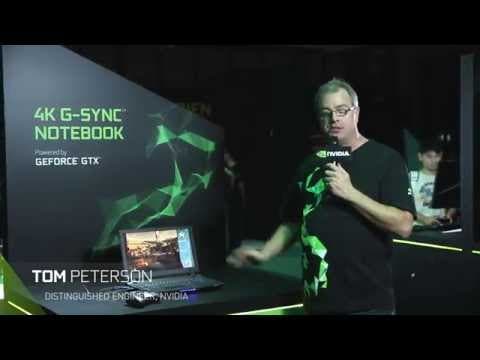
NVIDIA at Computex - G-SYNC For Notebooks, New Monitors, New Features

At Computex NVIDIA announced a new G-SYNC product wave: seven partner monitors (including IPS-based 34" ultrawide gaming displays) and G-SYNC support coming to notebooks. They also introduced two feature changes to the G-SYNC stack: a Window mode to enable G-SYNC for windowed games, and an explicit vsync on / vsync off option to let players trade off latency vs synchronisation. The net outcome is broader hardware support (desktop monitors + notebooks) and configurable latency behavior at very high frame rates; limitations implied are that adoption depends on partner hardware and correct integration into notebook/display stacks.

  • NVIDIA announced a new collection of G-SYNC products at Computex.
  • Seven new G-SYNC monitors are available from partners.
  • Some of the new monitors are 34-inch ultrawide gaming displays.
Read full briefing

Key technical points

  • NVIDIA announced a new collection of G-SYNC products at Computex.
  • Seven new G-SYNC monitors are available from partners.
  • Some of the new monitors are 34-inch ultrawide gaming displays.
  • Those 34" ultrawide monitors are IPS-based.
  • G-SYNC support is being extended to notebooks (notebook G-SYNC announced).
  • Notebooks will be able to deliver ultra-smooth, tear-free gaming comparable to desktop experiences.
  • Two new G-SYNC technologies were launched: G-SYNC Window mode and a vsync on / vsync off option.
  • G-SYNC Window mode enables G-SYNC in windowed (non-fullscreen) games.
  • G-SYNC now exposes both vsync on and vsync off modes for users.
  • Vsync off is provided for low-latency play; with very high frame rates the experience should remain optimal when vsync is off.
  • The announcements expand G-SYNC availability across both new monitors and notebook form factors.
  • NVIDIA framed G-SYNC as receiving strong positive reception (described as having incredible reviews).
Engineering relevance

For engineers this announcement implies several concrete integration points: monitor OEMs must ship partner hardware (including IPS 34" ultrawide panels) certified for G-SYNC; notebook system integrators and driver/display-stack teams must enable G-SYNC support on notebook GPUs and displays to achieve tear-free parity with desktops; compositor and display-path changes are required to support a G-SYNC Window mode (so G-SYNC can operate in windowed rendering contexts); and control over vsync on/off must be exposed and validated to ensure acceptable frame-pacing and lowest-latency behavior when frame rates are very high. Testing/validation should explicitly verify tear-free rendering in both fullscreen and windowed modes and verify behavior with vsync toggled at high frame rates. Deployment depends on partner hardware availability and correct integration into notebook/display firmware and drivers.

NVIDIA at Computex 2015 - Overview

NVIDIA showcased solutions aimed at higher-fidelity VR and realtime visual effects: they launched the Maxwell-based GeForce GTX 980 Ti and highlighted DirectX 12 features such as sparse textures. The company demonstrated these capabilities through hands-on VR experiences and demos that included realtime fluid simulations. They also introduced new G-SYNC modules and G-SYNC monitors and announced G-SYNC support for notebooks. The demonstrations indicate improved VR/display integration, but the transcript contains no quantitative performance or availability details.

  • NVIDIA hosted a GeForce VR experience at Computex where attendees could try the latest VR technology.
  • NVIDIA launched the GeForce GTX 980 Ti GPU.
  • The GTX 980 Ti is based on the Maxwell GPU architecture.
Read full briefing

Key technical points

  • NVIDIA hosted a GeForce VR experience at Computex where attendees could try the latest VR technology.
  • NVIDIA launched the GeForce GTX 980 Ti GPU.
  • The GTX 980 Ti is based on the Maxwell GPU architecture.
  • The GTX 980 Ti includes support for DirectX 12.
  • DirectX 12 features called sparse textures were specifically called out.
  • Sparse textures are used to enable realtime fluid simulations in the demos.
  • Realtime fluid simulations were shown in demonstrations to illustrate the new features.
  • NVIDIA introduced new G-SYNC modules.
  • NVIDIA announced brand-new G-SYNC monitors intended to improve gaming experiences.
  • NVIDIA is bringing G-SYNC technology to notebooks (laptop support).
  • Computex served as the launch and demonstration venue for these GPU, API, and display advances.
Engineering relevance

Architecture and API: The GTX 980 Ti is Maxwell-based and exposes DirectX 12 capabilities (notably sparse textures), so engineers targeting high-fidelity VR or realtime large-scene effects should consider integrating DX12 sparse texture workflows where supported. Validation method: NVIDIA relied on hands-on demos and realtime fluid-simulation demonstrations as evidence of capability; this implies prototype/demo-driven evaluation rather than published benchmarks in this talk. Display integration: new G-SYNC modules and monitors (and notebook support) indicate a push for tighter GPU-display synchronization in desktop and mobile form factors; display engineers and driver teams will need to integrate and test G-SYNC modules across monitor and notebook platforms. Operational note: the transcript shows feature announcements and demos but does not provide performance metrics, deployment dates, or guardrails, so engineering teams must obtain specifications, driver/firmware details, and quantitative data from product documentation before production integration.

NVIDIA at COMPUTEX 2023 Highlights

Computex 2023 presented a full-stack effort to enable large generative-AI models and industrial digitalization: NVIDIA announced the DGX GH200 (connecting 256 Grace Hopper Superchips into a massive “1X of flop GPU”), an MGX open modular server design, and the Spectrum X ethernet platform aimed at hyperscale AI. Complementing hardware, NVIDIA highlighted Omniverse and generative AI services for factory digitization, a WPP Omniverse ad content engine, and ACE for games to animate virtual characters. Evidence came from Jensen’s 90-minute keynote, partner demos, SoftBank’s planned Grace Hopper–powered data center, and a MediaTek in-vehicle AI partnership; the transcript does not provide performance benchmarks, cost, or deployment timelines. The announcements create an integrated path from chips to datacenter networking to application-level services, but operational details and metrics remain unspecified in the source.

  • DGX GH200 AI supercomputer: system seamlessly connects 256 Grace Hopper Superchips into a massive "1X of flop GPU" for building large language models and generative AI chatbots.
  • MGX: an "open modular server" design announced for accelerated computing (presented as a modular hardware approach to datacenter servers).
  • SoftBank is building a next-generation data center powered by NVIDIA Grace Hopper aimed at generative AI and 5G/6G communications workloads (example of a customer deployment).
Read full briefing

Key technical points

  • DGX GH200 AI supercomputer: system seamlessly connects 256 Grace Hopper Superchips into a massive "1X of flop GPU" for building large language models and generative AI chatbots.
  • MGX: an "open modular server" design announced for accelerated computing (presented as a modular hardware approach to datacenter servers).
  • SoftBank is building a next-generation data center powered by NVIDIA Grace Hopper aimed at generative AI and 5G/6G communications workloads (example of a customer deployment).
  • Spectrum X: an Ethernet platform specifically designed for hyperscale "degenerative" AI (phrasing from the transcript) — positioned for large-scale AI networking needs.
  • Omniverse announcements: electronic manufacturers are adopting NVIDIA's generative AI services and Omniverse to digitize state-of-the-art factories (digital twin / industrial metaverse use case).
  • NVIDIA and WPP partnership to create a digital ad content engine inside Omniverse (application of Omniverse for media/content generation).
  • ACE for games: a generative-AI capability described to animate and add life to virtual gaming characters (game-focused application of generative models).
  • MediaTek collaboration: partnership announced to develop in-vehicle AI cabin solutions for next-generation software-defined vehicles spanning entry-level to premium segments (edge / automotive AI application).
  • Greg Estes framed Omniverse, generative AI, and accelerated computing as enabling a new era of 3D workflows—termed the industrial metaverse—targeted at enterprise 3D/industrial pipelines.
  • NVIDIA’s 90-minute keynote and partner ecosystem presence (nearly 3,500 in person plus tens of thousands watching live) were used to demo end-to-end platform connections from chips to applications.
  • Over 30 NVIDIA partners showcased technologies on the showroom floor at the Nangang Exhibition Center (partner ecosystem engagement and demos).
  • A dedicated AI developer Meetup allowed developers to meet Jensen and engage directly, indicating emphasis on developer relations and community feedback loops.
Engineering relevance

Engineers should note the announced system-level components that connect chip design, server form-factor, networking, and application platforms: DGX GH200 (256 Grace Hopper Superchips) for large-model training, MGX modular servers for datacenter deployments, and Spectrum X for hyperscale AI networking. Omniverse and generative AI services were positioned as the application and digital-twin layer for factory digitization and media workflows, while ACE and the MediaTek vehicle partnership show targeted application stacks for games and in-vehicle AI. The source provides concrete architecture announcements and partner deployment examples (e.g., SoftBank) but does not include operational benchmarks, cost, or rollout schedules, so engineering planning will require follow-up for performance/scale metrics and integration details.

NVIDIA at COMPUTEX 2024 Highlights

NVIDIA framed COMPUTEX 2024 around preparing for the next industrial digitization wave by delivering full‑stack platforms that span consumer AI PCs to industrial robotics and digital twins. The company unveiled a roadmap including the Blackwell Ultra GPU and the Reuben platform, which will combine new GPUs, an Arm‑based CPU called Vera, and advanced networking, delivered on a one‑year cadence. Evidence presented at the keynote and show floor included >200 RTX AI laptops, >500 AI apps/games, over 60 partner demonstrations, and an NVIDIA AI Summit with 30 sessions and 1,000+ attendees. Outcome: an explicit hardware‑software platform roadmap and ecosystem activation; limitation: major platform innovations are staged on a multi‑quarter (one‑year) release rhythm rather than immediate availability.

  • NVIDIA positioned its strategy as delivering full‑stack platforms across industries, from AI PCs to industrial applications (robotics, autonomous operations, digital twins).
  • Roadmap reveal: the company introduced the Blackwell Ultra GPU as a forthcoming compute building block.
  • Reuben platform details: Reuben will feature new GPUs, the Arm‑based CPU Vera, and advanced networking solutions as integrated components.
Read full briefing

Key technical points

  • NVIDIA positioned its strategy as delivering full‑stack platforms across industries, from AI PCs to industrial applications (robotics, autonomous operations, digital twins).
  • Roadmap reveal: the company introduced the Blackwell Ultra GPU as a forthcoming compute building block.
  • Reuben platform details: Reuben will feature new GPUs, the Arm‑based CPU Vera, and advanced networking solutions as integrated components.
  • Release cadence: NVIDIA stated these platform innovations will arrive on a one‑year rhythm (an explicit iteration/deployment loop).
  • Consumer device scale: announcement of over 200 RTX AI laptop models and a software ecosystem of more than 500 AI‑powered apps and games.
  • Ecosystem activation: over 60 partners showcased NVIDIA offerings on the COMPUTEX show floor, indicating partner integrations and third‑party demonstrations.
  • Enterprise/industry impact claim: NVIDIA positions itself as leading a $50 trillion industrial digitization shift, focusing on efficiency improvements and cost reduction in IT and operations.
  • Demo tooling: NVIDIA's creative team built keynote demos using AI tools from the NVIDIA Inception startup program and technologies referenced as NVIDIA nms and accelerated Computing.
  • Developer engagement: the NVIDIA AI Summit ran alongside COMPUTEX with over 1,000 developers, researchers, and business leaders, offering 30 sessions, demos, a developer meetup, and training workshops.
  • Target outcomes called out: productivity gains with AI PCs and transformative industrial applications through the full‑stack approach.
  • Scale of audience and partner validation: Jensen's keynote addressed a sold‑out crowd and multiple university watch parties, used as qualitative evidence of community and partner engagement.
  • No specific benchmarks, detailed performance metrics, or production guardrails (e.g., safety/certification processes) were described in the provided remarks.
Engineering relevance

For engineers the brief provides three actionable signals: (1) a concrete hardware‑software roadmap centered on Blackwell Ultra GPUs and the Reuben platform (GPUs + Arm CPU Vera + advanced networking) that will shape architecture decisions; (2) an explicit one‑year product cadence to plan integration, testing, and procurement cycles; and (3) broad ecosystem momentum — hundreds of RTX AI laptops, 500+ AI apps, 60+ partners, and summit‑level developer engagement — indicating substantial third‑party software and reference implementations to leverage. The mention of NVIDIA nms, accelerated computing, and Inception startup tools signals available demo/stack components to prototype with, while the focus areas (robotics, autonomous operations, digital twins) identify likely target workloads to prioritize. The talk did not provide microbenchmarks, production guardrails, or failure‑mode analysis, so engineering teams should expect to validate performance, reliability, and safety requirements themselves during integration.

NVIDIA at COMPUTEX 2024 Partner Highlights

Computex 2024 emphasized building "AI factories" and data centers using NVIDIA's Blackwell architecture, new GB200 MV2 platform(s), MGX modular reference architecture, Spectrum X Ethernet, and inference microservices. The GB200 MV2 is presented as a mainstream LLM and data-processing accelerator targeted at inference, retrieval-augmented generation, and analytics workloads. MGX is positioned for scale-out servers (over 100 Blackwell systems / designs reported) while NVIDIA Inference Microservices (NIMS) provides pre-trained models as optimized containers for cloud, data center, or workstation deployment (adopted by 150+ partners). The announcements focus on system-level hardware + networking + software stacks, but the transcript contains no specific performance numbers, benchmarks, or operational guardrails.

  • NVIDIA Blackwell architecture, Power Systems, and NVIDIA networking (Spectrum X Ethernet) are central to building AI factories and data centers.
  • Range of systems mentioned: "Cloud unram embedded and Edge AI systems" spanning single- to multi-GPU configurations, "x86 to gr space processors," and cooling options from air to liquid.
  • Introduction of a new GB200 platform variant referenced in the transcript as "gb200 nvl2" / "gb200 mv2" positioned for mainstream large language model and data processing workloads.
Read full briefing

Key technical points

  • NVIDIA Blackwell architecture, Power Systems, and NVIDIA networking (Spectrum X Ethernet) are central to building AI factories and data centers.
  • Range of systems mentioned: "Cloud unram embedded and Edge AI systems" spanning single- to multi-GPU configurations, "x86 to gr space processors," and cooling options from air to liquid.
  • Introduction of a new GB200 platform variant referenced in the transcript as "gb200 nvl2" / "gb200 mv2" positioned for mainstream large language model and data processing workloads.
  • GB200 MV2 is described as built to deliver parallel performance for mainstream LLM inference, retrieval-augmented generation (RAG), and general data processing; it is said to be well suited for data analytics.
  • NVIDIA MGX is a modular reference architecture (first announced at Computex 2023) that supports Blackwell products, including the GB200 MV2, for scale-out server designs.
  • MGX is reported to be deployed in over 100 Blackwell systems, and system partners are building more than 100 Blackwell-based system designs using MGX.
  • NVIDIA Inference Microservices (referred to as NIMS / "Nvidia n inference microservices") are now generally available and were first announced at GTC in March.
  • NIMS provide pre-trained models packaged as optimized containers that can be deployed on clouds, data centers, or workstations to enable developers to build generative AI applications quickly.
  • NIMS adoption metric in the transcript: adopted by more than 150 partners.
  • A portfolio of MGX platform variants is listed in the transcript (verbatim): "gb200 mvl 72 hgx b00 hgx b200".
  • A set of Taiwan system partners is listed as offering MGX platforms (verbatim list from transcript): rock rack, Aus, gigabyte, bascon, Ingres, invent, pegatron, Quant, qct, super micro, W strong, and we win.
  • The announcements emphasize integrated stacks (hardware, networking, software containers) for scaling AI infrastructure, but the transcript does not include benchmark values, latency/throughput metrics, evaluation methods, or explicit production guardrails.
  • No failure modes, trade-off analyses, or detailed deployment/iteration loops were described in the transcript.
Engineering relevance

For engineers designing or operating AI infrastructure, the transcript signals three technical vectors to evaluate: (1) hardware platforms — Blackwell-based systems and the GB200 MV2 variant positioned for LLM inference, RAG, and analytics workloads; (2) system reference architecture — MGX for modular scale-out server designs (reported in >100 systems and designs); and (3) software packaging and deployment — NIMS offering pre-trained models as optimized containers for cloud, data center, and workstation deployment (150+ partner adoption). Also note the networking (Spectrum X Ethernet) and system-level considerations (single-to-multi GPU, processor variety, air-to-liquid cooling) mentioned for end-to-end deployments. The transcript does not provide numeric benchmarks, SLOs, or operational guardrails, so decisions will require obtaining detailed specs and performance data from NVIDIA or the listed system partners.

NVIDIA Blackwell: The Journey From Die to Data Center

The talk traces Blackwell from wafer fabrication to rack-scale AI systems: hundreds of lithography steps build roughly 200 billion transistors on a 12in wafer, which are scribed into dies, tested, packaged, and stress-tested. A chip-on-wafer-on-substrate flow bonds 32 Blackwell dies and 128 HBM stacks onto a custom silicon interposer, producing the B200 Super Chip after molding and curing. System integration uses automated PCB assembly, custom liquid cooling, ConnectX7 SuperNICs and BlueField‑3 DPUs, and Nvidia's MVLink fabric (14.4 TB/s per switch tray, 130 TB/s backplane) to present up to 72 Blackwells (144 dies) as a single giant virtual GPU. The result is a 1.8-ton, rack-scale AI supercomputer assembled from 1.2 million components and validated with high-temperature stress tests, with reliability and thermal management emphasized as production guardrails.

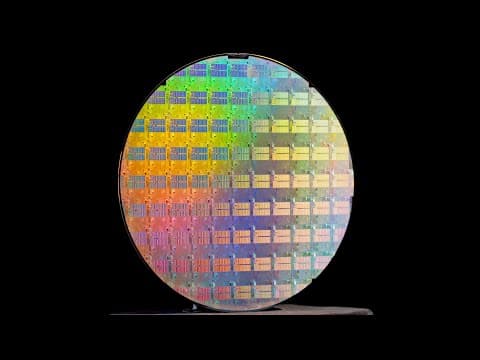
  • Wafer fabrication: hundreds of chip processing and ultraviolet lithography steps assemble approximately 200 billion transistors layer-by-layer on a 12in wafer.
  • Wafer scribing and selection: the wafer is scribed into individual Blackwell dies, which are tested and sorted to separate good dies for downstream processes.
  • Packaging (chip-on-wafer-on-substrate): at TSMC SPIL and Amcore, 32 Blackwell dies and 128 HBM stacks are attached onto a custom silicon interposer wafer.
Read full briefing

Key technical points

  • Wafer fabrication: hundreds of chip processing and ultraviolet lithography steps assemble approximately 200 billion transistors layer-by-layer on a 12in wafer.
  • Wafer scribing and selection: the wafer is scribed into individual Blackwell dies, which are tested and sorted to separate good dies for downstream processes.
  • Packaging (chip-on-wafer-on-substrate): at TSMC SPIL and Amcore, 32 Blackwell dies and 128 HBM stacks are attached onto a custom silicon interposer wafer.
  • Interposer metal interconnects: metal interconnect traces are etched directly into the silicon interposer to connect Blackwell GPUs and HBM stacks into each system and package unit.
  • Super Chip assembly: the assembled interposer and components are baked, molded, and cured to create the Blackwell B200 Super Chip.
  • Stress and qualification: each Blackwell is stress tested at KYC in ovens at 125° C and pushed to its limits for several hours as a production validation step.
  • PCB assembly automation: at Foxconn, robots pick-and-place over 10,000 components onto the Grace Blackwell PCB, with additional components prepared at factories worldwide.
  • Thermal management: custom liquid-cooling copper blocks from Cooler Master, ABC, Auras, and Delta are used to keep chips at optimal temperatures.
  • Networking and offload: ConnectX7 SuperNICs enable scale-out communications while BlueField‑3 DPUs offload and accelerate networking, storage, and security tasks.
  • Integration into compute trays: all parts converge and are carefully integrated into GB200 compute trays during system assembly.
  • MVLink fabric: MVLink is a proprietary high-speed link to connect multiple GPUs into a massive virtual GPU; an MVLink switch tray with MVLink switch chips provides 14.4 TB/s of all-to-all bandwidth.
  • Backplane scale: MVLink spines and a custom blind‑mated backplane integrate 5,000 copper cables to deliver 130 TB/s of all-to-all bandwidth, connecting 72 Blackwells or 144 GPU dies into one giant GPU.
  • Supply chain and assembly scale: parts arrive from multiple global partners (Foxconn, Wistrun, Quanta, Dell, Asus, Gigabyte, HPE, Super Micro, and others) and are assembled into a rack-scale AI supercomputer totaling 1.2 million components, 2 m of copper cable, 130 trillion transistors, weighing 1,800 kg.
  • Production emphasis: the end-to-end flow highlights precision manufacturing, automated assembly, thermal design, specialized networking/offload, and high-temperature stress testing as key production guardrails.
Engineering relevance

For software and AI engineers the transcript surfaces concrete hardware constraints and enabling technologies to design for: MVLink bandwidth figures (14.4 TB/s per switch tray, 130 TB/s backplane) and the claim of a single virtual GPU aggregating 72 Blackwells/144 dies are primary determinants of how large-scale model parallelism and collective communication can be mapped. HBM stack integration on a silicon interposer defines the memory subsystem and bandwidth available to workloads. BlueField‑3 DPUs and ConnectX7 SuperNICs indicate a shift of networking, storage, and security functions off the host CPU, affecting where to place dataplane services and telemetry. Thermal management (custom liquid cooling) and rigorous stress testing (125° C ovens) are explicit production guardrails that constrain power envelopes and reliability guarantees. Finally, automated high-volume PCB assembly and a multi-vendor supply chain define production throughput and system integration paths that software teams must account for when scheduling deployments and validation.

NVIDIA CEO Jensen Huang at Meet-a-Claw in Taipei

Engineers face the challenge of learning how to operate and compose open-source large language model (LLM) agents. The approach described is Open Claw, an open-source project whose harness functions as an "operating system" around a large language model to structure usage. Evidence in the transcript: the harness is explicitly called useful and good for learning, and an event demonstrates what open-source agents can do so participants can build their own. Outcome: attendees can study the harness, observe many different agent capabilities, and then create custom agents; the transcript does not provide technical metrics, performance data, or production guardrails.

  • Open Claw is open source.
  • Because it is open source, everybody can learn how to use it.
  • The project includes a component referred to as a "harness."
Read full briefing

Key technical points

  • Open Claw is open source.
  • Because it is open source, everybody can learn how to use it.
  • The project includes a component referred to as a "harness."
  • The harness is described as essentially an operating system around the large language model.
  • The harness is characterized as extremely useful and especially good for learning how to use the LLM.
  • The event being discussed focuses on showing what open-source agents can do.
  • After demonstrations, participants are encouraged to create their own agents.
  • There are many different capabilities available or demonstrated for these open-source agents.
  • The primary emphasis is on accessibility, hands-on learning, and exploration of agent capabilities.
Engineering relevance

For engineers, the key technical takeaway is that Open Claw provides an open-source harness that abstracts and organizes interaction with a large language model — framing it as an "operating system" implies a structured runtime or control layer around the model. The harness is positioned as a learning and experimentation platform: use the open-source code to study patterns, understand agent behaviors, and prototype custom agents. The event model (demonstration followed by participant creation) signals a rapid iteration loop focused on exploration rather than presenting production metrics; the transcript contains no details on inputs/outputs, evaluation methods, guardrails, or deployment practices.

NVIDIA CEO Jensen Huang at Taipei’s Raohe St. Night Market

Problem: The supplied transcript contains only a single colloquial utterance, preventing extraction of any technical content. System/approach: I attempted a transcript-grounded scan for architecture, inputs/outputs, evaluation, metrics, guardrails, trade-offs, failure modes, and deployment details. Evidence: The only line in the transcript is "Gotta go." and metadata names the event and speaker (NVIDIA CEO Jensen Huang at Taipei’s Raohe St. Night Market). Outcome/limitation: No engineering-usable information can be derived from this input; a fuller transcript or additional materials are required for a technical briefing.

  • Event title and context provided: "NVIDIA CEO Jensen Huang at Taipei’s Raohe St. Night Market".
  • Speaker identity is indicated by the title metadata (Jensen Huang).
  • Transcript content is a single utterance: "Gotta go."
Read full briefing

Key technical points

  • Event title and context provided: "NVIDIA CEO Jensen Huang at Taipei’s Raohe St. Night Market".
  • Speaker identity is indicated by the title metadata (Jensen Huang).
  • Transcript content is a single utterance: "Gotta go."
  • Utterance is colloquial and indicates immediate departure or end of interaction, not technical content.
  • No system architectures, components, or design descriptions are present in the transcript.
  • No inputs, outputs, or data modalities are described or inferable from the provided text.
  • No evaluation methods, benchmarks, metrics, or measurement results are present.
  • No production guardrails, safety constraints, or operational policies are mentioned.
  • No trade-offs, performance-versus-cost discussions, or design rationale appear in the text.
  • No failure modes, error cases, mitigation strategies, or debugging information are present.
  • No deployment, CI/CD, iteration loop, or release cadence information is included.
  • The dataset is insufficient for downstream tasks such as model extraction, replication, or technical summarization.
  • Any technical analysis would require additional transcript content, slides, or accompanying materials.
  • Because the transcript ends abruptly, conversational context and intents cannot be recovered.
Engineering relevance

Minimal. The supplied transcript contains no technical descriptions, metrics, architectures, or operational details that engineers could act on. The only usable metadata is the event title and speaker identity. For engineering purposes (design, implementation, evaluation, or deployment), this input provides no actionable artefacts or evidence.

NVIDIA CEO Jensen Huang Keynote at COMPUTEX 2024

CPU single‑thread scaling has slowed while total compute demand is exploding, creating "computation inflation". NVIDIA's approach is accelerated computing: GPU + CUDA domain libraries, integrated software stacks (cuDNN, TensorRT, Triton) and an end‑to‑end hardware platform (Blackwell GPUs, Grace CPU, NVLink, NIC/switch, DGX/MGX systems) to reduce training/inference cost and energy. Evidence presented includes library accelerations (cuDF accelerating pandas), a digital twin/weather demo (Earth‑2), packaged inference containers (NIMs) and production Blackwell hardware with NVLink switching and decompression engines. Outcome: very large speedups and energy savings but requires explicit software refactoring, system integration, and new operational practices (tail latency, RAS, secure AI).

  • Computation inflation: data volumes are scaling exponentially while CPU single‑thread performance scaling has slowed, motivating accelerated computing.
  • Accelerated computing model: offload parallelizable workloads (graphics, image processing, physics simulation, linear algebra for DL, combinatorial optimization, graph processing) from CPU to GPU via CUDA.
  • Domain libraries and ecosystem: NVIDIA provides ~350 CUDA‑accelerated libraries (examples: cuDNN, cuLITHO, Parabricks, cuOPT, cuQUANTUM, cuDF) to enable software refactoring and avoid rewriting algorithms from scratch.
Read full briefing

Key technical points

  • Computation inflation: data volumes are scaling exponentially while CPU single‑thread performance scaling has slowed, motivating accelerated computing.
  • Accelerated computing model: offload parallelizable workloads (graphics, image processing, physics simulation, linear algebra for DL, combinatorial optimization, graph processing) from CPU to GPU via CUDA.
  • Domain libraries and ecosystem: NVIDIA provides ~350 CUDA‑accelerated libraries (examples: cuDNN, cuLITHO, Parabricks, cuOPT, cuQUANTUM, cuDF) to enable software refactoring and avoid rewriting algorithms from scratch.
  • NIMs (NVIDIA Inference Microservices): pre‑packaged, cloud‑native containers integrating CUDA, cuDNN, TensorRT, Triton and ~400 dependencies, publishable and runnable across clouds and on‑prem; example: Llama 3 NIM on Hugging Face.
  • AI factory and tokens: data centers become AI factories that produce tokens (words, images, physics tokens, control signals); generation (not just retrieval) is central to new applications.
  • Blackwell platform hardware: two large dies connected by 10 TB/s SerDes, Grace CPU pairing, second‑generation transformer engine, secure AI features, fifth‑generation NVLink, RAS reliability engine, and decompression engine to increase I/O by ~20x.
  • DGX/MGX systems and scale domains: air‑cooled DGX Blackwell (8 GPUs) and liquid‑cooled MGX modular nodes (4 GPUs per board), with racks up to 72 GPUs connected by an NVLink switch to present large single domains for very large models.
  • NVLink switch and spine: NVLink switch described as ~50 billion transistors, 74 ports at 400 Gbps, 7.2 TB/s cross‑sectional bandwidth, with NVLink spine (thousands of copper traces) to link GPUs and save rack power (~20 kW).
  • Network requirements and Spectrum‑X Ethernet: AI traffic is bursty and tail‑sensitive; Spectrum‑X adds RDMA, congestion control with fast switch telemetry, adaptive routing with reordering at the NIC (BlueField), and noise isolation to minimize jitter and tail latency for reductions/collectives.
  • Operational and performance metrics: factory mindset requires measuring start time, uptime, utilization, throughput, idle time; throughput/utilization directly maps to financial outcomes in AI factories.
  • Reliability and failure modes: with thousands of GPUs MTBF is short; Blackwell includes RAS to probe flip‑flops and memories in field to improve availability and manage long training runs.
  • Energy and token cost improvements: token generation and training energy were presented as dramatically reduced across generations (example figures cited in talk: token energy down from thousands of joules to ~0.4 J per token; training energy for a large GPT‑class run reduced by orders of magnitude with Blackwell).
  • Omniverse and physical AI: Omniverse is the simulation OS combining real‑time physically based rendering, physics, and generative AI as robot gyms to train agents with reinforcement learning and minimize sim‑to‑real gaps.
  • Robotics stack (three computers): robotics development/testing cycle uses (1) NVIDIA AI supercomputers for training, (2) Omniverse for simulation and robot gyms, and (3) Jetson (Orin / next‑gen Thor) devices for runtime on robots; platforms provided for factories/warehouses, manipulators, mobile robots and humanoids.
  • Digital humans and ACE NIMs: ACE packaged as NIMs (Nemotron, SLM/LLM orchestration, Riva speech, audio→face/gesture, Omniverse RTX + DLSS) and delivered via NVIDIA GDN for low‑latency regions; RTX PCs with Tensor cores (100M+ GeForce RTX AI PCs) also run AI locally.
Engineering relevance

For engineers: prioritize identifying compute‑intensive kernels for GPU acceleration and adopt NVIDIA domain libraries to avoid ground‑up rewrites. Use NIMs to deploy pre‑trained inference services (ensure compatibility with CUDA and Triton) and instrument deployments for factory metrics (throughput, utilization, tail latency, start/up time). Design for system‑level integration: plan NVLink/PCIe topologies, include Grace CPU for checkpoint/context storage, and provision decompression pipelines to avoid I/O bottlenecks. For distributed training and large LLMs, address collective operations and tail arrivals—evaluate RDMA, congestion control and adaptive routing (Spectrum‑X features) or InfiniBand where supported. Bake in reliability (RAS checks, error detection) and security (model protection) for long‑running jobs. For robotics, adopt the three‑computer loop (train in data center, simulate in Omniverse, run on Jetson) and use simulation‑based RL and synthetic data to reduce sim‑to‑real risk.

NVIDIA CEO Jensen Huang Keynote at COMPUTEX 2025

Computing for modern AI workloads requires rethinking hardware, networks, software stacks, and the operational metrics used to evaluate systems. NVIDIA's response in the keynote is an end-to-end approach: new chip generations and rack-scale nodes (Grace Blackwell GB200/GB300), a high‑bandwidth MVLink fabric and MVLink Fusion for semi‑custom integration, server and workstation SKUs (RTX Pro, DGX Spark, DGX Station), plus software stacks (CUDA X libraries, Nemo/IQ, Omniverse, Isaac) and model blueprints. The talk gives concrete evidence (GB300: 1.5x inference, higher HBM and networking; MVLink spines with hundreds of TB/s all‑to‑all; IQ and Nemo retrieval speed/quality claims) and describes outcomes and limits: dramatic inference-time scaling and agent/robot training capability but very high power, liquid cooling, packaging and interconnect complexity and single‑rack scaling constraints.

  • AI factories: reframe data centers as AI factories measured by tokens produced per unit time (tokens/hour, tokens/second) rather than only FLOPS or storage capacity.
  • Inference-time scaling objective: move from one‑shot generative AI to 'thinking' AI (reasoning and long multi‑step inference) requiring much higher inference performance and interactivity (tokens/sec per user).
  • Grace Blackwell systems (GB200 → GB300): GB300 is presented as the same form factor but with a new Blackwell chip offering ~1.5× more inference performance, ~1.5× more HBM memory, and 2× networking; a single GB system example cited at ~40 petaflops (compared to Sierra 2018).
Read full briefing

Key technical points

  • AI factories: reframe data centers as AI factories measured by tokens produced per unit time (tokens/hour, tokens/second) rather than only FLOPS or storage capacity.
  • Inference-time scaling objective: move from one‑shot generative AI to 'thinking' AI (reasoning and long multi‑step inference) requiring much higher inference performance and interactivity (tokens/sec per user).
  • Grace Blackwell systems (GB200 → GB300): GB300 is presented as the same form factor but with a new Blackwell chip offering ~1.5× more inference performance, ~1.5× more HBM memory, and 2× networking; a single GB system example cited at ~40 petaflops (compared to Sierra 2018).
  • MVLink fabric and MVLink spine: an electrical all‑to‑all interconnect that aggregates many Blackwell GPUs into one virtual giant GPU; MVLink switch chip and a spine backplane with thousands of coax copper cables claim ~130 terabytes/sec all‑to‑all bandwidth across a rack and per-switch multi‑TB/s links.
  • Scaling trade-offs: scaling out (connecting many machines) is easy; scaling up (making one giant coherent computer beyond single‑chip limits) is hard and requires MVLink, custom packaging, SerDes distance limits (forcing one‑rack aggregation), and extreme power density with liquid cooling (~120 kW per rack).
  • MVLink Fusion: an ecosystem for semi‑custom AI infrastructure that provides an MVLink chiplet/IP to integrate third‑party ASICs or custom CPUs into the MVLink fabric so customers can mix NVIDIA GPUs, custom ASICs, and CPUs in a scale‑up system; partners named for integration and IP flow (e.g., MediaTek, Fujitsu, Qualcomm, Cadence, Synopsys).
  • RTX Pro / Omniverse server and CX8 motherboard/switch: a server category that runs standard enterprise hypervisors/Kubernetes and also serves as the enterprise AI agent platform; CX8 described as a switch‑first chip enabling 800 Gbps per GPU network interfaces inside a server for low‑latency east‑west GPU communication.
  • Throughput vs interactivity metric: two axes for AI factories — tokens per second (throughput) and tokens per second per user (interactivity/latency) — and different parallelism/batching/decoding strategies (pipeline, expert, batching, speculative decoding) change where a workload lies on that curve.
  • Software / libraries: CUDA and CUDA‑X libraries (cuDNN, Megatron, TensorRT, cuQuantum, cuTENSOR, cuSPARSE, cuLitho, etc.) are positioned as the fundamental software enabling domain accelerations (graphics, numerical, genomics, lithography, chemistry, optimization) across the stack.
  • AI data and retrieval (IQ / Nemo): a GPU‑accelerated AI data platform and IQ blueprint (Nemo Retriever) for continuous embedding, indexing, semantic search and retrieval — claimed 15× faster retrieval and ~50% better query results versus alternatives; post‑trained models and a transparent training‑data list are provided as guardrails.
  • AI ops and production guardrails: AI ops layer must curate data, fine‑tune, evaluate, guardrail and secure models; partners and libraries are integrated into production workflows for model lifecycle (fine‑tuning, evaluation, deployment) and governance.
  • Robotics and simulation loop: physical AI requires high‑fidelity, differentiable, GPU‑accelerated physics (Newton engine) integrated with simulators (Isaac, Mujoco, Omniverse) to train agents in simulation then deploy to hardware; Isaac Groot, Jetson Thor, and Isaac OS form the runtime/training/deploy stack for robots.
  • Synthetic data amplification for robotics (Groot Dreams, Cosmos): workflow to record human teleoperation demonstrations, fine‑tune a generative physical world model (Cosmos), synthesize many 'dream' trajectories, convert 2D videos to 3D action trajectories, evaluate/select best synthetic data, and use those trajectories to scale robotic skill learning.
  • Deployment and industrialization: digital twins (Omniverse) are used to plan fabs, factories and robotic fleets; heavy industrial investment and facility planning (power, cooling, floor layout) are required — example: one‑gigawatt AI factory and multi‑billion dollar compute stacks per site.
Engineering relevance

For software and AI engineers the keynote emphasizes concrete system constraints and integration points: (1) plan models and inference pipelines around tokens/sec and tokens/sec/user metrics and choose batching/parallelism strategies accordingly; (2) expect new server SKUs (RTX Pro, DGX Spark/Station) that provide seamless developer parity from laptop/workstation to rack; (3) use the NVIDIA CUDA‑X libraries and Nemo Retriever/IQ blueprints as optimized software building blocks for domain workloads and semantic retrieval; (4) incorporate AI ops—data curation, fine‑tuning, evaluation and guardrails—into production ML lifecycles and rely on provided post‑trained models and transparent dataset lists where available; (5) for robotics, adopt the Omniverse + Newton + Isaac simulation→train→deploy loop and the Groot Dreams blueprint to amplify teleoperation data into large training sets; (6) if integrating custom accelerators or CPUs at scale, evaluate MVLink Fusion IP and partner tool flows (Cadence/Synopsys) to join the MVLink fabric.

NVIDIA Data Center Partners Recap | GTC Taipei 2026 Recap

The talk frames a fundamental shift from generative models to agentic AI that plans, uses tools, and acts autonomously at extremely high frequency. NVIDIA responded with Vera Rubin (a pod-scale supercomputer end-to-end optimized from silicon to data‑center floor) and a Vera CPU designed for agentic workflows, claiming 10× agent throughput vs Blackwell and 1.8× CPU speed on agentic workloads. For operators, DSX (NVIDIA's data‑center optimization platform) addresses the hard power constraint by increasing safe GPU density and improving throughput-per-watt; evidence cited includes a tripling of GitHub commits in early 2026 and stated economic uplift metrics, while limits remain the fixed power budgets and the need for large-scale manufacturing co-design to deliver the systems.

  • Agentic era defined: models now plan, use tools, take actions, and run continuous autonomous workflows rather than only generating content.
  • Agents operate at much higher temporal frequency than human workflows: described as living in nanoseconds, orchestrating models, calling tools, processing outputs, and looping back millions of times per second across thousands of simultaneous workflows.
  • Production readiness evidence: GitHub commit activity tripled in early 2026 after years of flat growth, presented as empirical proof that agents are useful now.
Read full briefing

Key technical points

  • Agentic era defined: models now plan, use tools, take actions, and run continuous autonomous workflows rather than only generating content.
  • Agents operate at much higher temporal frequency than human workflows: described as living in nanoseconds, orchestrating models, calling tools, processing outputs, and looping back millions of times per second across thousands of simultaneous workflows.
  • Production readiness evidence: GitHub commit activity tripled in early 2026 after years of flat growth, presented as empirical proof that agents are useful now.
  • Economic productivity metric presented: AI agents are producing $9 of economic output from what used to be $3 in human engineering work (claim used to quantify impact).
  • Vera Rubin system: a new supercomputer built specifically for agentic AI, optimized end-to-end from silicon through system integration to data‑center deployment, and intended to run agents at scale.
  • Throughput claims: Vera Rubin provides 10× the agent throughput of Blackwell when deployed at pod scale (pod-scale deployment emphasized).
  • Vera CPU: a CPU designed for agent workloads (explicitly contrasted with traditional CPUs built for humans) and claimed to be 1.8× faster on agentic workflows; early adopters named: Anthropic, OpenAI, Oracle, and Cohere.
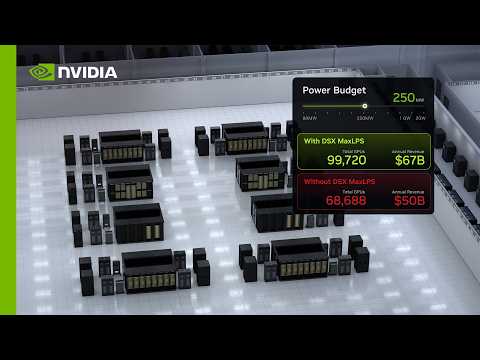
  • DSX platform: NVIDIA's data‑center optimization stack intended to increase GPU density inside fixed power budgets and maximize throughput-per-watt (positioned as the key conversation for data‑center operators).
  • Power constraint problem: data centers are power constrained (example: 1 gigawatt is fixed); current AI factories reportedly over-provision power by up to 40%, leaving room for optimization.
  • Business impact from power optimization: DSX enables safely deploying more GPUs within the same power envelope, which NVIDIA claims unlocks billions in additional annual revenue from existing infrastructure.
  • Metric emphasis: throughput-per-watt is framed as the primary metric tying infrastructure efficiency to revenue and competitiveness under fixed power limits.
  • Manufacturing and systems co-design: delivery of Vera Rubin relied on 150 partners (Foxconn, Quanta, Wistron, Asus, Gigabyte, Pegatron, Wiwynn named), millions of square feet, and hundreds of sites—described as extreme co-design and a unique manufacturing partnership.
  • Deployment scale and readiness: 'Project AI' and the combination of platform, infrastructure, and partnerships are presented as production-ready and deployed at scale in Taiwan.
Engineering relevance

For engineers building and operating AI systems, the talk signals that workloads will shift from episodic inference to continuous, high-frequency agent orchestration that stresses latency, throughput, and power budgets. Key engineering consequences from the source: (1) prioritize end-to-end co-optimization from silicon to rack to data‑center floor for agent workloads rather than treating inference as isolated compute; (2) measure and optimize throughput-per-watt as the primary operational metric because power is a fixed constraint and directly ties to revenue; (3) plan pod-scale deployments and orchestration that can sustain millions-of-loop iterations per second across many workflows; (4) evaluate processor choices for agentic performance (the Vera CPU is presented as 1.8× faster on agent workflows); (5) consider data‑center optimization platforms like DSX to increase GPU density safely within existing power caps (the talk cites up to 40% over‑provisioning today and billions in recoverable revenue); (6) use activity and productivity signals (example: commit rates) as operational evidence of agent adoption and to validate infrastructure ROI; (7) incorporate manufacturing and systems partner integration early — delivery depended on broad co-design across many sites and partners. Engineers should instrument for agent-specific metrics (agent throughput, tool-call rates, loop frequency, latency per loop, watts-per-throughput) and align capacity planning to fixed power budgets rather than unconstrained GPU count.

NVIDIA DSX Powers Gigawatt‑Scale AI Factories at Maximum Efficiency

Large, gigawatt‑scale AI factories require end‑to‑end co‑design of chips, racks, networks, power, cooling and grid interactions because compute directly drives revenue. Nvidia DSX is presented as a blueprint composed of a digital‑twin design stage (DSX Sim Omniverse), an operations/control plane (DSX OS), power/thermal optimization (DSX Max LPS with AI agents and in‑rack smoothing), and grid‑aware demand shaping (DSX Flex). The transcript reports simulation and validation before deployment, operating provisioning and continuous remediation after power‑on, hot liquid cooling at 45°C to save water/energy, and dynamic power allocation to recover stranded watts — all intended to increase GPU density and reduce cost per token. Limitation: claims of efficiency are architectural and operational; concrete numeric improvements beyond current overprovisioning (up to 40%) are not fully quantified in the source.

  • Problem framing: AI factories are the largest infrastructure build‑out in history and require integrated design across every layer (chip, rack, network, power, cooling, grid) because compute capacity directly maps to revenue.
  • DSX is a blueprint/reference design encompassing design, validation, provisioning, operations, and dynamic control for AI factories.
  • DSX Sim Omniverse blueprint provides a digital twin workflow: plan layout, simulate power and cooling, design the network, validate integrations, and test every change before any physical rack is installed.
Read full briefing

Key technical points

  • Problem framing: AI factories are the largest infrastructure build‑out in history and require integrated design across every layer (chip, rack, network, power, cooling, grid) because compute capacity directly maps to revenue.
  • DSX is a blueprint/reference design encompassing design, validation, provisioning, operations, and dynamic control for AI factories.
  • DSX Sim Omniverse blueprint provides a digital twin workflow: plan layout, simulate power and cooling, design the network, validate integrations, and test every change before any physical rack is installed.
  • DSX OS is the operational control plane that provisions, operates, monitors, and remediates installed infrastructure to deliver multi‑tenant, resilient, AI‑ready capacity.
  • Power overprovisioning is a current industry problem (quoted up to 40%); DSX Max LPS is positioned to safely increase deployed GPU density within the same power budget, recovering stranded watts and increasing revenue.
  • Hot liquid cooling at 45°C is highlighted as a breakthrough that reduces water and energy use, enabling more of the facility power to be delivered to revenue‑generating compute.
  • Dynamic power allocation routes power between racks to recover stranded watts and send power where work is happening, improving utilization of installed capacity.
  • In‑rack power smoothing flattens peak current spikes and surges to reduce transient limits and enable steadier power draw per rack.
  • Continuous coordination: teams of AI agents work with DSX Max LPS to continuously balance cooling and power in response to workload demand, implying closed‑loop control and orchestration.
  • Grid integration: DSX Flex ingests real‑time grid signals and dynamically adjusts factory power consumption to provide grid relief, making factories flexible energy assets.
  • Operational loop: design/validate in DSX Sim (digital twin) → factory powers on → DSX OS provisions and monitors → DSX Max LPS and AI agents continuously control power/thermal → DSX Flex coordinates with grid signals when needed.
  • Target outcomes: higher overall factory efficiency, lower cost per token, increased GPU deployment in constrained power envelopes, and strengthening of the grid via demand flexibility.
  • Metrics and signals mentioned: current power overprovisioning (up to 40%), coolant temperature baseline for the liquid cooling breakthrough (45°C), and global scale projection (100 gigawatts of AI factories expected by decade end).
  • Failure modes and trade‑offs implied: unmanaged power spikes and stranded watts reduce usable capacity; denser GPU packing increases thermal and power management risk; reliance on active control loops and grid signals requires robust monitoring and remediation capabilities.
Engineering relevance

For software and AI engineers, DSX emphasizes three engineering areas: 1) simulation and validation (digital twin workflows) as an upstream step to validate layouts, power, cooling and network integrations before hardware is deployed; 2) a runtime control plane (DSX OS) plus continuous closed‑loop controllers (DSX Max LPS with AI agents) for provisioning, monitoring, remediation, and live power/thermal orchestration; and 3) grid‑aware interfaces (DSX Flex) to consume real‑time grid signals and shape load. Relevant inputs/outputs to model or integrate include rack layouts, power and cooling models, network topologies, telemetry for monitoring, and grid signals; observable metrics to track are power utilization vs provisioned capacity, peak smoothing performance, cooling efficiency at 45°C, and token cost. Engineers should design robust telemetry, closed‑loop safety checks, multi‑tenant isolation in provisioning, and mechanisms to recover or reassign stranded watts while avoiding transient overloads.

NVIDIA Foundational Technology Montage I GTC Taipei and COMPUTEX 2026 Edition

NVIDIA built CUDA 20 years ago as a single architecture for accelerated computing to address the need for general-purpose hardware acceleration. That architecture is backed by a broad ecosystem of roughly a thousand CUDA‑X libraries that target domain-specific problems and are described as tools for agents. The talk lists concrete library examples—cuLitho, cuOpt, cuDSS, AIQ, Aerial, Warp, Parabricks—showing coverage across lithography, optimization, sparse solvers, document research, AI RAN, differentiable physics, and genomics. The stated foundation of this ecosystem is algorithms, which are presented as the core enabling element for breakthroughs across science and engineering.

  • CUDA was developed 20 years ago as a single architecture for accelerated computing.
  • CUDA is positioned as having reinvented computing by providing unified acceleration.
  • There exists an ecosystem of approximately a thousand CUDA‑X libraries.
Read full briefing

Key technical points

  • CUDA was developed 20 years ago as a single architecture for accelerated computing.
  • CUDA is positioned as having reinvented computing by providing unified acceleration.
  • There exists an ecosystem of approximately a thousand CUDA‑X libraries.
  • CUDA‑X libraries are described as helping developers make breakthroughs across every field of science and engineering.
  • The presentation frames CUDA‑X libraries explicitly as tools for agents.
  • cuLitho is named as a CUDA‑X library for computational lithography.
  • cuOpt is named as a CUDA‑X library for decision optimization.
  • cuDSS is named as a CUDA‑X library for direct sparse solvers.
  • AIQ is named as a CUDA‑X library for deep research across structured and unstructured documents.
  • Aerial is named as a CUDA‑X library for AI RAN (radio access network) use cases.
  • Warp is named as a CUDA‑X library for differentiable physics.
  • Parabricks is named as a CUDA‑X library for genomics.
  • The talk emphasizes that the foundation of these libraries is algorithms.
  • The presenter characterizes those foundational algorithms as ’beautiful,’ emphasizing the centrality of algorithmic design.
Engineering relevance

Treat CUDA as a unified acceleration platform and the CUDA‑X collection as domain‑specific building blocks rather than general implementation recipes. The transcript provides explicit mappings from library name to problem domain (e.g., cuLitho → computational lithography, cuOpt → decision optimization, cuDSS → direct sparse solvers, AIQ → document research, Aerial → AI RAN, Warp → differentiable physics, Parabricks → genomics), which engineers can use to identify candidate libraries for workload acceleration. Note that the source specifies intent and coverage but does not include API details, performance metrics, evaluation methods, production guardrails, failure modes, or deployment patterns—those must be obtained from the corresponding library documentation and empirical validation. Finally, recognize the emphasis on algorithms: algorithmic design and selection are presented as the primary technical lever in this ecosystem.

NVIDIA GTC Live at COMPUTEX Taipei 2025 Pregame

The transcript describes an industry response to rapidly escalating AI compute and system-integration demands: major suppliers (Nvidia, TSMC, Dell, ASUS, Quanta, Foxconn, Trend Micro, Delta, Techman) converge on a stack that pairs advanced-process silicon and packaging with modular server architectures, on-device vision/AI in robotics, and physics-accurate digital twins (Omniverse/Isaac). Evidence includes long-term foundry collaboration (TSMC since 1997, > six million 12-inch wafers delivered to Nvidia as stated), Dell/ASUS/QCT production of GB200/HGX-class systems (Dell first to ship GB200 with NVL72), Trend Micro training a cybersecurity LM (Cybertron) with NeMo, and factory productivity gains from Omniverse-driven digital twins (labor cost -50%, productivity +30%, changeover time /2, unit-per-hour +73%, cycle time -25%). Outcome: this integrated approach shortens iteration and deployment loops and enables new physical-AI applications, but remains constrained by manufacturing yield for very large dies, advanced-node and packaging complexity, power/thermal engineering, and the need for higher-fidelity sim-to-real (dynamics, materials) to reduce trial-and-error.

  • Long-standing foundry-system co-design: TSMC engaged Nvidia from 1997 and has supported successive process nodes up to 3/2 nm and advanced packaging (3D die stacking / SoIC), with stated production support including 'over six million 12-inch wafers' delivered to Nvidia (transcript claim).
  • Large-die GPUs impose extreme manufacturing/yield requirements: Nvidia designs very large dies that are difficult to manufacture, require highest quality/yield, and push foundry process and packaging limits.
  • Server/system engineering constraints drive new engineering flows: OEMs like Dell rebuilt engineering models to handle higher GPU density, power delivery, cooling, signal integrity and power-integrity challenges to reach rapid product cadences (e.g., GA200/GB200/HGX platforms).
Read full briefing

Key technical points

  • Long-standing foundry-system co-design: TSMC engaged Nvidia from 1997 and has supported successive process nodes up to 3/2 nm and advanced packaging (3D die stacking / SoIC), with stated production support including 'over six million 12-inch wafers' delivered to Nvidia (transcript claim).
  • Large-die GPUs impose extreme manufacturing/yield requirements: Nvidia designs very large dies that are difficult to manufacture, require highest quality/yield, and push foundry process and packaging limits.
  • Server/system engineering constraints drive new engineering flows: OEMs like Dell rebuilt engineering models to handle higher GPU density, power delivery, cooling, signal integrity and power-integrity challenges to reach rapid product cadences (e.g., GA200/GB200/HGX platforms).
  • Modular platform strategy (MGX/HGX/DGX lineage): modular server architectures let system builders keep pace with Nvidia’s accelerated product cadence (Jensen’s 'one-year' rhythm), enabling faster board, mechanical and thermal integration across generations.
  • On-device vision + embedded GPU inference for cobots: Techman Robot embeds native vision and GPUs in the robot control bus to do local AI inference (positioning, quality checks, force feedback) enabling vision-based compensation and higher autonomy at the edge.
  • Security workloads using DPU/GPU and domain LMs: Trend Micro uses Nvidia DPUs and GPUs for security data analysis, trains a cybersecurity LM named 'Cybertron' with NeMo, and composes an analysis pipeline (transcript mentions 'kud', 'includive', 'Morphy's system') to detect anomalies and package agentic security deployments.
  • Omniverse / Isaac for sim-to-real, concurrent engineering and factory twins: Delta, Foxconn and others use Omniverse and Isaac/Isaac Gym for virtual-to-real workflows—remote monitoring, calibration, virtual design, multi-user synchronized spaces, and duplication of validated lines across sites.
  • Simulation fidelity requirements: teams push Omniverse/Isaac to capture not just kinematics but dynamics, materials ('skin'), physics and process simulation to minimize trial-and-error and enable right-first-time deployment.
  • Pair-processing and simulation training speed: Isaac Gym / simulation toolchains and pair-processing approaches are cited to accelerate training and development (faster training loops and concurrent multi-user workflows).
  • AI factory conceptualization: multiple vendors treat the AI factory as an end-to-end token-in/token-out infrastructure stack—servers, storage, network, facility, MLOps and industry-specific models—where software and hardware integrate for application deployment.
  • Ecosystem and software investments: ASUS and QCT emphasize software stacks and platform services (ASUS AI hub, AIDC, infrastructure deploy center, ACC) and partnerships with MLCommons/Hugging Face for MLOps and multi-model deployment.
  • Operational metrics from digital-twin and AI factory pilots: claimed results include labor cost reduction ~50%, productivity +30%, line changeover time halved, unit-per-hour per person +73%, and delivery cycle time reduced ~25% (reported by Quanta/Foxconn pilots).
  • Manufacturing and deployment trade-offs: accelerating cadence forces trade-offs—cost vs. productivity, rushed adoption of less-mature process/packaging tech, supply-chain and capacity constraints (TSMC capacity expectations), and engineering strain to meet 'speed of light' schedules.
  • Limitations for flexible/soft-material handling and last-mile automation: certain production tasks (soft/flexible materials) still require higher-degree-of-freedom solutions (humanoid robots or advanced physical-AI) and present remaining gaps in full automation.
Engineering relevance

Collaborate across foundry, package, and system teams early: large-GPU designs demand co-optimization across process node, die size, and packaging; yield and test plans must be integrated into system schedules. Design for power, thermal and signal/power integrity at system scale: higher GPU density requires new cooling, PDN (power delivery network), SI/PI simulation and rapid thermal validation as part of board and mechanical design flows. Adopt modular server architectures and validated reference designs (MGX/HGX) to shorten integration cycles and align with accelerated silicon cadences. Use on-device vision and embedded GPU inference for robotics to offload latency-sensitive perception and enable compensating control (vision-based positioning, on-board anomaly checks). Integrate DPUs/GPUs into security and telemetry pipelines for large-scale data analysis and consider domain-specific LM fine-tuning (example: 'Cybertron' via NeMo) for anomaly detection. Invest in high-fidelity sim-to-real toolchains (Omniverse + Isaac Gym): model dynamics, materials, and process physics; enable multi-user concurrent engineering and remote calibration to reduce physical prototyping iterations. Track and validate operational metrics from pilots (labor, productivity, cycle time) as quantifiable success criteria for AI factory rollouts and for justifying capital/scale decisions. Plan for deployment guardrails: maintain security layers between infrastructure software and applications (as Trend Micro describes), and package agentic deployments with validated runtime agents for rapid, secure rollout.

NVIDIA GTC Live pregame show at COMPUTEX 2026

Speakers framed the NVIDIA GTC Live pregame at COMPUTEX 2026 as a central coordination point for a rapidly accelerating AI ecosystem: the problem is the fast-moving, global AI surge; the approach is to gather industry leaders and spotlight Taiwan’s role at COMPUTEX; evidence cited includes A-list leadership, a surprise guest, and the expectation of participation by ten trillion-dollar companies; the outcome is strong momentum and excitement, with the limitation that the industry has still "only scratched the surface."

  • AI adoption is accelerating: "AI is taking off and the world is responding."
  • The event (NVIDIA GTC Live pregame) is positioned as central to the AI ecosystem: "brought the pre-game to the center of the AI universe."
  • High anticipated attendance: "Everyone's coming to Computex."
Read full briefing

Key technical points

  • AI adoption is accelerating: "AI is taking off and the world is responding."
  • The event (NVIDIA GTC Live pregame) is positioned as central to the AI ecosystem: "brought the pre-game to the center of the AI universe."
  • High anticipated attendance: "Everyone's coming to Computex."
  • Location emphasis: explicit address to Taiwan ("Hello, Taiwan").
  • Atmosphere described as energetic and exciting: "The energy is just electric," "the future is just a little too exciting."
  • Presence of notable attendees: described as an "absolute A-list leadership" lineup.
  • Expectation of very large corporations participating: mention of "10 trillion-dollar companies."
  • A surprise guest appeared during the pregame show.
  • Taiwan is explicitly credited with a major role: "Taiwan is powering the AI revolution."
  • Speakers warn that current progress is early-stage: "We've only scratched the surface."
  • The presentation included informal elements (music, laughter) indicating a promotional, high-energy format rather than technical detail.
  • Framing emphasizes momentum and industry coordination rather than specific technical announcements or specifications.
Engineering relevance

Signals strong industry momentum and centralized events as coordination points for AI ecosystem activity (useful for scheduling partnerships or monitoring announcements). Highlights Taiwan's asserted central role in powering AI, implying attention to developments in Taiwan-based hardware and supply-chain players. Indicates major companies and leadership engagement; useful for engineers tracking platform support, SDKs, or ecosystem commitments tied to those organizations. The talk is promotional and high-level; it does not provide technical architectures, inputs/outputs, evaluation methods, guardrails, or metrics to act on directly. Expect further technical detail to emerge at the main sessions—treat this pregame as a signal of priorities rather than a source of implementation guidance.

NVIDIA GTC Taipei 2026 Keynote | Full Replay

Agentic AI changes the computing problem: agents require low-latency, memory‑heavy, tool‑driven loops rather than traditional application bundles. NVIDIA's approach is extreme co‑design across chips, racks, networking, storage, and software — exemplified by the Vera Rubin multi‑rack pod (NVLink‑72, Vera CPUs, BlueField DPUs, Spectrum‑X) plus DSX/Omniverse for digital twin design, and a matched software stack (Open Shell runtime, CUDA‑X libraries with agent skills, NeMoTron and Cosmos models). Jensen Huang presented production evidence: Vera Rubin is in full production, NeMoTron 3 Ultra is open and reported as 5× faster and 30% cheaper than leading open models, and Vera CPU shows multi× speedups on real workloads; however, physical AI data remains the hardest limiting input and the overall stack demands careful orchestration and TCO planning (tokens-per-watt, time‑to‑first‑token, reliability).

  • Agent architecture defined as model(s) + harness (orchestrator) + tools (libraries/third‑party software) + skills + runtime; agents observe, reason, plan, act, and use tools under harness orchestration.
  • Memory is a primary complexity: working memory (KV cache) and long‑term memory require compaction, retrieval strategies, structured vs unstructured retrieval, and will drive storage system redesign.
  • Vera Rubin is a purpose‑built, multi‑rack pod scale system for agentic workloads: no external cables/hoses, PCB midplane, liquid cooling manifolds, NVLink‑72 GPU trays, NVLink switch trays, and integrated BlueField DPUs and ConnectX‑9 NICs.
Read full briefing

Key technical points

  • Agent architecture defined as model(s) + harness (orchestrator) + tools (libraries/third‑party software) + skills + runtime; agents observe, reason, plan, act, and use tools under harness orchestration.
  • Memory is a primary complexity: working memory (KV cache) and long‑term memory require compaction, retrieval strategies, structured vs unstructured retrieval, and will drive storage system redesign.
  • Vera Rubin is a purpose‑built, multi‑rack pod scale system for agentic workloads: no external cables/hoses, PCB midplane, liquid cooling manifolds, NVLink‑72 GPU trays, NVLink switch trays, and integrated BlueField DPUs and ConnectX‑9 NICs.
  • Vera Rubin compute stack details: seven new chips, TSMC 3nm processes, CoWoS R/L packaging, HBM4 memory from major DRAM vendors, over 18,000 components on a board and quoted compute counted in trillions of transistors.
  • Vera CPU (codenamed Vera) is a new CPU architecture for agents: Olympus core family with high single‑thread IPC (ten‑wide decode mentioned), monolithic mesh coherency fabric unifying 88 cores, LPDDR5(X) memory support with ~1.2 TB/s external bandwidth, 3.6 TB/s internal fabric, and NVLink chip‑to‑chip memory coherence to GPUs and multi‑socket scale.
  • Vera CPU design tradeoffs: prioritize single‑thread latency, bandwidth per core and total system bandwidth, and energy efficiency to maximize tokens‑per‑watt; quoted improvements include 1.8× agent sandbox perf vs x86, 3× SQL speedup, and 6× real‑time stream processing in cited workloads.
  • BlueField‑4 DPUs handle storage processing and in‑silicon security (confidential computing): encrypt at rest, in motion, and in use; DPU used for memory/storage acceleration and isolation of agent contexts.
  • Networking and photonics: Spectrum‑X Ethernet with 200 Gbps co‑packaged optics and NVLink chip‑to‑chip for high‑bandwidth GPU/CPU interconnect; networking is a first‑order problem in disaggregated, distributed agent execution.
  • DSX (AI factory blueprint) uses Omniverse DSX Sim for full factory digital twins, DSX OS for provisioning/monitoring/remediation, DSX Max LPS for denser GPU deployment under fixed power, and DSX Flex to respond to grid signals (cooperative energy asset).
  • Runtime and security for enterprise agents: NVIDIA Open Shell sandbox (open source) provides identity, privileges, and policy enforcement; partners listed include Red Hat, Canonical, Microsoft; runtimes target cloud, on‑prem, and devices.
  • Models and open releases: NeMoTron 3 Ultra (open model, training data and scripts provided) is a hybrid SSM + mixture‑of‑experts architecture claimed as 5× faster and 30% lower cost versus leading open models; Cosmos 3 is an open world model for physical AI combining autoregressive transformers and diffusion decoders to generate physics‑accurate synthetic video and close the sim‑to‑real loop.
  • Application examples and loops: Cadence + NVIDIA chip‑design agents accelerate RTL verification loops (Cadence Xcelium, Jasper) with reported 40× faster verification (weeks→hours) by orchestrating sub‑agents; Isaac/Omniverse pipeline for robotics: teleop capture → synthetic data generation → train policies → evaluate in Isaac Lab Arena → deploy via Isaac ROS on Jetson Thor.
  • Edge and consumer device line: RTX Spark system (N1X partnership with MediaTek) integrates a Blackwell RTX GPU (6,144 CUDA cores, ~1 petaflop AI), a custom 20‑core Grace CPU fused by NVLink, 128 GB unified memory on TSMC 3nm — a PC line re‑engineered for native agents and local model execution.
  • Operational metrics and TCO framing: Jensen emphasized tokens as the revenue metric—time‑to‑first‑token, tokens‑per‑watt (performance/watt), reliability (MTBI/interrupts), and asset lifetime (software flexibility and ecosystem compatibility) are the primary economic variables driving architecture choices.
Engineering relevance

Design software and services assuming an agent runtime: plan for harness integration, tool APIs, and skill manifests so agents can call and compose existing software. Prioritize low latency single‑threaded CPU paths and high fabric bandwidth in system design for tool calls, KV cache retrievals, and sandboxed code execution; optimize critical paths to reduce waiting in agent loops. Expose CUDA‑accelerated libraries (CUDA‑X) with explicit skill documents/APIs so agents can learn to use them; package skills and manuals as first‑class artifacts for harnesses. Treat storage and memory as architectural bottlenecks: engineer KV cache compaction/retrieval, structured retrieval pipelines, and consider DPU‑accelerated storage processing for context memory workloads. Adopt digital twin simulation (Omniverse/DSX Sim) early for data center/factory planning and power/thermal co‑design; use DSX OS concepts for automated provisioning and power‑aware orchestration. Integrate confidential computing primitives and DPUs (BlueField) into the agent stack to secure model weights, context, and cross‑tenant isolation. When building robotics or self‑driving stacks, use the simulation→teleop→synthetic data→train→evaluate pipeline (Cosmos/Isaac) to close sample gaps and generate first‑person data. Benchmark real user workloads for tokens‑per‑watt, time‑to‑first‑token, and MTBI rather than relying solely on FLOPS; validate system economics across lifetime and software evolution scenarios. Prepare for heterogeneous deployment targets (cloud pods, on‑prem racks, desktops/laptops, embedded robots): design modular runtimes and data pipelines that can run locally or call out to Vera Rubin scale infra. Plan integration tests for runtime sandboxes (Open Shell) including identity, policy enforcement, and tool access controls; validate agent behavior under realistic failure and latency scenarios.

NVIDIA HGX H100 | The most powerful end-to-end AI supercomputing platform

The provided transcript contains only brief closing material: two occurrences of the phrase "thank you" and two music cues. There is no technical content, data, architecture, or claims about NVIDIA HGX H100 in the source. Because the source lacks substantive material, no engineering details, evaluations, metrics, or deployment guidance can be extracted. To produce a technical briefing or any actionable recommendations, a full technical transcript or presentation content is required.

  • The transcript text is limited to: "thank you" (spoken) and "[Music]" (music cue), each repeated twice.
  • No speaker names, roles, or affiliations are included in the transcript.
  • There is no mention of NVIDIA, HGX, H100, or any hardware or software components.
Read full briefing

Key technical points

  • The transcript text is limited to: "thank you" (spoken) and "[Music]" (music cue), each repeated twice.
  • No speaker names, roles, or affiliations are included in the transcript.
  • There is no mention of NVIDIA, HGX, H100, or any hardware or software components.
  • No system architecture, block diagrams, or component interactions are described.
  • No inputs, outputs, data formats, or model descriptions are present.
  • There are no evaluation methods, benchmarks, performance metrics, or experimental results.
  • No production guardrails, safety measures, monitoring, or reliability practices are mentioned.
  • No trade-offs, limitations, failure modes, or risk assessments are discussed.
  • No deployment, integration, or iteration loop information (CI/CD, orchestration, scaling) is provided.
  • The content appears to be closing material of a recording (polite closing + music), but contains no technical substance to analyze.
Engineering relevance

For engineers, the supplied source is not actionable: it contains only closing remarks and music cues and provides zero technical information about systems, performance, or deployment. You cannot derive architecture, API contracts, metrics, or failure modes from this transcript. To perform engineering work (design, implementation, evaluation), request the complete technical transcript or slides that include architecture diagrams, benchmarks, inputs/outputs, and deployment notes.

NVIDIA Isaac AMR | End-to-End Autonomy Platform for Next Generation AMRs

Manufacturing and warehousing operations are moving from manual forklifts and guided vehicles to fully autonomous mobile robots to raise productivity and improve worker safety. NVIDIA Isaac AMR is an integrated end-to-end platform built around NOVA Orin (a sensor suite plus on-board compute) and a cloud mapping service that produces detailed 3D voxel maps which can be sliced into 2D maps for different robots. On-robot Lidar or cost‑effective cameras provide navigation, Isaac Mission Control (using cuOpt) optimizes routes, and Isaac Sim + NVIDIA Omniverse let teams train and fully validate autonomy in realistic digital twins before real-world deployment. The result is faster, lower-cost migration to full autonomy with a simulation-based validation guardrail and an explicit trade-off between higher-performance Lidar and lower-cost camera solutions.

  • Problem: factories and warehouses are migrating from manual forklifts and guided vehicles to full autonomy to improve productivity and worker safety.
  • Isaac AMR is positioned as an integrated end-to-end solution for deploying fully autonomous mobile robots.
  • Core system component: NOVA Orin — a combined advanced sensor suite and on-robot computing hardware that supports mapping, autonomy, and simulation workloads.
Read full briefing

Key technical points

  • Problem: factories and warehouses are migrating from manual forklifts and guided vehicles to full autonomy to improve productivity and worker safety.
  • Isaac AMR is positioned as an integrated end-to-end solution for deploying fully autonomous mobile robots.
  • Core system component: NOVA Orin — a combined advanced sensor suite and on-robot computing hardware that supports mapping, autonomy, and simulation workloads.
  • NOVA's advanced sensors accelerate the mapping process by feeding a cloud-based service that generates an accurate, detailed 3D voxel map of the facility.
  • The 3D voxel map can be sliced across a plane to generate 2D maps tailored for different autonomous robot types operating in the same facility (multi-platform map output).
  • On-robot navigation can use either Lidar or cost-effective cameras; both are presented as options that enable reliable autonomous navigation in complex, dynamic environments.
  • Isaac Mission Control performs route planning optimization using the cuOpt library (route planning optimization component).
  • Isaac Sim together with NVIDIA Omniverse enables creation of realistic digital twins of the operating environment for training autonomous robots on complex tasks entirely in simulation.
  • Simulation is used not only for training but also for full validation: all operations can be fully validated in Isaac Sim prior to real-world deployment (production validation guardrail).
  • End-to-end deployment pipeline implied: capture environment with NOVA sensors -> cloud generates 3D voxel map -> slice to robot-specific 2D maps -> onboard sensors handle navigation -> Mission Control (cuOpt) optimizes routes -> train and validate behaviors in Isaac Sim -> deploy to real robots.
  • Inputs: NOVA sensor data for mapping and on-robot Lidar/camera streams for navigation. Outputs: detailed 3D voxel maps, robot-specific 2D maps, optimized routes, and validated autonomous policies.
  • Trade-off explicitly noted: a choice between on-robot Lidar versus cost-effective cameras, balancing sensor cost against expected navigation capability.
  • Reliability claim: the navigation stack (with chosen sensors and maps) is described to work reliably in the most complex and dynamic environments encountered in facilities.
  • Primary outcomes: accelerates migration to full autonomy, reduces deployment costs, and speeds time-to-deployment for next-generation AMRs.
  • Production guardrails and iteration loop emphasize simulation-first development: train in digital twin, validate in Isaac Sim, then deploy to reduce risk in the physical environment.
Engineering relevance

For software and systems engineers this talk defines an explicit, repeatable pipeline and integration points: NOVA Orin for sensor capture and on-board compute, a cloud mapping service that outputs 3D voxel maps, a map-slicing step to produce robot-specific 2D maps, and a navigation stack that accepts either Lidar or camera inputs. Route optimization integrates cuOpt via Isaac Mission Control. Use Isaac Sim and Omniverse to create digital twins for training and full validation before field deployment, which serves as a production guardrail and shortens iteration cycles. Key design decisions to evaluate: sensor selection (Lidar vs camera) for cost vs performance, how to integrate cloud-generated 3D voxel maps into on-robot localization stacks, and embedding cuOpt-based mission planning into your fleet manager. The platform emphasizes simulation-first testing to reduce real-world risk and speed deployment, so plan CI/CD and validation workflows around Isaac Sim artifacts and the digital-twin models.

NVIDIA Keynote at COMPUTEX 2023

Computex keynote frames two simultaneous industry transitions: accelerated computing (full‑stack, domain specific, data‑center scale) and generative AI. NVIDIA presents system‑level solutions from silicon (H100, Grace Hopper/GH200), interconnect (NVLink, Spectrum‑4 + BlueField‑3), software (TensorRT, NVIDIA AI Enterprise, NVIDIA AI Foundation) and application platforms (Omniverse, ACE, Isaac) to deploy LLMs, real‑time ray tracing, 3D video and factory/robot simulation. Evidence includes production H100/Hopper supply, GH200 single‑module memory coherency (~600 GB aggregated), Spectrum‑4 switch specs and multi‑pod GH200 exaFLOPS design; outcomes are higher per‑Watt throughput, larger single‑GPU memory footprints to reduce sharding, and cloud/enterprise deployment paths — limitations remain in full stack integration complexity, power and network requirements.

  • Ray tracing accelerated by combining hardware ray‑tracing cores, AI on Tensor cores, and new algorithms; AI predicts 7 additional pixels per computed pixel to reduce compute and energy.
  • RTX mainstream products (e.g., mobile ADA 14" GPU, RTX 4060 Ti) demonstrate real‑time ray tracing and AI enhancements running at 60 FPS on client devices.
  • Avatar Cloud Engine (ACE): pre‑trained, fine‑tunable models including speech recognition, text‑to‑speech, natural language understanding (LLM), and audio‑driven face and gesture animation; deployable to cloud or devices via TensorRT and ONNX backends.
Read full briefing

Key technical points

  • Ray tracing accelerated by combining hardware ray‑tracing cores, AI on Tensor cores, and new algorithms; AI predicts 7 additional pixels per computed pixel to reduce compute and energy.
  • RTX mainstream products (e.g., mobile ADA 14" GPU, RTX 4060 Ti) demonstrate real‑time ray tracing and AI enhancements running at 60 FPS on client devices.
  • Avatar Cloud Engine (ACE): pre‑trained, fine‑tunable models including speech recognition, text‑to‑speech, natural language understanding (LLM), and audio‑driven face and gesture animation; deployable to cloud or devices via TensorRT and ONNX backends.
  • Full‑stack accelerated computing requirement: chip microarchitecture, packaging (SXM), NVLink, HGX/HGX‑style motherboards, high‑performance networking (InfiniBand/now Ethernet with Spectrum‑4), system software (Magnum IO), and AI libraries are all necessary for end‑to‑end performance.
  • H100 (HGX) in mass production: eight Hopper GPUs on a system board (35,000 components); DGX class appliances replace entire rooms of CPU servers for certain AI workloads.
  • Grace Hopper (GH200) super chip: transformer engine with claimed 4 PFLOPS, 72 CPU cores, 96 GB HBM3 local plus large coherent LPDDR for ~600 GB CPU/GPU coherent memory, and 900 GB/s chip‑to‑chip links to reduce model sharding and simplify large‑model inference/training.
  • Scale architecture: 8‑node NVLink pods and 32 pods wired via switches to form 256‑node GH200 clusters (DGX GH200) claimed to reach 1 exaFLOPS transformer engine with 144 TB of memory visible across the cluster.
  • Cost/energy examples: a $10M CPU deployment for a large LLM workload consumed ~11 GWh; equivalent GPU servers reduced energy to ~3.2 GWh with 44× performance (48 GPU servers) — accelerated computing improves TCO when data‑center is the unit of optimization.
  • Spectrum‑4 Ethernet switch: 128×400 Gb ports, 51.2 TB/s switch fabric, chip described as ~100B transistors, 90×90 mm, ~500 W die, ~2.8 kW chassis; intended to bring InfiniBand‑like features into Ethernet domains.
  • Spectrum‑X system = Spectrum‑4 switch + BlueField‑3 400 Gb DPU + interconnects + software; introduces adaptive routing, congestion control, RDMA performance and telemetry to reduce packet loss and enable high‑throughput AI across Ethernet.
  • MGX open modular server design: mechanical/thermal/electrical standard for dense accelerated servers, multi‑generation compatible to preserve investment across future GPU/CPU/DPU generations and support many server configurations (Omniverse, inference, cloud graphics, telco, liquid‑cooled).
  • NVIDIA AI Enterprise & NVIDIA AI Foundation: end‑to‑end enterprise offering — Foundation trains/fine‑tunes/guard‑rails models (supervised FT, RLHF) and AI Enterprise provides an enterprise‑grade, lifecycle‑managed software stack available across major clouds.
  • Omniverse as a cloud‑hosted digital twin and real‑time ray‑traced simulation platform: integrates CAD/3D data, multi‑user collaboration, physics, and synthetic data generation (Replicator) to train perception and AOI models; deployed as managed service (example on Azure).
  • Pegatron production example: synthetic data + TAO + DeepStream + Metropolis used to build AOI workflows achieving 99.8% accuracy and 4× throughput improvement in PCB inspection, illustrating simulation→training→deployment loop.
  • Isaac AMR and Nova Orin reference platform: end‑to‑end robotics stack (sensors, mapping, localization, planning), cloud mapping and Isaac Sim for training in simulation and transfer to physical robots (sim‑to‑real workflow).
Engineering relevance

Architectural tradeoffs: GH200 emphasizes large coherent memory to reduce model sharding and simplify LLM/DB workloads (vector DBs, 65B‑param inference), while NVLink and pod switches enable scale‑out without extreme software partitioning. Network and fabric matter: achieving supercomputer‑class throughput on loosely coupled enterprise Ethernet requires switch+DPU+software co‑design (Spectrum‑4 + BlueField‑3 + adaptive routing + congestion control + cables). Full‑stack integration cost: performance gains depend on co‑optimization from chip packaging (SXM/HGX) to system board, NVLink, OS and libraries (Magnum IO, TensorRT), and lifecycle updates benefit all generations when the stack is maintained. Deployment model: training/fine‑tuning flows (NVIDIA AI Foundation) feed into enterprise deployment (NVIDIA AI Enterprise) to provide enterprise security, lifecycle management and cloud portability (available on major clouds). Simulation→training→deployment loop: Omniverse + Replicator + TAO + DeepStream + Metropolis is a validated pipeline for producing production‑grade perception and AOI models with measurable accuracy/throughput gains. Power and TCO constraints: when data centers are power‑limited, accelerated nodes can deliver orders‑of‑magnitude higher throughput per watt; design choices must reflect floor‑space, power provisioning and cooling (liquid vs air) implications. Software interfaces: ACE outputs (TensorRT, ONNX) and Omniverse/Isaac integration imply standardized model export and runtime formats are critical for cross‑device deployment (cloud ↔ edge). Failure modes & operational risk: high utilization and tightly coupled workloads make networking losses and noisy neighbors costly — this motivates loss‑less flow control, telemetry and in‑fabric congestion management. Hardware production and mechanical considerations: HGX/GH200 assemblies are heavy, have high insertion pressures, and require robotic handling and specific thermal/power infrastructure; system engineers must plan for mechanical and deployment constraints. Application domains: vector DBs, recommender systems and LLM inference are explicitly highlighted as workloads that benefit from large coherent memory and high interconnect bandwidth — prioritize these when designing clusters.

NVIDIA Keynote Song at COMPUTEX 2024

The speaker, who says they are new at computers, presents a short, highly repetitive song-like message that repeatedly names two phrases: "Infinity On" and "Digital Twins." The approach is performative and promotional — calling the audience to sing along, addressing "computers," and claiming to "show you all our best." Evidence in the transcript is purely lyrical and branded; there are no technical specifications, metrics, or implementation details, so the content is non-actionable for engineering work.

  • Speaker self-identifies: "I am new at computers."
  • Speaker expresses an intention to influence affinity: "I will make you like me best."
  • Audience engagement: repeated invitations to "sing it with me."
Read full briefing

Key technical points

  • Speaker self-identifies: "I am new at computers."
  • Speaker expresses an intention to influence affinity: "I will make you like me best."
  • Audience engagement: repeated invitations to "sing it with me."
  • Branding/term repeated: "I really like Infinity On."
  • Repeated address to a target: "Once again, I come to you, computers."
  • Commitment to present quality: "We will show you all our best."
  • Explicit association: "Digital Twins and me."
  • Linkage between terms: "With Infinity On." pairs the brand with Digital Twins.
  • Global address: "To all of our entire world."
  • Expressed expectation: "We hope that you like this song."
  • Formal closure and gratitude: "so goodbye from me" and "Thank you for joining us."
  • Structural feature: the content is highly repetitive with multiple refrains and repeated lines.
  • Tone and format: musical/ceremonial rather than technical or documentary.
  • Absence of technical material: the transcript contains no descriptions of architecture, inputs and outputs, evaluation methods, production guardrails, metrics, trade-offs, failure modes, or deployment/iteration loops.
Engineering relevance

From an engineering perspective this transcript provides only brand-level signals (the phrases "Infinity On" and "Digital Twins") and no technical artifacts. There are no specifications, APIs, architectures, data inputs/outputs, metrics, or operational details to analyze or implement. As-is, the content is not actionable for design, implementation, testing, or deployment decisions and requires a separate technical brief for engineering work.

NVIDIA RTX PRO 6000 Blackwell Server Edition

Requested briefing source contains only repeated musical cues and the single-word vocalizations "Heat" (including "Heat up here"). The observable system is an audio excerpt with no technical narration or data. Evidence: the transcript shows five "[Music]" markers and four occurrences of the word "Heat" and no product details. Outcome/limitation: no architecture, inputs/outputs, metrics, guardrails, or deployment information can be extracted from this source.

  • Transcript content is dominated by nonverbal markers: the token "[Music]" appears five times.
  • Spoken content consists solely of the token "Heat" appearing four times, once as "Heat up here."
  • No technical terms or product identifiers (e.g., NVIDIA, RTX, PRO 6000, Blackwell, Server, Edition) are present in the transcript.
Read full briefing

Key technical points

  • Transcript content is dominated by nonverbal markers: the token "[Music]" appears five times.
  • Spoken content consists solely of the token "Heat" appearing four times, once as "Heat up here."
  • No technical terms or product identifiers (e.g., NVIDIA, RTX, PRO 6000, Blackwell, Server, Edition) are present in the transcript.
  • There are no descriptive sentences, specifications, or numerical data in the source.
  • The source includes no information about system architecture or model design.
  • No inputs, outputs, data formats, or interfaces are described or implied.
  • No evaluation methods, benchmarks, metrics, or performance results are provided.
  • No production guardrails, safety constraints, or operational limits are mentioned.
  • There is no discussion of trade-offs, failure modes, or mitigation strategies.
  • The transcript lacks deployment, iteration, or development loop details.
  • There are no speaker labels, timestamps, or contextual annotations to clarify the excerpt.
  • The material appears to be a short audio excerpt (possibly promotional or musical) rather than a technical talk.
Engineering relevance

For engineering use, this source is not actionable: it contains only music cues and the repeated word "Heat" and provides no engineering detail. You cannot derive architecture, interfaces, evaluation criteria, metrics, or deployment guidance from it. To produce a technical briefing, obtain the full technical transcript or raw audio with the talk segments that discuss system design and measurements.