Nomae video feed

Watch the talk.Keep the signal.

Public engineering recordings paired with summaries grounded in their transcripts. Conference briefings are the first source; this feed will grow beyond them.

62videos with summaries
Latest source collection

Videos worth keeping

Newest first · Showing 1–25 of 62.

AI Engineer

Evolution of agentic surfaces — Gagan Bhat & Isabella Kai He, Anthropic

Gagan Bhat, Isabella Kai He

31 min

Anthropic engineers outline the evolution from simple Messages API to Claude Managed Agents, which package production-grade agent infrastructure. The managed architecture decouples the agent’s “brain” (agentic loop + model) from its “hands” (sandbox) to improve reliability, security, and latency. Core primitives—agent, environment, and durable session with logs—enable long-running, recoverable workflows and observability. Frontier features like dreaming and outcomes aim to deliver self-improving agents and rubric-driven success.

  • Evolution of agentic surfaces: Messages API (tokens in/out) → manual agentic loop with heavy infra burden → Claude Agent SDK (built-in loop, FS access, tools, sandbox) → Claude Managed Agents (production infra provided).
  • Managed Agents supply the agentic loop (“brain”) and a just-in-time sandbox (“hands”) plus hosting, session management, observability, sandboxing, and credential handling run by Anthropic.
  • Harnesses encode assumptions that go stale as models improve; fixes for older behavior can become overhead (e.g., Sonnet 4.5 context anxiety fix became harmful for Opus 4.5).
Read full briefing

Key technical points

  • Evolution of agentic surfaces: Messages API (tokens in/out) → manual agentic loop with heavy infra burden → Claude Agent SDK (built-in loop, FS access, tools, sandbox) → Claude Managed Agents (production infra provided).
  • Managed Agents supply the agentic loop (“brain”) and a just-in-time sandbox (“hands”) plus hosting, session management, observability, sandboxing, and credential handling run by Anthropic.
  • Harnesses encode assumptions that go stale as models improve; fixes for older behavior can become overhead (e.g., Sonnet 4.5 context anxiety fix became harmful for Opus 4.5).
  • Architecture decouples brain from hands to improve reliability and allow on-demand sandbox spin-up and retries if the sandbox dies, and session-based recovery if the brain dies.
  • Three primitives: agent (model, prompts, tools, skills), environment (container definition; multiple isolated containers per environment), and session (durable, persisted log of all interactions).
  • Session states: idle (waiting on input), running (executing), rescheduling (retry after error), terminated (unrecoverable), enabling robust long-running execution and recovery.
  • Context engineering via a durable session log lets the harness re-read slices of prior context into the current window and recover discarded context during runs.
  • Decoupling reduced latency: the model can start reasoning while container setup runs in parallel, improving time-to-first-token for median and tail cases.
  • Credential security: keep secrets away from the agent using vaults; credentials are decrypted only at tool execution time so the model never sees tokens.
  • Enterprise security features: self-hosted sandboxes to run tool execution in a customer VPC, and MCP tunnels so MCP servers stay private and only make outbound calls.
  • Demo SRE agent: define agent (e.g., SRE Investigator with system prompt, tools like bash/grep/blob, and MCP toolset), define environment (Anthropic cloud, restricted networking, allowlisted MCP host), upload logs/skills, create session, and run with full observability of traces and tool results.
  • Managed Agents target long-running, asynchronous, complex tasks, requiring strong context accumulation, secure sandbox action, reliability, and workflow parallelization.
  • The harness provides agent loop, memory, and observability; developers focus on domain-specific prompts, skills, tools, and context management.
  • Frontier features: dreaming (batch processing transcripts + memory to update memory and self-improve) and outcomes (rubric-driven grader agent that enforces success criteria and triggers retries), plus items like scheduled deployments and multi-agent orchestration.
Engineering relevance

For AI/software engineers, the talk specifies a modular, production-ready agent architecture: define agents/environments/sessions; rely on a durable session log for recovery and context management; decouple reasoning from execution for reliability and latency; and secure tool execution via vaults, self-hosted sandboxes, and MCP tunnels. It highlights how harness assumptions must adapt to model changes, and surfaces built-in observability and session states to operate long-running agents at scale. Engineers can scope customization to prompts, tools, and domain skills while offloading orchestration and infra to Managed Agents.

Claude Managed AgentsDecoupled Brain and HandsSession Logs and ContextReliability and Latency
Watch source
AI Engineer

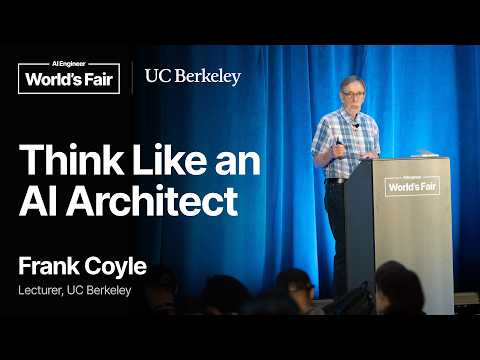
Anthropic's CCA Exam as a Field-Guide for Agentic Engineering — Frank Coyle, UC Berkeley

Frank Coyle

20 min

Frank Coyle (UC Berkeley) frames Anthropic’s Claude Certified Architect (CCA) exam as a practical guide to agentic AI patterns and anti-patterns. He details scenario-based, timed, proctored testing that emphasizes loops with explicit stop reasons, tool orchestration, context management, and multi-agent specialization. Concrete practices include isolating subtasks via context forks, limiting context to improve accuracy and cost, using Claude Code’s hierarchical configuration, and leveraging batch mode for cost savings.

  • CCA exam: scenario-based, timed, proctored; available to companies and to individuals for $99 (once every 6 months).
  • Exam domains include Agentic architecture (27%), Claude Code configuration/workflow (20%), prompt engineering with structured JSON outputs, tool design, Model Context Protocol integration, and contact management and reliability.
  • Six production scenarios are provided; the exam randomly selects four and centers all questions on those.
Read full briefing

Key technical points

  • CCA exam: scenario-based, timed, proctored; available to companies and to individuals for $99 (once every 6 months).
  • Exam domains include Agentic architecture (27%), Claude Code configuration/workflow (20%), prompt engineering with structured JSON outputs, tool design, Model Context Protocol integration, and contact management and reliability.
  • Six production scenarios are provided; the exam randomly selects four and centers all questions on those.
  • Agent loop design: implement a while loop that inspects stop_reason (e.g., tool_use), executes the tool with LLM-produced parameters, and continues or finalizes accordingly.
  • LLMs cannot execute tools; they only generate parameters/invocations for external code to run (they are probabilistic next-word predictors).
  • Handle stop reasons for token exhaustion; partial outputs require intervention (e.g., recovery or escalation).
  • Human-in-the-loop: after tool execution and response, check confidence and escalate to a human if needed.
  • Claude Code: use a Claude MD (markdown) configuration file with a hierarchical setup at project top level, project folder, and within directories to control behavior.
  • Multi-agent anti-pattern: avoid one overloaded agent with many tools; prefer specialized agents with minimal, focused toolsets.
  • Limit context spillover from sub-agents; larger contexts increase cost and can reduce accuracy—even with very large windows, avoid dumping everything in.
  • Critic agent pattern: provide only claim and evidence (omit chain-of-thought) to reduce groupthink and keep each agent focused on its slice.
  • Subtask isolation: fork contexts for subtasks, then inject only compact summaries back into the primary thread to prevent context bloat.
  • Monitor token counts and compact long sessions; Anthropic/Claude provide compaction mechanisms (implementation details not provided).
  • Reference to custom context compression (e.g., Sam Bagwell’s material) suggests extensible compression logic for tailored compaction.
  • CI anti-pattern: interactive modes in pipelines block automation; configure flows to run straight through, and consider batch processing for 50% lower token costs with results in at least 24 hours.
Engineering relevance

The talk translates agentic design into concrete engineering moves: build explicit control loops around LLM calls, gate actions via stop reasons, and externalize tool execution. It emphasizes context discipline (forks, summaries, compaction) to improve accuracy and reduce cost, and advocates for specialized agents to avoid tool overload and groupthink. For delivery pipelines, it points to non-interactive CI and batch processing to reduce spend and manage latency. Claude Code configuration via hierarchical Claude MD files provides project-level governance of behavior.

Claude Certified Architect examAgentic loops and stop reasonsTool-use orchestrationMulti-agent specialization
Watch source
Stanford Online

Stanford CS329A Self-Improving AI Agents | Part 1 | Course Overview

1h 10m

The lecture surveys scaling laws in LLMs, the post-training stack (instruction tuning and RLHF), and the rise of test-time (inference) scaling and reasoning models. It highlights how few/zero-shot and chain-of-thought behaviors emerge at larger scales, and how repeated sampling plus verifiers can unlock much higher problem coverage. The instructors connect these advances to agentic workflows (planning, tools, memory, verifiers) now powering coding and research agents, and outline course logistics focused on hands-on, research-style projects.

  • Predictable scaling laws: increasing compute, data, and parameters monotonically lowers test loss and improves capability.
  • Model size trend examples: BERT (~340M), GPT-2 (~1.5B), GPT-3 (~175B), PaLM (~540B), GPT-4 (estimated trillions).
  • Few-shot and zero-shot prompting enable task completion without task-specific fine-tuning; larger models generalize better.
Read full briefing

Key technical points

  • Predictable scaling laws: increasing compute, data, and parameters monotonically lowers test loss and improves capability.
  • Model size trend examples: BERT (~340M), GPT-2 (~1.5B), GPT-3 (~175B), PaLM (~540B), GPT-4 (estimated trillions).
  • Few-shot and zero-shot prompting enable task completion without task-specific fine-tuning; larger models generalize better.
  • Chain-of-thought benefits emerge with larger models; small models often do not gain from CoT, while big models show reasoning gains (e.g., math, word tasks).
  • Modern post-training stack: pretraining → fine-tune on higher-quality data → instruction tuning (Q/A, possibly CoT) → RLHF via learned reward models (e.g., correctness/helpfulness/harmlessness).
  • ChatGPT (Nov 2022) differentiated prior models via instruction tuning and RLHF; reached 1M users in ~5 days.
  • Inference/test-time scaling (e.g., Large Language Monkeys): sample many candidate solutions in parallel and select with a verifier; with up to 10,000 samples, smaller models can surpass GPT‑4o on coverage in verifiable domains.
  • Temperature controls diversity; too high (≈>1.2) degrades outputs; parallelism helps latency but increases compute cost.
  • When verifiers are unavailable, use LLM-as-judge/reward modeling; verification remains a key bottleneck.
  • OpenAI o1 reportedly shows log-linear pass@1 gains on a hard math benchmark as test-time compute increases (parameters fixed).
  • Reasoning models exhibit analysis, task decomposition, self-evaluation/correction, and backtracking; traces can self-correct mid-thought.
  • Reasoning models tend to outperform non-reasoning models on math/coding/data analysis, but not necessarily on personal writing/editing.
  • Models prefer their own reasoning traces; bootstrapping with synthetic data and process vs outcome rewards are used; a lab paper ('Swirl') explores multi-step reasoning with external evaluators.
  • Agents extend LLMs with goal-driven planning, tool use, environment interaction, memory, and stopping criteria; today many systems use static DAG-style orchestrations with LLM evaluators.
  • Agentic components/patterns: LLM calls, judges/critics, verifiers, tool calls (e.g., web/search), and orchestration (prompt chaining, routing, parallelization, central orchestrator).
  • Coding agents iterate via repo navigation, file edits, terminal execution, and tests; reliability improved via better models, RL with verifiable rewards, train-time + test-time scaling; generator–verifier gaps and robust verification remain challenges.
Engineering relevance

Leverage test-time scaling: run parallel diverse samples and select via strong verifiers (e.g., unit tests) to boost pass@1 and overall reliability. Tune sampling temperature conservatively (avoid very high values) to balance diversity and quality. Invest in verifiers; where none exist, consider LLM-as-judge/reward models but recognize their limits and bias. Combine inference scaling with training: harvest synthetic trajectories/solutions to fine-tune reasoning (process and/or outcome rewards). Adopt agentic orchestration patterns (prompt chaining, routing, parallel fan-out/fan-in, central ‘manager’ LLM) for end-to-end workflows. For coding agents, structure loops around file navigation, edits, command execution, and test-based feedback; auto-generate tests when possible. Expect reasoning models to excel on math/coding/analysis tasks but not necessarily in creative/personal writing. Plan for compute/latency tradeoffs; exploit parallelism to mitigate latency while monitoring cost.

LLM Scaling LawsInstruction Tuning and RLHFInference/Test-Time ScalingReasoning Models and Chain-of-Thought
Watch source
AI Engineer

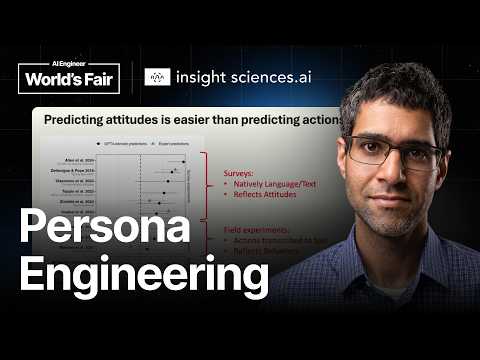
Persona Engineering: A Field Guide to AI Synthetic Personas — Ishan Anand, InsightSciences.ai

Ishan Anand

21 min

Talk introduces LLM-based synthetic personas as forecast-like simulations for market research, emphasizing both promise and limits. It details key failure modes (missing-context confounders, prompt order bias, and gap between stated attitudes vs behaviors) and stresses rich grounding and durability testing. Three techniques are outlined: careful prompting with empirical validation, fine-tuning to align distributions with human data (generalizing to unseen groups), and mapping free-text outputs to Likert scales via semantic similarity to capture full distributions. Evaluation must compare distributions (not single right/wrong), estimate human noise floors, and avoid misusing synthetic samples to claim statistical significance. Synthetic personas complement, not replace, human studies and can extend insights and enable simulations.

  • Synthetic personas are best viewed as forecasts (akin to weather), enabled by increased compute and LLMs, and accurate only within certain regimes.
  • LLMs unlock language-based simulation of attitudes/choices, providing a medium beyond traditional equation-based modeling.
  • A study with ~1,000 humans (multi-hour interviews + surveys) and AI agents taking the same instruments reported ~83% alignment normalized to human noise.
Read full briefing

Key technical points

  • Synthetic personas are best viewed as forecasts (akin to weather), enabled by increased compute and LLMs, and accurate only within certain regimes.
  • LLMs unlock language-based simulation of attitudes/choices, providing a medium beyond traditional equation-based modeling.
  • A study with ~1,000 humans (multi-hour interviews + surveys) and AI agents taking the same instruments reported ~83% alignment normalized to human noise.
  • Failure mode: missing context leads LLMs to invent confounders (e.g., price used as proxy for other attributes), causing inverted U-shaped willingness-to-purchase curves; personas must be richly grounded (personality, context, and even study construction).
  • Failure mode: strong prompt order sensitivity—reordering multiple-choice options can flip outcomes and average out to ~50/50; durability testing via rewording/reordering/adversarial prompts is needed.
  • Failure mode: LLMs better predict stated attitudes (surveys) than actions (field behaviors) because training data is what people say, not do.
  • Technique: basic persona prompting (e.g., Argyle ‘I am …’ completions) can work but must be empirically validated against human ground truth.
  • More detailed persona prompts can inadvertently amplify model biases and diverge further from reality (observed in voting-pattern persona construction).
  • Fine-tuning approach (e.g., Subpop): use demographic prompt templates + survey questions and tune to match human response distributions.
  • Fine-tuning improved alignment for seen groups and also for unseen groups by a similar amount, suggesting the model learns to express latent group knowledge in survey format.
  • Calibration technique: have the model produce free-text rationales, then map to Likert scales via semantic similarity to human-written anchors to recover both central tendency and distribution shape.
  • Distribution-level evaluation is required: pair correlation-like metrics with shape-similarity metrics to detect mean-vs-shape errors.
  • Synthetic samples do not increase statistical significance; rerunning the same persona without new inputs only refines the estimate of the model, not the truth.
  • Establish a noise floor: humans showed ~80% test–retest consistency; use repeat human measurements or split-half resampling of ground-truth data to bound achievable alignment.
  • Synthetic personas complement human research, extend coverage to unasked questions, and can support generative agent-based simulations of interacting personas.
Engineering relevance

For building reliable synthetic persona systems: implement rich grounding of persona, context, and study protocol to suppress confounders; run durability tests (option reorderings, rewordings, adversarial probes) to quantify prompt sensitivity; prefer tasks aligned with stated attitudes or triangulate behaviors via attitudes; validate prompting strategies empirically against human ground truth to detect bias amplification; consider fine-tuning to match human response distributions and improve generalization to unseen groups; use free-text-to-scale semantic mapping to capture full distributional outputs; evaluate via distribution comparisons using complementary metrics and compute a human noise floor; do not claim increased statistical significance from additional synthetic runs; position personas as complements to human data and as inputs to agent-based simulations.

Synthetic PersonasFailure ModesPrompting and CalibrationFine-Tuning for Survey Alignment
Watch source
AI Engineer

Why We Killed Our Multi-Agent Pipeline — Subbiah Sethuraman and Abhilash Asokan, ZS Associates

Subbiah Sethuraman, Abhilash Asokan

15 min

ZS built a multi-agent system to mimic pharma commercial analytics (signal detection → source localization → driver attribution → synthesis) but found incoherent outputs due to context loss, misuse of LLMs for deterministic tasks, and lack of shared domain knowledge. They replaced LLM-based signal detection with a deterministic pipeline (statistical methods, guardrails, thresholds, prioritization) that enqueues vetted signals. Reasoning was consolidated into a single agent with tools for function-writing and database queries, optionally spawning sub-agents for focused investigations while retaining centralized judgment. A domain knowledge graph (geos, payers, accounts, brands, KPIs and their causal/derivation links) became the agent’s control plane, bounding permissible hypotheses and traversal. This looped, hypothesis-driven process reportedly compresses weeks of analyst work into tens of minutes.

  • Original architecture: multi-agent pipeline mapped to analyst steps—signal detection, source localization, driver attribution, and synthesis—coordinated by an orchestrator agent.
  • Observed failure: agents derived correct local facts but produced incoherent actions/outlooks due to fragmented reasoning and context loss at handoffs.
  • Concrete incoherence example: correct cause (payer tier downgrade raising patient cost) but incorrect action (send more reps) and mismatched outlook.
Read full briefing

Key technical points

  • Original architecture: multi-agent pipeline mapped to analyst steps—signal detection, source localization, driver attribution, and synthesis—coordinated by an orchestrator agent.
  • Observed failure: agents derived correct local facts but produced incoherent actions/outlooks due to fragmented reasoning and context loss at handoffs.
  • Concrete incoherence example: correct cause (payer tier downgrade raising patient cost) but incorrect action (send more reps) and mismatched outlook.
  • Root causes identified: LLM handling deterministic signal detection; context loss between agents; no shared business domain understanding across agents.
  • Deterministic pre-processing: automated statistical workflows with guardrails, thresholds, and prioritization detect anomalies/trend breaks per KPI before any agent runs.
  • Queue-triggered investigation: vetted signals are placed on a queue; the agent wakes only to investigate, not to identify signals.
  • Consolidated reasoning: shift from distributed judgment to a single agent that owns end-to-end reasoning; parallelism retained where helpful.
  • Tooling: the main agent is given a tool to repeatedly write functions and query the database, mirroring observed code patterns.
  • Selective sub-agents: dynamically spawn sub-agents for narrow, focused investigations (e.g., rep activity in a region) while the main agent keeps final reasoning/judgment.
  • Knowledge graph construction: domain experts helped encode entities (geographies, payers, accounts, brands) and KPI hierarchies/driver relationships.
  • Graph as control plane: the KG constrains what the agent can inspect, which paths it may take, and which hypotheses it can evaluate; each edge is a hypothesis.
  • Hypothesis loop: start at a focal entity, examine graph neighborhood, form hypotheses from edges, query raw data to test, accept/reject, and traverse until root cause or exhaustion.
  • Separation of concerns: deterministic vs agentic parts are cleanly split; agents do investigation/reasoning, not deterministic detection.
  • Reported outcome: after ~50+ turns and many tokens, the system can produce analyses in roughly 20–30 minutes that previously took analysts 3–4 weeks.
  • Key takeaway: avoid importing human organizational constraints; have one agent own reasoning; use a knowledge graph as more than lookup—use it to govern agent navigation and decisions.
Engineering relevance

For AI/software engineers, this illustrates replacing brittle multi-agent reasoning with a single-agent core plus deterministic pre-stages and bounded delegation. It shows how to trigger LLM investigation via a queue fed by statistical signal detection, equip the agent with programmatic DB tools, and use a knowledge graph as a control plane to constrain hypothesis space. The pattern targets coherence, reduces context loss, and grounds decisions in both data and explicit domain relationships.

Multi-agent vs single-agent LLM systemsDeterministic preprocessing for anomaly detectionKnowledge graph as control planePharma commercial analytics
Watch source
LangChain

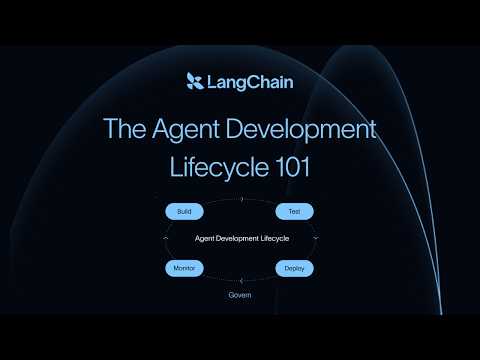
The Agent Development Lifecycle 101

Harrison Chase

45 min

Organizations struggle to get agents to behave reliably at scale; the Agent Development Life Cycle focuses on build, test, deploy, monitor and govern to iterate systematically. The recommended approach separates concerns: use frameworks/runtimes/harnesses (e.g., LangChain, LangGraph, Deep Agents) for building and stateful execution; use sandboxed environments, virtual file systems, tracing and online/offline evals for testing and monitoring; and apply governance for cost, tool access, and audit trails. Evidence in the talk includes concrete tooling patterns (Harbor for sandboxed evals, TerminalBench2 for coding benchmarks, LangSmith traces and Engine) and production primitives (durable execution, human-in-the-loop, Smith DB). A limitation is that many pieces are application-specific (datasets, metrics, envs) and human review remains necessary for many evaluations and final approvals.

  • Agent Development Life Cycle comprises four operational stages—build, test, deploy, monitor—and a cross-cutting govern layer that wraps the whole cycle.
  • Primary engineering challenge: behavioral reliability of agents in production at scale, not just initial functionality.
  • Build tier separation: frameworks (abstractions for prompts, tools, retrieval; e.g., LangChain, Llama Index), runtimes (durable execution, state management; e.g., LangGraph, Temporal), and harnesses (higher-level features like state, file-system access, human-in-loop; e.g., Deep Agents, Claude Agents SDK).
Read full briefing

Key technical points

  • Agent Development Life Cycle comprises four operational stages—build, test, deploy, monitor—and a cross-cutting govern layer that wraps the whole cycle.
  • Primary engineering challenge: behavioral reliability of agents in production at scale, not just initial functionality.
  • Build tier separation: frameworks (abstractions for prompts, tools, retrieval; e.g., LangChain, Llama Index), runtimes (durable execution, state management; e.g., LangGraph, Temporal), and harnesses (higher-level features like state, file-system access, human-in-loop; e.g., Deep Agents, Claude Agents SDK).
  • Trade-off of frameworks: they provide helpful abstractions but can obfuscate underlying LLM calls and token usage; LangChain was slimmed down to reduce this risk.
  • No-code and file-system driven agent definitions are viable: prompts, tools, and skills can be represented as markdown or JSON (agents.md, mcp.json, skills), enabling low-code/no-code workflows (example: eve.dev style).
  • Testing for agents differs from LLM apps: inputs come from production traces, dogfooding, or synthetic generation; tests produce datasets of inputs plus outputs/criteria; scoring uses ground-truth comparisons or criteria-based checks (e.g., TerminalBench2 runs unit tests against coding outputs).
  • Long-running/stateful agent evals require sandboxed environments per task; Harbor is cited as a framework that runs tasks in isolated sandboxes for reliable evaluation of stateful agents.
  • Metrics for evals include correctness, criteria-based checks, and policy compliance; experiments (collections of eval runs) enable version comparisons, regression detection, and readiness assessment.
  • Deployment concerns include durable execution/resumability, persistence and memory (short-term thread memory vs long-term), streaming semantics (tokens vs inner thoughts/tool calls), and human-in-the-loop pause/resume support at scale.
  • Safety and execution: sandboxes are essential for executing untrusted code generated by agents; virtual file systems (store context in DB/S3 and expose read/write/grep/ls/glob/edit) let agents interact with files without heavy disk overhead.
  • Monitoring center: detailed tracing of agent steps, inputs/outputs, tool calls and sub-agent calls is the core observable to debug behavior; traces enable downstream tooling like online evals and dashboards.
  • Online evals operate over production traces without ground truth to surface issues (e.g., perceived error detection via a small model that reads user signals such as explicit complaints or pasted error snippets); guardrails run during execution and can add latency.
  • Governance must cover cost controls, tool access controls (on-behalf-of identities), audit trails (which tools called and for whom), human approvals for sensitive tools, and discoverability/sharing of skills and agents.
  • Operational scaling recommendations: centralize infra and shared frameworks/evaluation standards via a platform or core AI team; instrument tracing, feedback collection and dashboards because operating agents at scale is harder than initial build.
  • LangChain / LangSmith product mappings discussed as concrete implementations: Deep Agents (harness), LangChain (framework), LangGraph (runtime), LangSmith (platform for datasets, evals, deployments, sandboxes, context hub), Smith DB (purpose-built store for traces), and LangSmith Engine (runs every ~6 hours over traces to cluster issues, suggest code/prompt fixes, add examples and create online evals, with human acceptance required before applying changes).
  • Token and prompt context management strategies: store large tool outputs in files and expose only last N tokens, summarize when thresholds exceeded, evict or remove inputs that are already persisted into files to reduce token count while preserving cache-friendly prompt prefixes.
  • Testing novel or adversarial scenarios: use LLMs/agents to synthesize inputs; use techniques like LangFuzz (generate semantically equivalent inputs and detect inconsistent outputs) to find failure modes when ground truth is unavailable; create synthetic/stateful eval environments that can be reset between runs.
Engineering relevance

Engineers should treat traces as the primary telemetry for agent debugging and iteration; design for durable execution, resumability, and explicit memory models (thread vs long-term). Adopt a layered tooling approach—framework for primitives, runtime for state/durability, harness for UX and higher-level patterns—and prefer sandboxed execution for running untrusted code. Build evaluation pipelines that include both offline benchmarks (ground-truth where possible) and online evals over production traces; expect to need SME human annotation queues for complex success criteria. Implement governance primitives early: cost controls, tool access policies, and audit trails. When optimizing token usage, prefer file-backed context and summarization while preserving prompt-prefix stability for caching.

Agent lifecycleEvalsObservability
Watch source
OpenAI

Codex just got better for developers

7 min

Developers struggle to ship ambitious projects and keep work organized beyond individual code edits. Codex is now integrated into ChatGPT and centered on GPT-5.6 "Sol" (with an optional Ultra mode) that automatically parallelizes work across subagents, interacts directly with desktop and browser UIs via appshots, and offers end-to-end flows from inline code edits to hosting on Sites. Demo evidence includes automated Simulator interactions (Codex moving the cursor), visual annotation-driven edits, automated creation of isolated worktrees and tasks, and one-click deployment to Sites. Limitation: Ultra buys a larger reasoning budget but consumes token limits faster, so budget trade-offs must be managed.

  • Product integration: Codex and ChatGPT are merged into one app; Codex has a dedicated workspace alongside a work agent.
  • New model: GPT-5.6 "Sol" is available to everyone and is presented as able to sustain long, difficult reasoning; an Ultra mode increases the model's reasoning budget.
  • Token budget trade-off: Ultra mode provides a much larger reasoning budget but uses token limits faster, requiring caution about token consumption.
Read full briefing

Key technical points

  • Product integration: Codex and ChatGPT are merged into one app; Codex has a dedicated workspace alongside a work agent.
  • New model: GPT-5.6 "Sol" is available to everyone and is presented as able to sustain long, difficult reasoning; an Ultra mode increases the model's reasoning budget.
  • Token budget trade-off: Ultra mode provides a much larger reasoning budget but uses token limits faster, requiring caution about token consumption.
  • Parallelization architecture: Codex automatically splits tasks across subagents (parallel worker threads) and provides UI to follow each subagent or view the entire team working concurrently.
  • UI and desktop automation inputs: "Appshots" capture both the screen and app context (a smarter screenshot) so Codex can operate the Simulator/browser directly (clicking and navigating) while the user continues using their machine.
  • In-app browser + visual context: Codex opens created apps in an in-app browser, supports point-and-click annotations to reference UI elements, and uses that visual context to make requested behavioral or code changes.
  • Authentication support in browser automation: The in-app browser supports applications requiring login, including passkeys, enabling automation workflows that cross authenticated boundaries.
  • Code editing and review flows: Codex exposes a diff view and allows precise inline edits, or behavioral requests that Codex transforms into code changes; users can choose to edit manually or have Codex modify code.
  • End-to-end deployment: Sites (previously enterprise-only) is available to everyone; publishing to Sites provisions hosting, authentication, a persistent database, and file storage for web apps built with Codex, enabling deployment without separate infrastructure work.
  • Task orchestration and repo isolation: Codex can generate and manage its own tasks (example: find five bugs from Linear), create separate tasks and isolated worktrees for each, pin critical tasks, and show a coordinating thread with status for all launched work.
  • Cross-context continuity: Work originating in ChatGPT conversations can be @mentioned into Codex to transfer conversation context directly into the build workflow, eliminating manual copy-paste.
  • Mobile and remote operations: Mobile upgrades let developers create/search/manage tasks from phone, review changes with filters (staged/unstaged/branch/compare), connect to SSH hosts (dev boxes) from mobile, and start tasks remotely.
  • Pull request integration: Codex tracks which branch each task uses and surfaces open PRs in a summary pane; developers can review, leave inline comments, request fixes, mark PRs ready, and merge within Codex without going to GitHub.com.
  • Failure handling and fixes: When CI checks fail or comments arrive on PRs, Codex can be asked (with full context) to fix issues in-place, integrating review and remediation into the same environment.
  • Product iteration evidence and adoption: The product has had 150+ updates in two months and is used by over 6 million weekly users, indicating rapid iteration and broad adoption driving the announced features.
Engineering relevance

This release affects engineering workflows at multiple layers: model selection (GPT-5.6 Sol vs. Ultra with token/compute cost trade-offs), automation of UI workflows through appshots (enabling programmatic Simulator/browser interactions), and parallel task execution via subagents. Use cases include visual-driven UI fixes, automated multi-language screenshot generation, and integrated end-to-end deployment through Sites (hosting, auth, DB, file storage). Repo workflows change because Codex can create isolated worktrees per task, surface PRs and CI failures in-context, and perform inline edits or behavioral refactors. For production planning, engineers should account for token budgeting when using Ultra, validate automated UI actions against local state, and integrate Codex-managed tasks and PR actions into their existing CI/CD and code review policies.

Coding agentsDeveloper toolsAI engineering
Watch source
Stanford Online

Stanford CS547 HCI Seminar | Spring 2026 | Just-in-Time Objectives for Specialized AI Interactions

Michelle Lam

47 min

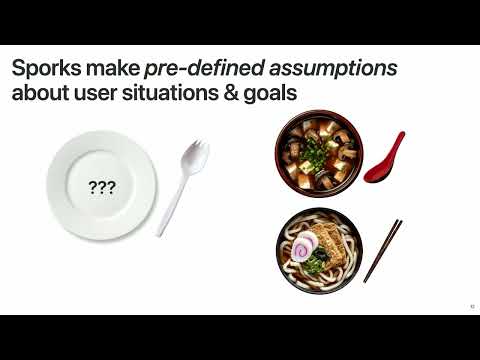
Talk proposes 'just-in-time objectives' to replace generic 'spork' AI interactions by inferring a user's in-the-moment goals from interaction traces and steering LLM generators/evaluators accordingly. Demonstrated with Poppins (on-demand UI/tool generation) and evaluated on user-provided tasks, plus LLooM (steerable concept induction for text analysis) and societal objective functions for social media feed reranking targeting reduced partisan animosity. Evidence includes user studies, preference wins, and feed experiments, with open-source uptake and field validation by collaborators.

  • Problem framing: 'spork' AI—single generic interface/objectives produce homogeneous, subpar outputs across diverse tasks.
  • JIT objectives: automatically induced, instantaneous models of user goals (name, detailed description, weight) from low-effort observations (screenshots, streams, webpage DOM).
  • Induction method: LLM prompt over interaction trace; emphasizes bounded, momentary goals and allows stated uncertainty in the pipeline.
Read full briefing

Key technical points

  • Problem framing: 'spork' AI—single generic interface/objectives produce homogeneous, subpar outputs across diverse tasks.
  • JIT objectives: automatically induced, instantaneous models of user goals (name, detailed description, weight) from low-effort observations (screenshots, streams, webpage DOM).
  • Induction method: LLM prompt over interaction trace; emphasizes bounded, momentary goals and allows stated uncertainty in the pipeline.
  • General architecture: insert JIT objectives into existing system prompts to steer both generators (content/tools/plans) and evaluators (LLM-as-judge rubrics) on the fly.
  • Evaluation (induction accuracy): >200 online participants uploaded real-task screenshots; majority rated induced objectives accurate/very accurate; top-3 choice task showed ~98% selection of induced objectives with alignment to induced weights.
  • Generation results: JIT-augmented generators preferred ~70% vs baselines in head-to-head comparisons on participants’ tasks.
  • Evaluation results: JIT evaluators increased selection of user-preferred outputs, with a reported ~16 percentage point gain from 10 samples to 1 sample in selection win rate.
  • Poppins system: browser extension that proposes objectives, suggests tool ideas/specs, generates code, and renders tailored interfaces (e.g., slide flow organizer, research narrative validator) without manual prompting.
  • In-lab Poppins study: 17 participants with their own writing tasks; Poppins outputs rated significantly higher quality than a baseline LLM similar to ChatGPT; tools supported processes (e.g., character emotion trajectories, method comparison).
  • Training-time leverage: DITTO fine-tuning aligns a model to a user’s writing style using ~5 samples by iteratively preferring user demos over model generations.
  • LLooM concept induction: modular operators—Distill (extract key quotes/points), Cluster (HDBSCAN on embeddings), Synthesize (LLM-generated natural-language concepts with inclusion criteria), Score (map concepts back to documents), Seed (user steering at any operator).
  • LLooM output: steerable, interpretable concepts (beyond vague keywords) enabling analysts to refine/extend concepts (e.g., 'crisis') and analyze political social media posts via a matrix view.
  • LLooM adoption: open-source package with documentation; used by researchers (e.g., EMNLP, IEEE VIS) across varied text types (visualization notebooks, product reviews).
  • Societal objective functions: translate social science constructs (e.g., AAPA with eight dimensions) into LLM prompts to score/rerank social media inventory in real time.
  • Feed experiments: manual AAPA-based reranking reduced partisan animosity vs engagement-based feeds; LLM-based reranking also achieved significant reductions for Democrats and Republicans; field experiments by colleagues with a browser extension on X confirmed exposure shifts changed animosity.
Engineering relevance

Implement JIT steering by adding an 'objective slot' to existing generator/evaluator prompts; feed it a structured objective induced from interaction traces (screenshots/DOM). Build a JIT induction service: capture low-friction observations, run an LLM prompt to produce {name, description, weight}, and surface uncertainty; keep it instantaneous and bounded. Adopt generator–evaluator loops: use JIT objectives to condition both content generation and LLM-as-judge scoring/rubrics for hill-climbing. For on-demand tools (Poppins-style), pipeline: objective -> tool ideas/specs -> code generation -> live rendering in extension/UI container. For text analytics, replicate LLooM’s modular operators (Distill, Cluster via embeddings+HDBSCAN, Synthesize via LLM, Score, Seed) to produce steerable, interpretable concepts. For social feeds, create an LLM reranker: per-post scoring across construct dimensions -> aggregate score -> rerank; design for real-time and swappable constructs/scales. Leverage existing third-party models; gains reported came from objective steering rather than bespoke model training. Consider extending scope: background agents and project/long-term goal inference (e.g., motivations, scheduling support) using JIT-like signals.

Just-in-Time ObjectivesGenerator–Evaluator SteeringPoppins On-Demand UI GenerationLLooM Steerable Concept Induction
Watch source
Claude

How Spotify runs agents across 20M+ lines of code

Niklas Gustavsson

26 min

Spotify faced rapid code growth and slow manual maintenance across thousands of components. They built Honk: an agent orchestration layer using the Claude-based agent SDK running in Kubernetes pods with access to internal tools (including CI on Linux and macOS) to make and verify large-scale code mutations and prototypes. The system has merged millions of PRs, produced a 75%+ increase in PR frequency and ~73% of PRs are AI-authored; an earlier LLM "judge" raised PR success from ~20–30% to ~80% but was later removed as model/agent quality improved. The approach works at monorepo scale (20M+ LOC) but required heavy investment in test automation, ownership boundaries, and standardization to keep reliability neutral while increasing speed.

  • Problem: codebase growth outpaced engineering headcount (code grew ~7x faster), making bulk maintenance (library/API migrations) infeasible to do manually across thousands of components.
  • Fleet management concept: automate repository-wide changes (previously manual per-team migrations) to remove repetitive work performed by hundreds of teams across thousands of components.
  • Early tooling relied on deterministic scripts for transformations, which hit a complexity ceiling because code has a very large API surface and many edge cases (variable/state tracking, multiple calling patterns).
Read full briefing

Key technical points

  • Problem: codebase growth outpaced engineering headcount (code grew ~7x faster), making bulk maintenance (library/API migrations) infeasible to do manually across thousands of components.
  • Fleet management concept: automate repository-wide changes (previously manual per-team migrations) to remove repetitive work performed by hundreds of teams across thousands of components.
  • Early tooling relied on deterministic scripts for transformations, which hit a complexity ceiling because code has a very large API surface and many edge cases (variable/state tracking, multiple calling patterns).
  • Honk evolution: moved from homegrown heuristics + judge to an agent-based system built on the Claude agent SDK; V2 expanded capabilities and allowed users to add custom tools to the agent's toolset.
  • Architecture: agents run in Kubernetes pods, have access to internal tools (including the ability to run CI builds), and operate on worktrees across mono and poly repositories.
  • Verification / CI as a production guardrail: agents run builds on Linux and macOS (macOS needed for iOS work); verification is essential for closed-loop, human-out-of-loop changes and for safe automerging.
  • Earlier LLM judge: used as an evaluation layer to raise automated PR success rates from roughly 20–30% to ~80%; as models and agent logic improved, the judge was removed.
  • Monorepo suitability: despite initial concerns about indexing and scale, Claude-based agents performed well in very large monorepos (backend monorepo >20M LOC); consistency across codebases improves agent performance.
  • Test automation and team ownership: to support automerging and agent-driven changes, Spotify strengthened automated tests and enforced component ownership so teams were no longer the default human gatekeepers for every PR.
  • Metrics and ROI signals: observed 75%+ improvement in PR frequency and ~73% of PRs attributed to AI; Spotify executes ~4,500 production deployments per day, amplifying the need for automated quality controls.
  • Prototyping workflow: built infrastructure to let engineers and non-engineers generate end-to-end app prototypes (mobile and backend) quickly; internal prototype app store enables sharing and trialing of ideas in hours instead of weeks.
  • Deployment and iteration loop: agents decompose tasks, apply code changes, run verification (including simulator or UI checks in some cases), and can operate across multiple terminal sessions—engineers commonly run 5–10 agent sessions concurrently.
  • Failure modes and trade-offs: deterministic transformations struggled with API diversity and edge cases; the solution traded investment in automated testing and standardization for speed, making encoded quality practices a prerequisite.
Engineering relevance

This talk documents an operational path for using LLM-driven agents at scale: run agents in containerized environments with controlled tool access, integrate CI (Linux and macOS) into the agent verification loop, and make automerging safe by improving test coverage and enforcing component ownership. Key engineering investments are stronger test automation, consistent code and tooling standards, and an operational verification pipeline; those reduce human review needs while keeping quality stable. The concrete metrics (millions of merged PRs, 75%+ PR frequency uplift, ~73% AI-authored PRs, ~4.5k daily deploys) illustrate that agent-driven workflows require both robust automation and measurement to attribute ROI and user impact.

Developer productivityAgent systemsCodebases
Watch source
Google Cloud Tech

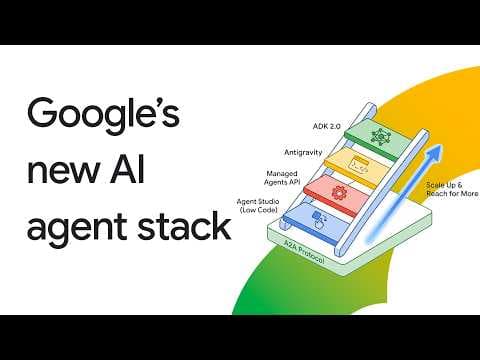
Google’s new AI agent stack from I/O 2026

17 min

Google presented a four-rung agent stack that combines improved models (Gemini 3.5 Flash), orchestration/runtime (SDK/ADK, agent CLI), managed hosted agents, and higher-level tooling (Agent Studio, Anti-Gravity, skill registry). The stack uses a common agent-to-agent two-way protocol and a single platform/runtime so solutions at different rungs interoperate. Key technical outcomes: SDK 2.0 is now graph-based for deterministic vs creative control and long-horizon tasks; managed agents API offers one-call, persistent, hosted agents; skill registry enables dynamic, org-scoped skill discovery. Limitations/guardrails discussed include governance, agent identity, isolated runtimes, and a payment protocol (AP2) to constrain transaction spending.

  • Four-layer (rung) agent stack: Agent Studio (low-code UI), Managed Agents API (one-call hosted), Anti-Gravity (agent-first orchestration/management), and full-code SDK/ADK (code-level control).
  • A rail alongside the ladder: an agent-to-agent protocol (two-way) that lets the different rungs and solutions interoperate and interrupt together.
  • Agent Studio: visual, low-code environment that can be converted to code and used as an entry point for teams that prefer a UI-first workflow.
Read full briefing

Key technical points

  • Four-layer (rung) agent stack: Agent Studio (low-code UI), Managed Agents API (one-call hosted), Anti-Gravity (agent-first orchestration/management), and full-code SDK/ADK (code-level control).
  • A rail alongside the ladder: an agent-to-agent protocol (two-way) that lets the different rungs and solutions interoperate and interrupt together.
  • Agent Studio: visual, low-code environment that can be converted to code and used as an entry point for teams that prefer a UI-first workflow.
  • Managed Agents API: single API call to spin up a fully hosted, persistent agent that can reason, call tools, execute code, and keep files/state across interactions (no manual sandbox provisioning).
  • ADK/SDK distinction: managed agents API is configuration-first (low friction); ADK/SDK is engineering-first for teams needing full control and customization.
  • Agent CLI (announced at Cloud Next): scaffolding, local run, writing evals, and deploy target to Agent Platform; deploys agents as autoscaling services with no infra to manage.
  • SDK 2.0 (GA): moved from imperative orchestration to a graph-based model allowing workflows described as graphs of steps, with a slider to choose deterministic vs creative behavior—designed for long-horizon tasks that run minutes or hours.
  • Skill registry: private, org-scoped repository of skills (Markdown with instructions and tools); agents dynamically discover and load only the skills needed at runtime for leaner agents and shared governance.
  • Anti-Gravity 2.0: agent-first development platform with a desktop 'mission control', CLI, and SDK surfaces to orchestrate cohorts of agents, subagents, scheduled/background tasks; can host the agent harness on customer infra and plug into Agent Platform for cloud customers to inherit data protections.
  • Gemini 3.5 Flash: announced as the new default model tuned for agentic, long-horizon work; designed for cost-effectiveness and speed, co-designed with new TPUs, and reported to beat Gemini 3.1 Pro on some agent-relevant benchmarks.
  • Gemini Spark: consumer-facing 24/7 personal agent running in dedicated VMs in a managed runtime; can run background multi-step work while device is locked; every task runs in a fresh, isolated ephemeral VM to reduce data overlap.
  • Agent payment protocol (AP2): guardrail for transactions—agents operate within a mandate that sets what they can spend and associated limits, enabling safer commerce flows.
  • Operational guardrails: agent identity for traceability, governance features to limit blast radius, agent sandboxes/ephemeral VMs and isolated runtimes to reduce data leakage, and SynthID watermarking for generated video outputs.
  • Model Garden and templates: Model Garden hosts many agents as starting templates influenced by real-world deployments—useful for bootstrapping agent implementations and iterating from observed customer patterns.
  • Omni / Gemini Omni Flash: a multimodal creation model that accepts heterogeneous inputs (text, images, audio clips, video) and fuses them into coherent grounded video output; outputs carry a watermark (SynthID) and the model reasons about physics/consistency rather than performing simple collage.
Engineering relevance

Choose a rung based on team experience and needs: use Agent Studio or Managed Agents API for low-friction, configuration-first deployments; use SDK/ADK and the graph-based SDK 2.0 for engineering-first, long-horizon workflows requiring determinism or custom orchestration. Use the Agent CLI to scaffold, run locally, write evals, and deploy to the Agent Platform (autoscaling, no infra). Implement skills as Markdown-backed entries in the org-scoped skill registry so agents dynamically load what they need at runtime. Use Anti-Gravity to manage cohorts, parallel agents, and background automation; optionally host the agent harness on your infra or connect to Agent Platform to inherit cloud data protections. Adopt Gemini 3.5 Flash for agentic, long-horizon workloads and test against available benchmarks; for consumer personal agents, consider Spark’s dedicated VM/ephemeral task model. Apply governance primitives (agent identity, sandboxing, ephemeral VMs, AP2) and SynthID watermarking for production safety and traceability. Iterate using Model Garden templates and the CLI’s eval tooling.

Agent platformsCloudAI engineering
Watch source
Claude

How we Claude Code

32 min

Long-running agents can burn many tokens if requirements and verification are underspecified. The talk demonstrates an approach that front-loads requirement extraction and verification into rich HTML specifications, lets Claude (an agent) interview the user, and exposes component state into the DOM so the agent can run verification end-to-end. Evidence is provided via a public repo with three phases (interactive spec, multi-direction HTML designs, and an agent-native verification framework for a React to‑do app using Storybook fixtures, Playwright MCP, and Opus 4.7). Outcome: fewer iterative cycles and more agent-driven verification at cost of upfront engineering to modularize components and publish DOM contracts; one-off HTML token cost may be higher but reduces total iterations.

  • Problem: Longer agent runtimes increase token cost when agents act on underspecified or ambiguous requirements; prefer extracting requirements interactively rather than overconstraining up front.
  • Use HTML as a denser, more ergonomic spec format instead of long Markdown files; HTML enables richer presentation (screenshots, interactive elements) that humans and vision-capable models can inspect more efficiently.
  • Interactive requirement extraction: prompt Claude to interview the user via an explicit "ask user question" tool so the model elicits latent requirements rather than relying on a single upfront spec.
Read full briefing

Key technical points

  • Problem: Longer agent runtimes increase token cost when agents act on underspecified or ambiguous requirements; prefer extracting requirements interactively rather than overconstraining up front.
  • Use HTML as a denser, more ergonomic spec format instead of long Markdown files; HTML enables richer presentation (screenshots, interactive elements) that humans and vision-capable models can inspect more efficiently.
  • Interactive requirement extraction: prompt Claude to interview the user via an explicit "ask user question" tool so the model elicits latent requirements rather than relying on a single upfront spec.
  • Model and mode recommendations: use Opus 4.7 for improved vision capabilities; enable auto mode and fast mode for quicker iteration; set the effort parameter (recommendation: X high or max effort for thoroughness).
  • Verification embedded in artifact: components publish their state and verification manifests into the DOM (schemas, fixtures, known states, invariants, probes) so agents can read contracts rather than scraping React internals.
  • Verification tooling and architecture: combine Storybook fixtures, a testing library, data emissions/attributes, and Playwright MCP to let agents execute probes and capture evidence (video clips) of verification runs.
  • Three execution surfaces for verification: a human-readable dashboard for manual review, agent-driven in-browser execution (Claude running Playwright MCP), and headless CI execution (bun verify) producing the same verification outcomes.
  • Probes and invariants: include probes to push off the happy path and test invariants; verification manifests in DOM list specific checks that agents can run and return pass/fail plus evidence.
  • Evidence recording and sharing: capture verification runs as clips (videos), download them or store on S3 or internal storage, and share with colleagues as proof of verification.
  • Separation of contract vs. app: examples show the app can continue to function while the verification contract is broken (e.g., removing published total stats causes verification to fail even if UI works), highlighting the importance of publishing state separately from React internals.
  • Failure examples used in demo: deliberately planted failing verification (schema mismatch: 4 + 3 != 10) to illustrate how agents detect and diagnose invariant violations.
  • Modularization requirement: to make agent-driven verification practical, sensible modularization of components and explicit fixtures/schemas per component are necessary so each component can publish known states and invariants.
  • Trade-off on token cost: a rich HTML spec may cost more tokens to generate once, but reduces iteration overhead and overall token consumption across repeated agent-led refinement cycles.
  • Repo and demo structure: the provided workshop repo contains three phases—interactive bill-splitting spec extraction, generation of four HTML design directions, and a to‑do app verification framework with detailed README and verification manifest examples.
Engineering relevance

Integrate this pattern by instrumenting front-end components to emit a verification manifest into the DOM (schemas, fixtures, invariants, probes) and publish visible state separately from framework internals so agents can read it reliably. Use Storybook fixtures and a test library to define known states; connect Playwright MCP for in-browser agent execution and recording; enable headless verification via tools like bun verify in CI. For model setup, prefer Opus 4.7 for vision, enable auto mode and fast mode for interactive iteration, and set the effort parameter to a higher setting for thoroughness. Design probes to intentionally exercise non-happy paths and treat evidence clips as artifacts to store (S3 or internal) for team review. Plan upfront engineering to modularize components and define DOM contracts; expect one-time token cost increases for richer HTML specs but fewer total refinements.

Coding agentsDeveloper workflowsAI engineering
Watch source
Claude

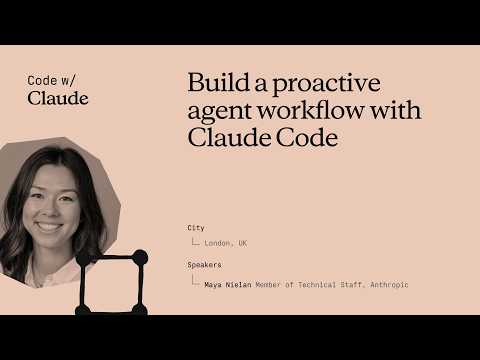
Build a proactive agent workflow with Claude Code

22 min

Building proactive agents traditionally requires custom hosting, persistence, and trigger infra (cron/webhooks) plus limited observability. Claude Code 'routines' launches managed remote Claude Code sessions from a declarative prompt plus repository and connector configuration and a trigger (time-based or event/webhook). Anthropic uses routines to automate docs PRs and GitHub‑event workflows; sessions are interactive and resumable so humans can watch, steer, or chain agent reviews. Routines remove most infra boilerplate but their effectiveness is bounded by the context and connectors you provide and still requires steerability/verification in production.

  • Problem: proactive agents normally need separately managed hosting, data persistence, and authentication; running on a laptop is unreliable.
  • Routines is a Claude Code feature that launches a remote Claude Code session by specifying only: the prompt, repositories to connect, connectors available, and a trigger; Cloud Code handles hosting, session state, and connectors.
  • Routines run on Cloud Code's managed infrastructure so sessions do not depend on the user's local machine being open.
Read full briefing

Key technical points

  • Problem: proactive agents normally need separately managed hosting, data persistence, and authentication; running on a laptop is unreliable.
  • Routines is a Claude Code feature that launches a remote Claude Code session by specifying only: the prompt, repositories to connect, connectors available, and a trigger; Cloud Code handles hosting, session state, and connectors.
  • Routines run on Cloud Code's managed infrastructure so sessions do not depend on the user's local machine being open.
  • Trigger types supported: schedule/time-based triggers and event-based triggers; event-based triggers include native GitHub events and custom webhooks/post requests where the event payload is passed as session context.
  • Context inputs to routines include connected GitHub repos (source code, documentation), external connectors (examples given: Google Drive, Slack), and monitoring/tooling connectors (examples mentioned: DataDog, Grafana) and alerting connectors (Twilio for SMS).
  • Sessions launched by routines are full Claude Code sessions under the hood and are interactive and steerable via web, CLI, or desktop: you can open, watch live, ask questions, steer, and resume past sessions.
  • Steerability and guardrails: support for human-in-the-loop interaction during live runs, the ability to resume past sessions, and agent-on-agent review patterns (generator/critiquer) by chaining routines (e.g., one routine opens a PR, another routine comments on it before human review).
  • Output patterns demonstrated: routines can open PRs in documentation repos, ping channels in Slack when PRs are created, and render changed documentation pages for verification.
  • Demo: a scheduled weekly routine compares Claude Code source changes to the docs repo and opens PRs; the routine asks configuration questions (e.g., weekly time, notification preferences) during setup.
  • Demo: an event-triggered routine runs on GitHub issue opens, receives the issue content as context, investigates whether the issue is a documentation gap, and can open a PR and ping Slack; sessions can be stopped if duplication or prior PRs exist.
  • Deploy-verifier use case: a CD pipeline can post to a webhook to trigger a routine that has access to the deployed service source code and monitoring tools; Claude can investigate and provide a go/no-go decision and assist with rollback under human supervision.
  • Limitation: the 'ceiling' of routine performance is determined by the context and connectors supplied; insufficient context increases the need for human steering.
  • Operational note: creating a routine can begin from a single /schedule command in the Claude Code terminal; Claude will follow up with configuration prompts (time, notifications).
  • Evidence/motivation: Anthropic observed a 200% increase in weekly PRs for Claude Code, motivating automation for documentation maintenance using routines.
Engineering relevance

Architecture: managed remote Claude Code sessions host agent runs and store session state on Cloud Code infrastructure; routines are declarative bindings (prompt + repos + connectors + trigger) that instantiate these sessions. Inputs: trigger (schedule or event/webhook/GitHub event), initial prompt/instructions, repository access (source and docs), connectors (Slack, Google Drive, monitoring tools), and optionally event payload as context. Outputs: created GitHub PRs, Slack notifications, rendered documentation pages for verification, and operational actions (e.g., guided rollbacks) produced by the session. Evaluation methods and verification: render changed pages for human verification, use agent-on-agent critiquer runs to pre-review PRs, and retain ability for humans to watch/steer/resume sessions for final decisions. Production guardrails: interactive sessions, live observability (web/CLI/desktop), human-in-the-loop steering, chained routines for automated review before human inspection, and configuration prompts at routine creation to set notification behavior. Metrics and evidence: measured PR volume (200% weekly PR increase) used as a driver for automating documentation workflows. Trade-offs: routines eliminate the need to build and maintain hosting/persistence/auth infra and cron endpoints but place an operational dependency on the managed Cloud Code environment and on the quality/coverage of provided context and connectors. Failure modes exemplified: duplicate work (routine opens PR when a human already has one), incorrect decisions if monitoring/data or repo context is missing, and the need to stop/steer sessions in real time to prevent incorrect outputs. Deployment and iteration loop: create routine via /schedule or event trigger configuration, answer setup prompts (timing, notifications), run routine, inspect live session, steer or resume as needed, chain or create additional routines for review, and iterate configuration based on observed outcomes.

Coding agentsWorkflowsAutomation
Watch source

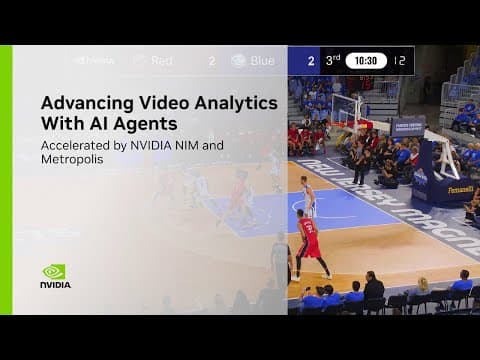
Advancing Video Analytics With AI Agents

The clip states that artificial intelligence has made extraordinary progress over the last 10 years and introduces Nvidia's new DGX product, called DGX Spark, noting it has 20 CPU cores. The source provides only these high-level claims and a short musical intro, offering no additional hardware, software, or benchmark details. As a result, engineers can register the product name and a CPU-core count but cannot assess system capability, performance, or suitability for specific video-analytics or AI workloads from this transcript alone.

  • The speaker asserts that artificial intelligence has made extraordinary progress.
  • A timeframe is given: "It has only been 10 years."
  • Vendor identified: Nvidia.
Read full briefing

Key technical points

  • The speaker asserts that artificial intelligence has made extraordinary progress.
  • A timeframe is given: "It has only been 10 years."
  • Vendor identified: Nvidia.
  • New product name introduced: DGX Spark (described as Nvidia's new DGX).
  • An explicit hardware datapoint: 20 CPU cores are mentioned for DGX Spark.
  • The recording includes musical intro/outro cues (marked as [Music]), suggesting a promotional or short-form clip.
  • No GPU or accelerator details are provided in the transcript.
  • No memory, storage, network, or I/O specifications are provided.
  • No software stack, frameworks, or preinstalled models are mentioned.
  • No performance benchmarks, metrics, or evaluation methods are provided.
  • No production guardrails, safety measures, or operational constraints are mentioned.
  • No deployment, orchestration, or iteration/CI loops are discussed.
  • The transcript is brief and fragmentary, insufficient to support technical decision-making about system capabilities.
Engineering relevance

From an engineering standpoint the only concrete, actionable facts in the source are the product identity (Nvidia DGX Spark) and a single hardware count (20 CPU cores). Those two points allow only a very high-level recognition of a new DGX offering; they do not permit assessment of GPU/accelerator resources, memory, storage, network, software stack, performance characteristics, or operational requirements. Engineers should treat the transcript as an introductory announcement rather than a technical specification and seek full vendor documentation for any design, procurement, or benchmarking work.

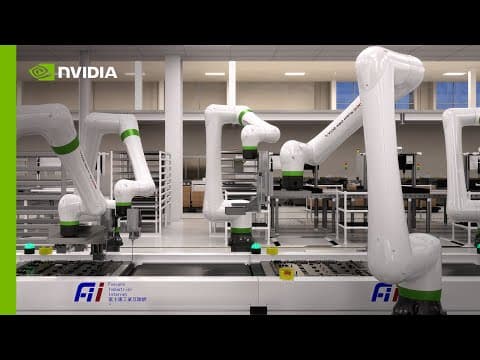
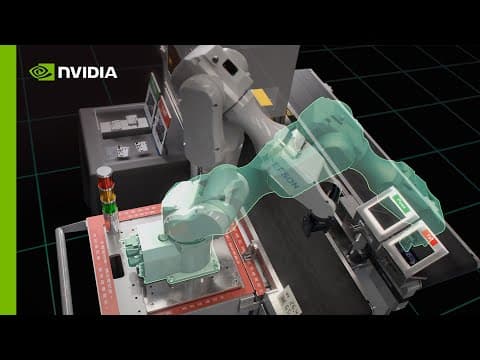
Building Digital Twins of Foxconn’s Robotic Factories

Foxconn addresses rising demand for NVIDIA accelerated computing by building robotic factories using NVIDIA Omniverse as a digital twin and AI Factory planners. Omniverse ingests facility and equipment data from Siemens Teamcenter X and Autodesk Revit to optimize floor layout, line configurations, and camera placement, and serves as a robot gym to simulate and train NVIDIA Isaac and Metropolis AI applications. Virtual integration reduces the enormous cost of physical change orders during construction and produces runtimes that are deployed to line computers and jets for production. The process creates a closed loop where robots running Isaac build NVIDIA AI supercomputers that are then used to train Foxconn robots, with the digital twin serving as the source of truth for equipment layout verification.

  • Platform: NVIDIA Omniverse is used as the central digital twin and simulation environment for Foxconn's robotic factories.
  • Data inputs: Facility and equipment data are integrated from Siemens Teamcenter X and Autodesk Revit into the Omniverse digital twin.
  • Layout optimization: The digital twin is used to optimize factory floor layout and assembly line configurations before physical construction.
Read full briefing

Key technical points

  • Platform: NVIDIA Omniverse is used as the central digital twin and simulation environment for Foxconn's robotic factories.
  • Data inputs: Facility and equipment data are integrated from Siemens Teamcenter X and Autodesk Revit into the Omniverse digital twin.
  • Layout optimization: The digital twin is used to optimize factory floor layout and assembly line configurations before physical construction.
  • Sensor planning: Omniverse is used to locate optimal camera placements to monitor future operations, leveraging NVIDIA Metropolis vision AI.
  • Cost avoidance: Virtual integration in Omniverse reduces the enormous cost of physical change orders during construction by validating designs virtually.
  • Source-of-truth: The Omniverse digital twin acts as the authoritative source for communicating and validating accurate equipment layout to planners and teams.
  • Robot gym: Omniverse doubles as a robot gym where developers train and test NVIDIA Isaac AI applications for robotic perception and manipulation.
  • Sensor fusion: Metropolis AI applications for sensor fusion are trained and validated within the Omniverse simulation environment.
  • Pre-deployment simulation: Foxconn simulates two robot AIs in Omniverse before deployment to production.
  • Runtime deployment: After simulation and testing, runtimes are deployed to 'jets and computers on the assembly line' to run in production.
  • AOI simulation: Isaac manipulator libraries and AI models are simulated for automated optical inspection tasks—object identification, defect detection, and trajectory planning to transfer HGX systems to test pods.
  • AMR simulation: Isaac-perceptor-powered fobot AMRs are simulated performing 3D mapping and reconstruction as they perceive and move through the environment.
  • Closed-loop system: The factories orchestrate robots running NVIDIA Isaac to build NVIDIA AI supercomputers, which in turn are used to train Foxconn robots, creating a training/deployment loop.
Engineering relevance

Engineers should note the tight integration between PLM/CAD data sources (Siemens Teamcenter X, Autodesk Revit) and the Omniverse digital twin to enable pre-construction layout and sensor-placement optimization. Use Omniverse as both a validation/source-of-truth for equipment layouts and as a simulation gym to train/test NVIDIA Isaac perception and manipulation stacks and Metropolis sensor-fusion models. Validate AOI pipelines (object ID, defect detection, trajectory planning) and AMR 3D mapping in simulation prior to deploying runtimes to assembly-line computers and devices. The workflow emphasizes reducing physical change orders via virtual verification and establishes a production loop where trained models are moved from simulation to deployed runtimes on line hardware.

Cadence Cuts Chip Verification From Weeks to Hours With AI Engineers and NVIDIA OpenShell

Chip verification faces extreme scale and timing constraints—trillions of transistors, 3D circuits and picosecond synchronization—so physical prototypes are impractical and RTL must be verified in simulation. Cadence and Nvidia built an AI-driven verification stack: Codex orchestrates Cadence ChipStack, which launches an RTL verification loop powered by Neumitron and secured by Nvidia OpenShell, calling specialist sub-agents for RTL generation, testbench creation, regression and debug. The agents run hundreds of simulations with Cadence Xcelium and perform formal verification with Jasper to find design flaws and enable fixes. Reported outcome: what once took weeks now takes hours, with verification cycles over 40× faster.

  • Partnership: Cadence and Nvidia collaborated to build AI-driven chip design verification agents.
  • Design challenge: chip design complexity includes trillions of transistors, three-dimensional circuits, microscopic scale, and gate/wire timing synchronized to picoseconds; physical prototypes are too slow and costly.
  • Design flow described: architectural specifications are translated into RTL, and RTL must be verified in simulation because a single bug can delay a chip by months.
Read full briefing

Key technical points

  • Partnership: Cadence and Nvidia collaborated to build AI-driven chip design verification agents.
  • Design challenge: chip design complexity includes trillions of transistors, three-dimensional circuits, microscopic scale, and gate/wire timing synchronized to picoseconds; physical prototypes are too slow and costly.
  • Design flow described: architectural specifications are translated into RTL, and RTL must be verified in simulation because a single bug can delay a chip by months.
  • Existing scale at Nvidia: thousands of engineers, billions of compute hours per year, and millions of tests written, run, and debugged; verification cycles previously took teams weeks.
  • Orchestration layer: 'Codex' orchestrates the verification process and launches the loop through Cadence ChipStack.
  • Runtime/agents: Cadence ChipStack runs an RTL verification loop powered by 'Neumitron' and secured by Nvidia OpenShell; it calls expert sub-agents for RTL generation, testbench creation, regression testing, and debug.
  • Autonomy: the system 'drives itself' by coordinating sub-agents to run simulations and debugging workflows without manual orchestration in each cycle.
  • Simulation tools and formal methods: the agents execute hundreds of simulations using Cadence Xcelium and perform formal verification using Jasper to reveal design flaws.
  • Inputs and outputs: inputs are architectural specifications and generated RTL; outputs include simulation runs, formal-check results, revealed design flaws, and bug fixes.
  • Iteration loop: the workflow is a verification loop that includes testbench generation, regression testing, simulation, formal verification, and debug to rapidly iterate on RTL fixes.
  • Security/guardrail: the verification loop is described as secured by Nvidia OpenShell (presented as a security or production guardrail).
  • Metrics and reported result: verification cycles compressed from weeks to hours, with a stated speedup of over 40×.
  • Scale implications: moving from manual team-driven cycles to agent orchestration addresses high compute and test volume (hundreds of simulations per run and millions of tests historically).
  • The talk does not provide details on specific trade-offs, failure modes, or lower-level implementation details (for example, model architectures, agent training, rollback policies, or how OpenShell is configured).
Engineering relevance

For engineers, the talk demonstrates an operational pattern: an orchestration layer (Codex) coordinates specialist AI sub-agents to automate RTL generation, testbench creation, regression, simulation (Cadence Xcelium) and formal checks (Jasper). This shortens feedback loops dramatically—moving verification from multi-week cycles to hourly cycles—by running hundreds of simulations per loop and automating debug. Important engineering touchpoints are integration with existing EDA tools (Xcelium, Jasper), an autonomous verification loop (regression + debug), and a named security envelope (Nvidia OpenShell). The source does not specify implementation details such as agent model internals, training data, failure recovery, or deployment patterns, so engineers should treat the described system as a high-level architecture and look for concrete integration and safety details before adoption.

Digital Humans Transform Industries

The talk frames the problem of making computers interact with people in humanlike, low-latency ways across industries (customer service, healthcare, advertising, design). The presented approach is a stacked set of AI capabilities — multilingual speech recognition and synthesis, LLMs for conversational intent, generative animation tied to a 3D face mesh, and neural rendering (real-time path-traced subsurface scattering) — packaged as deployable microservices (NIMs) in Nvidia Ace and served on a global accelerated network. Evidence includes application examples: phone-scan-based AI interior design that returns multiple photorealistic options, a conversational healthcare agent safely answering a drug-allergy question, and EMA, a Japanese virtual model/brand ambassador. Outcome: a production-oriented microservice architecture that enables real-time digital humans with regional low-latency delivery (100+ regions), though it requires orchestration across multiple specialized models and heavy real-time rendering compute.

  • Primary capability stack: multilingual speech recognition and synthesis + LLMs for understanding and generating conversation.
  • Generative animation layer: a separate generative AI dynamically animates a lifelike 3D mesh of a face from audio/intent.
  • Neural appearance models: real-time path-traced subsurface scattering to simulate skin light penetration and scattering for soft, translucent skin appearance.
Read full briefing

Key technical points

  • Primary capability stack: multilingual speech recognition and synthesis + LLMs for understanding and generating conversation.
  • Generative animation layer: a separate generative AI dynamically animates a lifelike 3D mesh of a face from audio/intent.
  • Neural appearance models: real-time path-traced subsurface scattering to simulate skin light penetration and scattering for soft, translucent skin appearance.
  • Nvidia Ace packaging: digital human technologies are provided as easy-to-deploy, fully optimized microservices (referred to in the talk as NIMs).
  • Named NIMs and roles (as stated): 'Neotron slm and llm Nims' to understand intent and orchestrate other models; 'Reva speech Nims' for interactive speech and translation; 'audio to face and gesture nyss' for facial and body animation.
  • Rendering infrastructure: Omniverse RTX with DLSS is used for neural rendering of skin and hair.
  • Inputs and outputs: inputs include phone scans of environments (e.g., kitchens) and audio; outputs include photorealistic interior design suggestions, sourced materials/furniture options, conversational responses, and synchronized facial/body animation.
  • Example applications: AI interior designers generating multiple photorealistic options from phone scans; AI customer service agents for more engaging/personalized interactions; digital healthcare workers providing timely personalized care (demonstrated with a medication/allergy exchange); AI brand ambassadors/virtual models (EMA).
  • Microservice integration: Ace NIMs can be integrated into existing frameworks, game engines, and digital human experiences, implying modular runtime components.
  • Deployment and latency: Ace NIMs run on Nvidia GDN (a global network of Nvidia-accelerated infrastructure) that delivers low-latency digital human processing to over 100 regions.
  • End-to-end orchestration requirement: multiple specialized models (speech, LLMs, generative animation, neural rendering) must be orchestrated to produce synchronized, real-time digital humans.
Engineering relevance

Adopt a microservice architecture (Ace NIMs) to decouple speech, intent, animation, and rendering components for easier integration into existing engines and frameworks. Route sensory inputs explicitly: phone-captured 3D/photogrammetry data for design generation; audio streams for speech recognition/synthesis and audio-to-face animation pipelines. Use LLM/SLM NIMs as an orchestration/intent layer to sequence downstream models (speech, translation, animation) rather than tightly coupling logic into a single model. Leverage Reva-like speech NIMs for interactive speech and translation to support multilingual user interaction flows. Implement an audio→animation module (audio-to-face/gesture NIMs) to generate synchronized facial/body motion driven by speech. Plan rendering pipeline around Omniverse RTX + DLSS for neural rendering, and include support for real-time subsurface scattering for convincing skin appearance — budget for high GPU compute. Deploy on regionally distributed accelerated infrastructure (Nvidia GDN) to meet low-latency requirements; design for multi-region routing and failover. Prepare orchestration and timing controls to synchronize conversational output, animation frames, and neural-rendered frames for real-time responsiveness. Instrument pipelines for per-component performance (latency of speech-to-text, LLM response time, animation synthesis time, render frame time) to identify bottlenecks in end-to-end interactions. Integrate NIMs as modular services to allow iterative updates to individual components (speech model, LLM, animator, renderer) without full system redeploys.

Digital Twins Power Taiwan's Industrial AI Transformation

Taiwanese manufacturers are building digital twins on NVIDIA Omniverse to move manufacturing design, validation, and operations into software-defined workflows. Workflows include converting 2D CAD into full 3D fab layouts (TSMC/MEAI), simulating multi-floor piping, power and cooling for data centers, and virtual commissioning of production lines and solder-paste dispensing. Companies use the twins as robot gyms to develop, train, and test manipulators, AMRs, humanoids, and vision agents, and connect twins to IoT for realtime interactive dashboards; reported outcomes include months saved in design and millions saved by reduced downtime and defects. The talk focuses on applied simulation and integration examples rather than quantitative metrics or formal guardrails.

  • Platform: Multiple Taiwanese firms are developing digital twins on NVIDIA Omniverse as the core platform for manufacturing and city simulations.
  • 2D-to-3D conversion: TSMC with MEAI generates full 3D fab layouts from 2D CAD inputs to accelerate facility-level modeling.
  • Piping simulation and optimization: AI tools (developed on co-op) simulate and optimize complex multi-floor piping systems, reducing design time by months.
Read full briefing

Key technical points

  • Platform: Multiple Taiwanese firms are developing digital twins on NVIDIA Omniverse as the core platform for manufacturing and city simulations.
  • 2D-to-3D conversion: TSMC with MEAI generates full 3D fab layouts from 2D CAD inputs to accelerate facility-level modeling.
  • Piping simulation and optimization: AI tools (developed on co-op) simulate and optimize complex multi-floor piping systems, reducing design time by months.
  • Virtual facility planning: Quanta, Wistron, and Pegatron plan new facilities and production lines entirely virtually before construction to lower downtime and save millions in costs.
  • Process-level simulation: Pegatron simulates solder paste dispensing to identify and reduce production defects prior to physical deployment.
  • PLM integration: Quanta uses Seaman's Team Center X with Omniverse to analyze and plan multi-step manufacturing processes (integration between PLM and the digital twin).
  • Data-center simulation: Foxconn, Wistron, and Quanta simulate power and cooling efficiency for test data centers using Cadence reality digital twin capabilities.
  • Robot gym concept: Digital twins serve as training and testing environments for physical-AI robots — manipulators, AMRs, humanoids, and vision AI agents — enabling development, training, testing, and multi-robot fleet simulation.
  • Real-time operational linkage: When connected to physical twins via IoT, the virtual models act as realtime interactive dashboards for monitoring and operations.
  • Operator assistance agents: Pegatron uses NVIDIA Metropolis to build AI agents that help employees learn complex techniques, indicating human-in-the-loop training and assistance use cases.
  • Urban/digital-twin extension: Linker Vision and Kaohsiung city deploy city-scale twins to simulate unpredictable scenarios and run camera-stream monitoring agents that send instant alerts to first responders.
Engineering relevance

For software and AI engineers, the talk highlights practical system compositions: Omniverse as the simulation/visualization backbone, ML-assisted 2D→3D model generation (TSMC/MEAI), integration with PLM (Team Center X), and domain-specific simulators (piping, solder deposition, power/cooling). Key engineering patterns include creating synthetic training environments (robot gyms) for multiple robot types, integrating IoT telemetry for live digital-physical coupling, and using simulation-driven validation to reduce physical rework and downtime. The examples demonstrate end-to-end workflows from CAD and PLM inputs to simulation outputs and operational dashboards, useful reference architectures when designing manufacturing or facility-scale digital twins.

During last night's dinner, Jensen took a quick break for a very important TVBS shoutout.

Audience concern: whether AI is a short-lived bubble. Jensen counters that the industry has decades of runway because intelligence (and automating cognitive tasks) is fundamentally useful. He cites expanding compute capacity driven by partners (TSMC, SK Hynix, Amkor) as part of enabling that automation. Outcome: sustained multi‑year growth opportunity and a clear personal recommendation to engage and upskill rather than withdraw.

  • Taiwan and its partners (TSMC, SK Hynix, Amkor) are actively scaling compute capacity to serve global demand.
  • The immediate public concern framed: some fear an AI bubble.
  • Jensen's assessment: the AI industry has decades of growth remaining, not a near-term collapse.
Read full briefing

Key technical points

  • Taiwan and its partners (TSMC, SK Hynix, Amkor) are actively scaling compute capacity to serve global demand.
  • The immediate public concern framed: some fear an AI bubble.
  • Jensen's assessment: the AI industry has decades of growth remaining, not a near-term collapse.
  • Core rationale: intelligence is fundamentally useful across applications.
  • We now possess the capability to automate cognitive intelligence (i.e., tasks requiring thinking or judgment).
  • Automating cognitive intelligence creates significant value for many industries and many people.
  • The compute capacity expansion is directly tied to enabling broader deployment of AI capabilities.
  • There is an explicit long time horizon implied for both infrastructure and application development.
  • The recommended personal strategy is to engage with AI rather than avoid it.
  • Practical individual actions recommended: take advantage of the technology and become skilled with it.
  • Framing device for decision-making: consider what advice you would give your children about engaging with AI.
  • The closing emphasis is on elevating oneself and one’s craft through adoption and mastery of AI tools.
Engineering relevance

Implications for engineers: anticipate long-term, growing demand for compute and AI-enabled systems rather than a short bubble; plan architectures and roadmaps that leverage increasing compute availability; prioritize delivering practical automation of cognitive tasks that produce measurable value; invest in building team skills and tooling to integrate AI capabilities into products; treat AI engagement as a strategic, multi-year commitment rather than a temporary trend.

Early Preview of NVIDIA RTX Spark at Computex

NVIDIA announced the RTX Spark super chip to enable local, high-capacity AI agents, advanced content creation, and high-performance gaming on slim Windows laptops and compact desktops. The system combines an NVIDIA Blackwell RTX GPU, an NVIDIA Grace CPU, up to 128 GB of unified memory, and the full NVIDIA AI/RTX software stack to run large models quickly and keep processing local for privacy. Demonstrations showed an agent (Open Claw) controlling ComfyUI to generate images and video from a sketch, real-time creative previews via DLSS 4.5 Ray Reconstruction in Blender, and games running at 1600p with ray tracing and DLSS 4.5. New laptops and compact desktops with RTX Spark will begin shipping this fall; the talk emphasizes local-model capabilities, large-memory workloads, and multi-API gaming support but provides demo examples rather than formal benchmarks.

  • Product goal: RTX Spark is positioned to combine personal AI agents, advanced creation, and high-performance gaming in slim Windows laptops and compact desktops.
  • Hardware architecture: RTX Spark integrates an NVIDIA Blackwell RTX GPU and an NVIDIA Grace CPU as the core compute elements.
  • Memory: Systems can provide up to 128 GB of unified memory, highlighted as enabling "big models" and very large creative workloads.
Read full briefing

Key technical points

  • Product goal: RTX Spark is positioned to combine personal AI agents, advanced creation, and high-performance gaming in slim Windows laptops and compact desktops.
  • Hardware architecture: RTX Spark integrates an NVIDIA Blackwell RTX GPU and an NVIDIA Grace CPU as the core compute elements.
  • Memory: Systems can provide up to 128 GB of unified memory, highlighted as enabling "big models" and very large creative workloads.
  • Software stack: RTX Spark includes the full NVIDIA AI and RTX technologies stack and is shown working with Microsoft for local model execution.
  • Local inference and privacy: The speaker emphasizes that models run locally ("everything's local"), keeping data private and secure.
  • Agent-driven workflows: Demo shows a personal agent named Open Claw controlling ComfyUI to handle prompts and hyperparameters, generate a finished image from a sketch and reference photos, and place a character into a scene.
  • Agent-driven video generation: The same agent workflow was used to create a short video by using the generated image as a start frame and supplying a text prompt for camera movement.
  • High-resolution video editing: RTX laptops are claimed to support editing up to 12K 4:2:2 video formats.
  • Large-scene rendering: Systems can render scenes up to ~90 GB in size enabled by the 128 GB unified memory.
  • Ecosystem integration: NVIDIA is working with top creative apps so they are ready at launch; some apps are adapting features to leverage the platform.
  • Blender integration example: Blender is moving from the OptiX Denoiser to DLSS 4.5 Ray Reconstruction to provide a more final-quality preview while navigating scenes.
  • DLSS 4.5 Ray Reconstruction UX benefit: Ray Reconstruction lets creators see near-final renders in motion, enabling more confident creative decisions compared to unresolved previews.
  • Gaming support and enhancements: Demos show games (Alan Wake 2, War Thunder, Pragmata) running at 1600p with ray tracing and DLSS 4.5; DLSS 4.5 uses a transformer model to improve environmental detail.
  • API and anti-cheat compatibility: RTX Spark supports DirectX, OpenGL, and Vulkan titles and can run multiplayer games with anti-cheat systems (example given: Fortnite).
  • Availability: New laptops and compact desktops using RTX Spark will start shipping in the fall; NVIDIA points users to RTX Spark social channels for more information.
Engineering relevance

From an engineering perspective the announcement highlights several concrete platform constraints and integration points: the combination of a Blackwell RTX GPU, Grace CPU, and up to 128 GB unified memory is the primary enabler for running large local models and large creative workloads (12K 4:2:2 editing, ~90 GB scene rendering). The emphasis on "everything's local" (in partnership with Microsoft) indicates on-device inference and data residency are central to the use cases. Agent-driven automation (Open Claw controlling ComfyUI) demonstrates a model-to-application orchestration pattern where agents handle prompts, hyperparameters, and multi-step creative tasks. Creative tool integration will require supporting DLSS 4.5 Ray Reconstruction (Blender example) to provide final-quality previews in interactive navigation. For gaming and real-time apps, engineers must consider DLSS 4.5 transformer-based upscaling and ray-tracing pipelines, while maintaining compatibility with DirectX/OpenGL/Vulkan and anti-cheat systems. The source provides demo-level evidence rather than formal benchmarks, and the stated availability timeline (shipping this fall) frames the deployment window for validating apps and workflows on the platform.

Earth-2 Goes Down to Street Level

Weather forecasting faces large path uncertainties for storms and city-scale impacts. Nvidia Earth-2 is a digital twin that fuses generative AI, physics simulations, and computer graphics; its Cordi model was trained on WRF numerical simulations to produce higher-resolution weather fields. Cordi upsamples from ~25 km to ~2 km (12× higher resolution) and is reported to run ~1,000× faster and ~3,000× more energy-efficiently than traditional physical simulators; Taiwan's Central Weather Administration is already using the models for more precise typhoon landfall forecasts. The stated next frontier is hyper-local forecasts down to tens of meters using high-resolution physics models (PALM) to capture urban airflow and street-level effects such as downwash, indicating ongoing work and current limitations at that scale.

  • Nvidia Earth-2 is a digital twin that combines AI, physical simulations, and computer graphics to generate weather and climate predictions at global scale.
  • Cordi is Nvidia's generative AI model trained on WRF (Weather Research and Forecasting) numerical simulation output.
  • Cordi increases spatial resolution by a factor of 12, transforming ~25 km resolution input to ~2 km output.
Read full briefing

Key technical points

  • Nvidia Earth-2 is a digital twin that combines AI, physical simulations, and computer graphics to generate weather and climate predictions at global scale.
  • Cordi is Nvidia's generative AI model trained on WRF (Weather Research and Forecasting) numerical simulation output.
  • Cordi increases spatial resolution by a factor of 12, transforming ~25 km resolution input to ~2 km output.
  • Performance claims: Cordi operates roughly 1,000 times faster and about 3,000 times more energy-efficiently than traditional physical simulation methods.
  • The models are being applied operationally: Taiwan's Central Weather Administration uses them to forecast typhoon landfalls with improved precision.
  • There are significant uncertainties in storm track predictions; different plausible paths lead to materially different impacts on affected regions.
  • Next development goal is hyper-local forecasting down to tens of meters where city infrastructure effects are explicitly modeled.
  • Cordi is also trained with or augmented by high-resolution data from PALM, a physics model that simulates atmospheric and oceanic boundary layers.
  • When combined with weather-simulation wind fields, PALM-derived high-resolution data enables modeling of airflow around buildings.
  • Modeling airflow at building/street scales allows prediction of phenomena like downwash, where winds funnel to street level and affect pedestrians and infrastructure.
  • Earth-2’s architecture explicitly fuses learned generative components with traditional physics simulation outputs and observational data.
  • The stated outputs span global/regional higher-resolution forecasts and an intended extension to street-level impact predictions for extreme weather response.
Engineering relevance

Key engineering considerations in the source: use numerical physics simulations (WRF) as training data for a generative AI (Cordi) to achieve large upsampling in spatial resolution; integrate physics-model outputs (PALM) for boundary-layer and urban-scale flow representation; design pipelines that fuse observational data, physics simulations, and learned components into a digital twin; target orders-of-magnitude improvements in runtime and energy (claims: ~1,000× faster, ~3,000× more energy efficient) which impacts hardware and deployment choices; account for uncertainty in storm tracks as an explicit failure mode; and plan for iterative extension from regional (~2 km) to hyper-local (tens of meters) forecasts to capture building-scale effects such as downwash.

Foxconn Builds Robotics for Healthcare With NVIDIA Physical AI

Hospitals face clinician shortages and rising patient demand, with Taiwan's nurse shortage highlighted as urgent. Foxcon is building physical AI for digital hospitals using NVIDIA's stack: DGX for model training, Isaac for healthcare robotics development and simulation, and Jetson Orurin with NVIDIA holoskin for edge execution. Example Neurobot — powered by the Fox Brain LLM and trained virtually in a digital twin ward — navigates, delivers specimens and medications, and interacts with staff and patients, freeing nurses for clinical work. Early real-world deployment is reported as positive, but the source provides no quantitative metrics or detailed failure-mode analysis.

  • Global hospital pressures: not enough clinicians, rising patient demand; Taiwan nurse shortages are especially urgent (problem statement).
  • Foxcon's approach is 'physical AI for digital hospitals' combining generative AI, robotics, and realtime compute (overall system concept).
  • NVIDIA DGX is used to train models that interpret clinical and operational data, predict complications, and power intelligent agents (data-center training role).
Read full briefing

Key technical points

  • Global hospital pressures: not enough clinicians, rising patient demand; Taiwan nurse shortages are especially urgent (problem statement).
  • Foxcon's approach is 'physical AI for digital hospitals' combining generative AI, robotics, and realtime compute (overall system concept).
  • NVIDIA DGX is used to train models that interpret clinical and operational data, predict complications, and power intelligent agents (data-center training role).
  • Foxcon develops both physical (robots) and digital agents spanning the full spectrum of AI (mixed agent architecture).
  • Neurobot is an AI-powered nursing assistant developed in Taiwan's first digital twin hospital ward (example system + testbed).
  • Neurobot capabilities explicitly described: hallway navigation, delivery of specimens and medications, and interaction with staff and patients to free up nurses (inputs → actions/outputs).
  • Neurobot is built on Isaac for healthcare, identified as a healthcare robotics development platform (robotics development framework).
  • The platform uses three NVIDIA computing tiers: training foundation models in the data center, learning in simulation, and running AI at the edge (three-stage pipeline).
  • Edge execution component specified as NVIDIA holoskin running on Jetson Orurin (edge runtime and hardware).
  • Neurobot is powered by the Fox Brain LLM; models are trained virtually (simulation) then deployed into real-world wards (sim-to-real training/deployment loop).
  • Stated objectives: improve patient care, support overburdened staff, enable more personalized treatment plans, and ultimately improve outcomes (intended impact).
  • Reported deployment status: Neurobot has been deployed in a digital twin ward and is 'already making a difference'—the source gives qualitative evidence but no quantitative evaluation metrics.
  • The work is a collaboration between Foxcon and NVIDIA to build smarter hospitals and shape future technology that supports clinical staff (partnership context).
Engineering relevance

Architecture: a three-tier pipeline—DGX-based data-center training of foundation models, Isaac-driven simulation and digital-twin learning, and edge inference on Jetson Orurin with NVIDIA holoskin. Inputs and outputs: models ingest clinical/operational data to interpret conditions and predict complications, then drive agent behaviors (navigation, deliveries, staff/patient interactions). Deployment/iteration loop: virtual training in simulation (digital twin) followed by real-world deployment (sim-to-real). Components explicitly named: NVIDIA DGX, Isaac for healthcare, NVIDIA holoskin, Jetson Orurin, Fox Brain LLM. Evidence: qualitative early real-world deployment in Taiwan's digital twin ward. Not provided in the source: quantitative evaluation metrics, production guardrails, specific failure modes, or detailed validation procedures—these were not described and must be obtained from further documentation before production rollout.

GenAI Powered by NVIDIA Grace Hopper | Supercharges 3D Video Calling and 5G Communications

Problem: 2D video limits depth, presence, and natural interaction in remote communications, and specialized hardware restricts access. Approach: NVIDIA Aerial streams standard 2D camera captures from phones/laptops/webcams over 5G to cloud services; NVIDIA Maxine-3D, running on the NVIDIA Grace Hopper Superchip, converts those 2D streams into 3D visualizations and avatars. Evidence: The demo elements include low-latency 5G streaming, 2D-to-3D conversion, dynamic virtual camera angles, enhanced eye contact, text-driven avatar stylization, and multilingual avatar speaking. Outcome/limitation: The system promises immersive 3D conferencing on any device without specialized client hardware or software, while depending on cloud GPU compute (Grace Hopper) and low-latency 5G connectivity.

  • Input sources are standard 2D camera sensors found in most cell phones, laptops, and webcams—no specialized capture hardware required.
  • NVIDIA Aerial is used to stream 2D video from devices to the cloud over 5G with low latency.
  • NVIDIA Maxine-3D runs in the cloud and converts incoming 2D video streams into 3D visualizations.
Read full briefing

Key technical points

  • Input sources are standard 2D camera sensors found in most cell phones, laptops, and webcams—no specialized capture hardware required.
  • NVIDIA Aerial is used to stream 2D video from devices to the cloud over 5G with low latency.
  • NVIDIA Maxine-3D runs in the cloud and converts incoming 2D video streams into 3D visualizations.
  • Maxine-3D is run on the NVIDIA Grace Hopper Superchip to leverage its processing power for the generative 3D conversion and related services.
  • Outputs include rendered 3D video/visualization that creates enhanced sense of depth and presence compared to original 2D streams.
  • Interactive features demonstrated: dynamic virtual camera adjustments to view subjects from multiple angles in motion.
  • User-experience features include enhanced eye contact correction and personalized animated avatars.
  • Avatar personalization supports stylization driven by simple text prompts (text-to-style control).
  • Maxine includes language capabilities enabling an avatar to speak in other languages, including languages the user does not know.
  • The combined stack (Aerial + Maxine-3D + Grace Hopper) is positioned to enable immersive 3D video conferencing to anyone with a mobile device, without requiring specialized client software or hardware.
  • The approach relies on cloud-side generative AI rendering and low-latency 5G transport rather than edge hardware acceleration on the client device.
Engineering relevance

For engineers, the described system defines a cloud-centric pipeline: capture with commodity 2D cameras, low-latency transport via NVIDIA Aerial over 5G, and generative 3D processing in cloud services on Grace Hopper hardware using NVIDIA Maxine-3D. Integration points include device camera capture APIs, a 5G streaming transport layer, cloud service endpoints for Maxine-3D, and rendering/streaming back to clients. Key operational dependencies are availability of low-latency 5G connectivity and scalable GPU compute (Grace Hopper) in the cloud; client-side requirements are minimal (standard cameras and network access). Functional capabilities engineers can expect to expose or integrate: 2D-to-3D conversion, virtual camera control, eye-contact correction, avatar generation and stylization via text prompts, and multilingual avatar speech. The talk does not provide quantitative metrics, evaluation methods, or production guardrails—those would need to be defined in product-specific engineering and ops plans.

Highlights from NVIDIA Keynote and GTC Taipei 2025

NVIDIA framed the problem as building full‑stack infrastructure to power next‑generation "AI factories" and agentic AI. Their approach combines new interconnect and system designs (NVLink Fusion, Blackwell family, upcoming GB300), enterprise servers (RTX Pro Servers with CX8), and application blueprints (Isaac Group Dreams and Omniverse) to enable semi‑custom racks, digital twins and robotics. Evidence from the keynote: NVLink Fusion announced, Blackwell in production, GB300 scheduled for Q3, RTX Pro Servers launched, and a Foxconn/Taiwan government AI factory supercomputer partnership. Outcome: a platform and ecosystem intended to accelerate deployment of enterprise AI and physical AI; limitation: some components (GB300, broader factory deployments) are forthcoming rather than immediately available.

  • Strategic repositioning: NVIDIA presented itself as an AI infrastructure company delivering a full stack of hardware, software and systems to enable "AI factories" and agentic AI.
  • NVLink Fusion: announced as an NVLink scale‑up interconnect that opens a standardized rack design and allows partners to build semi‑custom AI infrastructure by integrating their own ASICs or CPUs with NVIDIA's ecosystem.
  • Blackwell in production: the Blackwell GPU family is described as being in full production and used across form factors from desktops to data centers.
Read full briefing

Key technical points

  • Strategic repositioning: NVIDIA presented itself as an AI infrastructure company delivering a full stack of hardware, software and systems to enable "AI factories" and agentic AI.
  • NVLink Fusion: announced as an NVLink scale‑up interconnect that opens a standardized rack design and allows partners to build semi‑custom AI infrastructure by integrating their own ASICs or CPUs with NVIDIA's ecosystem.
  • Blackwell in production: the Blackwell GPU family is described as being in full production and used across form factors from desktops to data centers.
  • Grace Blackwell GB300: a new system (Grace Blackwell GB300) was showcased as promising significant performance and efficiency gains for demanding AI workloads, with availability planned for Q3.
  • RTX Pro Servers: announced as enterprise servers with integrated CX8 networking and optimizations for NVIDIA AI software, targeted to run AI agents and generative AI built with NVIDIA Blueprints.
  • Use cases highlighted: RTX Pro Servers are positioned as platforms for large‑scale digital twins and physical AI applications such as industrial robotics.
  • Robot development toolchain: Jensen introduced tools described as "Isaac Group Dreams blueprints" to accelerate intelligent robot development (presented as part of the physical AI toolset).
  • Omniverse blueprints: NVIDIA Omniverse blueprints are promoted for building digital twins and optimizing large, complex factory designs.
  • Ecosystem and partners: the keynote emphasized a broad partner ecosystem covering infrastructure, orchestration, AI ops and agentic AI platform builders necessary for enterprise AI factories.
  • Taiwan AI factory supercomputer: a partnership with Foxconn and the Taiwan government was announced to build an AI factory supercomputer in Taiwan, bringing Blackwell to researchers and industries including TSMC.
  • Local investment and presence: NVIDIA revealed a new Taiwan office named NVIDIA Constellation, signaling continued investment in the Taiwan ecosystem.
  • Developer engagement and training: GTC Taipei was sold out with over 100,000 attendees and millions online; included expert sessions, live demos (generative AI, industrial digitalization, robotics, LLMs) and hands‑on workshops that were fully booked and offered certificates of competency.
Engineering relevance

Engineers should plan for architectures that can leverage NVLink Fusion for scale‑up interconnects and semi‑custom rack integrations (including third‑party ASICs/CPUs). Expect Blackwell GPUs to be available now for production work, with the GB300 arriving in Q3 for higher performance/efficiency needs; schedule migrations or benchmarking accordingly. RTX Pro Servers with CX8 networking are the enterprise deployment target for agentic and generative AI workloads as well as digital twin and robotics stacks. For robotics and physical AI projects, evaluate Isaac Group Dreams blueprints and Omniverse blueprints as accelerators for development and factory modeling. The announced partner ecosystem and supercomputer in Taiwan imply additional infrastructure capacity and collaboration opportunities; use the GTC workshops and certification offerings to upskill teams on NVIDIA software and blueprints.

How Robot Brains Dream and Explore Unseen Worlds

Industrial robotics face a shortage of large-scale real and synthetic data for training because human demonstrations do not scale. Groot Dreams is a blueprint built on the NVIDIA Cosmos physical-AI foundation model that amplifies data by fine-tuning on teleoperated human demonstrations and then synthesizing many novel future-world “dream” videos from a prompt (image + new instructions). Cosmos internally reasons about and filters generated dreams; Groot Dreams converts the selected 2D dream videos into 3D action trajectories that are used to train robot models. The result is the ability to teach a robot a wide variety of new actions with minimal manual captures, though the pipeline requires converting pixel dreams into actionable trajectories and relies on quality selection of generated dreams.

  • Problem: There is a lack of large-scale real and synthetic data to train robot models; human teleoperation demonstrations are limited by available human hours.
  • Enabling trends: Advances in mechatronics, physical AI, and embedded computing have enabled an era of generalist robotics.
  • Foundation model: NVIDIA Cosmos is used as a physical-AI world foundation model capable of generative future-world prediction.
Read full briefing

Key technical points

  • Problem: There is a lack of large-scale real and synthetic data to train robot models; human teleoperation demonstrations are limited by available human hours.
  • Enabling trends: Advances in mechatronics, physical AI, and embedded computing have enabled an era of generalist robotics.
  • Foundation model: NVIDIA Cosmos is used as a physical-AI world foundation model capable of generative future-world prediction.
  • Blueprint: Groot Dreams is a data-amplification blueprint built on Cosmos for large-scale synthetic trajectory data generation in a real-to-real workflow.
  • Fine-tuning input: Developers fine-tune Cosmos with human demonstrations recorded by teleoperation of a single task in a single environment.
  • Prompting: After fine-tuning, developers prompt Cosmos with an image plus new action/instruction words to generate dreams (future world states/videos).
  • Generative flexibility: Because Cosmos is generative, it can accept new action words in prompts without requiring additional teleoperation captures.
  • Evaluation/filtering: Cosmos reasons about and evaluates the quality of each generated dream and selects the best dreams for downstream training.
  • Limitation of dreams: Generated dreams are pixel-space videos and are not directly actionable for robots.
  • 2D-to-3D conversion: Groot Dreams converts 2D dream videos into 3D action trajectories so robots can learn from actions rather than pixels.
  • Training output: The resulting 3D trajectories are used to train robot models, expanding the set of learnable actions beyond the original demonstrations.
  • Scaling outcome: Groot Dreams lets a small team of human demonstrators generate the diversity of data that would otherwise require thousands of manual captures, addressing the robot data challenge.
Engineering relevance

For engineers building robot learning pipelines: use a foundation physical-AI model (Cosmos) as the generative core, fine-tune it on a small set of teleoperated demos for a single task/environment, then batch-generate diverse future-state videos by prompting with images and new action instructions. Implement an automatic evaluation/filter stage where the model reasons about dream quality and selects candidates for training, and implement a module to convert selected 2D dream videos into 3D action trajectories usable by the robot controller. The production loop is: collect teleop demos -> fine-tune Cosmos -> prompt to generate many dreams -> evaluate and select -> convert to trajectories -> train robot model. Key engineering considerations called out by the talk are the need for reliable dream evaluation/filtering, and a robust 2D-to-3D trajectory conversion step because pixel outputs are not directly actionable; the talk does not provide quantitative metrics or specific failure-rate targets, so teams must define task-specific evaluation metrics and guardrails when operationalizing this pipeline.

Introducing Generative Physical AI

The talk frames a transition to robotics driven by "generative physical AI": models that understand instructions and autonomously perform complex real-world tasks. The approach couples multimodal LLM capabilities (perception, instruction understanding, planning) with reinforcement learning that uses physics feedback inside high-fidelity simulation "robot gyms." NVIDIA Omniverse is presented as the operating system for these simulations, and a three-tier compute stack (AI supercomputers for training, Jetson Orin/Thor for runtime, Omniverse for simulation) closes the train→simulate→deploy loop; simulation scale (millions of trial-and-error acts) is used to refine behaviors and reduce the sim-to-real gap.

  • Definition: "Physical AI" = models that understand instructions and autonomously perform complex tasks in the real world.
  • Multimodal LLMs are positioned as the perception/planning layer enabling robots to perceive, understand, and plan actions from multimodal input and instructions.
  • Learning from human demonstrations is used to teach robots gross and fine motor skills needed to interact with objects.
Read full briefing

Key technical points

  • Definition: "Physical AI" = models that understand instructions and autonomously perform complex tasks in the real world.
  • Multimodal LLMs are positioned as the perception/planning layer enabling robots to perceive, understand, and plan actions from multimodal input and instructions.
  • Learning from human demonstrations is used to teach robots gross and fine motor skills needed to interact with objects.
  • Reinforcement learning is an integral technology; generative physical AI learns skills via reinforcement learning from physics feedback inside a simulated world (analogy to RLHF for LLMs).
  • Simulation environments ("robot gyms") are physics-accurate virtual worlds where robots perform actions, enabling millions of trial-and-error experiences to safely and quickly refine policies.
  • NVIDIA Omniverse is described as the operating system/development platform combining real-time physically based rendering, physics simulation, and generative AI capabilities for creating and refining physical AI.
  • Primary robot behaviors emphasized: precise autonomous manipulation (grasping, handling) and autonomous navigation (finding optimal paths while avoiding obstacles and hazards).
  • Training/deployment compute architecture: (1) NVIDIA AI supercomputers to train models at scale, (2) NVIDIA Jetson Orin and next-generation Jetson Thor robotic supercomputers to run models on robots, and (3) NVIDIA Omniverse for simulation and skill refinement.
  • The platform approach includes providing platforms, acceleration libraries, and AI models that developers and companies can mix-and-match across the stack.
  • Key operational goal of simulation: minimize the sim-to-real gap and maximize transfer of learned behaviors to physical robots.
  • Scale metric implied: training via "millions of acts" of trial-and-error in simulation as a means to refine complex and dynamic tasks.
  • Trade-off highlighted implicitly: simulation gives safety and speed for training but requires attention to sim-to-real transfer to succeed in physical deployments.
  • Failure modes/operational hazards mentioned include navigation obstacles and hazards that robots must perceive and avoid; sim-to-real mismatch is presented as a primary challenge to address.
  • End claim: robotics powered by generative physical AI will revolutionize industries, implying broad cross-sector deployment as the eventual outcome.
Engineering relevance

Adopt a simulation-first training pipeline: collect human demonstrations, train multimodal LLMs and policies with reinforcement learning using physics feedback inside high-fidelity simulators. Use Omniverse-like platform capabilities (physically based rendering + physics simulation + generative AI) to create robot gyms where policies can be updated over millions of simulated episodes. Plan compute allocation across three tiers: large-scale training on AI supercomputers; inference/runtime on embedded/robotic supercomputers (Jetson Orin / Jetson Thor); and simulation/iteration in Omniverse. Target both manipulation and navigation behaviors: focus on grasping/handling precision and path planning with obstacle/hazard avoidance as separate training objectives. Emphasize transfer engineering: instrument simulators and training pipelines to explicitly measure and reduce sim-to-real gap (transfer of learned behaviors). Leverage platform-provided acceleration libraries and prebuilt AI models where available, but design for modularity so teams can mix stacks that suit their integration constraints. Scale experiments: expect policy refinement through millions of simulated actions; build tooling to manage large-scale simulation runs, data collection, and policy evaluation. Treat reinforcement learning from physics feedback as the core evaluation method for skill acquisition, analogous to RLHF practices used in LLM fine-tuning.