Nomae video feed

Watch the talk.Keep the signal.

Public engineering recordings paired with summaries grounded in their transcripts. Conference briefings are the first source; this feed will grow beyond them.

62videos with summaries
Latest source collection

Videos worth keeping

Newest first · Showing 51–62 of 62.

NVIDIA Spectrum-X Platform | World’s first Ethernet fabric built for AI
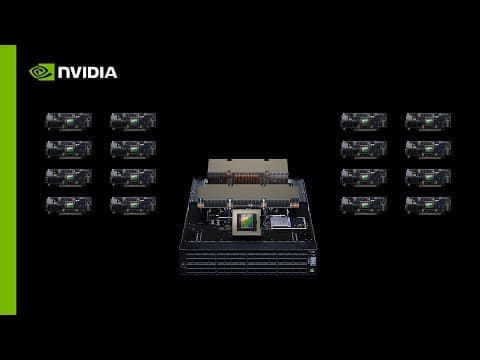
AI training generates very large network flows that cause congestion, higher latency, and bandwidth unfairness when run on traditional cloud Ethernet, reducing GPU utilization. NVIDIA's Spectrum-X is an end-to-end Ethernet fabric purpose-built for AI, based on the Spectrum-4 switch/Spectrum-4 ASIC working tightly with the BlueField-3 DPU and enhanced RoCE features. In real-world examples Spectrum-X shows up to 1.7× improvement in per-GPU performance, power efficiency, training time, and TCO, and 2.5× higher effective bandwidth for NCCL AllReduce, yielding lower jitter and shorter tail latency. The platform relies on full‑stack optimizations (software, libraries, OS) and RoCE controls (adaptive routing, performance isolation, congestion control) to deliver predictable, higher effective bandwidth across AI clusters.

  • AI workloads produce very large network flows and therefore require a separate AI fabric rather than running on traditional Ethernet clouds.
  • Running AI workloads on traditional Ethernet introduces congestion, increased latency, and bandwidth unfairness, which cause performance loss and can prevent effective GPU utilization.
  • NVIDIA Spectrum-X is presented as the world’s first Ethernet fabric built specifically for AI workloads — an end-to-end NVIDIA solution.
Read full briefing

Key technical points

  • AI workloads produce very large network flows and therefore require a separate AI fabric rather than running on traditional Ethernet clouds.
  • Running AI workloads on traditional Ethernet introduces congestion, increased latency, and bandwidth unfairness, which cause performance loss and can prevent effective GPU utilization.
  • NVIDIA Spectrum-X is presented as the world’s first Ethernet fabric built specifically for AI workloads — an end-to-end NVIDIA solution.
  • The hardware architecture centers on the Spectrum-4 switch featuring the Spectrum-4 ASIC, paired in tight coordination with the BlueField-3 DPU for cluster resource utilization and efficient data transfer.
  • Spectrum-4 and BlueField-3 are combined into an optimized full‑stack solution that applies acceleration technologies over standard Ethernet protocol.
  • Enhanced RoCE (RDMA over Converged Ethernet) features are included: adaptive routing, performance isolation, and congestion control to manage AI traffic characteristics.
  • Spectrum-X aims to maximize AI performance by delivering the highest effective bandwidth, low jitter, and short tail latency.
  • A documented real-world example reports Spectrum-X delivering 1.7× higher performance per GPU, improved power efficiency, faster training time, and reduced total cost of ownership.
  • For collective communication patterns (NCCL AllReduce), Spectrum-X enables 2.5× higher effective bandwidth, which translates to faster and more predictable distributed training.
  • Continuous optimizations across the software stack, libraries, and operating systems are a core part of the solution to ensure optimal performance and interoperability of AI infrastructure.
  • The platform’s congestion-control and performance-isolation features act as operational guardrails to reduce unfairness and mitigate the failure modes (congestion, latency spikes) seen on traditional Ethernet.
  • Spectrum-X’s approach preserves standard Ethernet protocol compatibility while delivering acceleration technologies—positioning it as purpose-built but interoperable with existing Ethernet ecosystems.
  • The overall claimed outcome is accelerated AI cluster performance and reduced time-to-market by adopting an Ethernet fabric designed specifically for AI workload patterns.
Engineering relevance

For engineers building or operating GPU-based AI clusters, the brief highlights that network behavior (very large flows) is a first-order bottleneck and that traditional Ethernet can throttle GPU utilization via congestion, latency, and bandwidth unfairness. The architecture to consider is an end-to-end stack (Spectrum-4 ASIC + switch, BlueField-3 DPU, software/library/OS optimizations) with RoCE features (adaptive routing, performance isolation, congestion control) to raise effective bandwidth, reduce jitter and tail latency, and improve NCCL AllReduce performance. Key operational metrics to track and optimize are performance per GPU, effective bandwidth for collective ops, jitter and tail latency, training time, power efficiency, and TCO. Continuous software-stack tuning and interoperability testing are necessary parts of the deployment/iteration loop to realize the stated gains.

NVIDIA Vera Rubin Platform Ramping into Full Production | Built for the Era of Agents

Agentic AI requires systems that support observation, reasoning, planning, tool use, large working and long‑term memory, and dynamic sub‑agent spawning; conventional single‑chip or single‑rack designs are insufficient. NVIDIA Vera Rubin is a multi‑rack pod‑scale supercomputer built for this agentic era: heterogeneous, liquid‑cooled racks that combine NVL72 superchips for high‑throughput token generation, Groq 3 LPX for ultra‑low latency, BlueField‑4 DPUs for memory/storage/security acceleration, and Spectrum‑X photonic switching. The build is evidenced by the production rollout: seven new 3 nm chips, CoWoS packaging, HBM4 from multiple vendors, a 6‑trillion‑transistor compute board, MGX third‑generation racks with 1.3M components, and five connected rack‑scale systems now in full production. Outcome: a purpose‑built pod‑scale platform that trades extreme power, cooling, and supply‑chain complexity for agentic capabilities and deployment resilience (hot‑swappable NVLink switches, cableless interconnects), with the practical limitation of very large manufacturing and operations scale.

  • Problem context: agentic AI workloads require systems that handle observation, reasoning, planning, tool invocation, large context (working and long‑term memory), and dynamic sub‑agent creation—demands beyond prior single‑rack designs.
  • System architecture: Vera Rubin is a pod‑scale supercomputer composed of five connected rack‑scale systems (heterogeneous racks tuned to different roles) designed to run agentic workloads.
  • Heterogeneous compute tiers: NVL72 (MVL‑72) superchips focused on prompt/context understanding, reasoning, planning, and highest token throughput; Groq 3 LPX trays focused on ultra‑low latency token generation.
Read full briefing

Key technical points

  • Problem context: agentic AI workloads require systems that handle observation, reasoning, planning, tool invocation, large context (working and long‑term memory), and dynamic sub‑agent creation—demands beyond prior single‑rack designs.
  • System architecture: Vera Rubin is a pod‑scale supercomputer composed of five connected rack‑scale systems (heterogeneous racks tuned to different roles) designed to run agentic workloads.
  • Heterogeneous compute tiers: NVL72 (MVL‑72) superchips focused on prompt/context understanding, reasoning, planning, and highest token throughput; Groq 3 LPX trays focused on ultra‑low latency token generation.
  • Compute hardware details: seven new 3 nm chips, CoWoS‑R and CoWoS‑L packaging, HBM4 memory supplied by Micron, SK Hynix, and Samsung; the Vera compute board contains ~6 trillion transistors and >18,000 components.
  • Rack design and connectivity: third‑generation MGX rack with 1.3 million components, modular compute trays, a new PCB midplane design, 18 compute trays per rack, nine hot‑swappable NVLink switch trays, and cableless mating of Superchips, ConnectX‑9 SuperNICs, and BlueField‑4 DPUs for resiliency.
  • Power and cooling: liquid‑cooled bus bars carrying over 5,000 amps per system (scale compared to 20 electric cars at full acceleration), plus new high‑efficiency manifolds—indicating major facility power and liquid‑cooling requirements.
  • Orchestration and control plane: a dedicated Vera CPU rack containing 256 liquid‑cooled CPUs per rack to orchestrate models, shuffle memory, and launch tools—separating control/orchestration from token generation compute.
  • Memory and storage acceleration: BlueField‑4 STX DPUs accelerate storage processing and act as the memory/storage/security interconnect (described as where AI keeps its memory), providing in‑silicon security functions.
  • Networking and photonics: NVIDIA Spectrum‑X Ethernet switch is the first with 200 Gbps co‑packaged optics, using TSMC CoWoS, chip‑scale packaging, and indium phosphide laser diodes—targeted at extremely high bandwidth/low‑latency interconnects.
  • Latency vs throughput trade‑off: MVL‑72 (NVL72) optimized for highest throughput token generation, while Groq 3 LPX is optimized for lowest latency token generation—implying heterogeneous placement of workloads by latency/throughput needs.
  • Resiliency and serviceability design choices: hot‑swappable NVLink switch trays and cableless mating aim to improve resiliency and maintenance at AI factory scale.
  • Scale of manufacturing and supply chain: production involves ~150 supply‑chain partners across Taiwan, millions of square feet of factory floor, and hundreds of sites—characterizing extreme co‑design and complex manufacturing orchestration.
  • Deployment evidence: Vera Rubin has moved into full production with engineering racks operational at partners (Microsoft, Dell, Corweave) and mass manufacturing partners (Foxconn, Quanta) building Groq LPX trays.
  • Component and bandwidth numbers called out: Groq 3 LPX deployment example—256 Groq 3 LPUs across 16 trays delivering ~40 petabytes/second of SRAM bandwidth in that tier.
  • Co‑design emphasis: the system and its manufacturing are described as an integrated effort with Taiwan partners from chip process through packaging, boards, racks, and data‑center deployment—an explicit example of extreme co‑design.
Engineering relevance

For engineers designing and operating agentic AI systems, Vera Rubin demonstrates several concrete implications: architect workloads against heterogeneous compute tiers (throughput‑optimized NVL72 vs latency‑optimized Groq LPX) and separate orchestration/control plane (256‑CPU Vera CPU rack) to manage memory shuffling and tool launching. Systems must integrate DPUs (BlueField‑4) to offload storage processing and enforce in‑silicon security, and use high‑bandwidth photonic switching (Spectrum‑X) to meet interconnect demands. Physical infrastructure planning must account for extreme power (5,000+ amps per liquid‑cooled bus), dense liquid cooling, hot‑swappable NVLink switch maintenance, and cableless interconnect topologies to achieve resiliency at scale. Production readiness requires supplier coordination, CoWoS packaging and HBM4 integration, and acceptance of the manufacturing complexity inherent in multi‑rack pod designs. Finally, expect trade‑offs between throughput and latency across compute tiers and design placement/orchestration policies accordingly.

Official Keynote Closing Video | GTC Taipei 2026

The keynote frames a concrete problem: agent-based AI is moving from novelty to production but demands much more compute, memory correctness, and safety. The presented approach is an integrated stack (Vera/Rubin token optimization, BlueField memory, a faster agent-focused CPU, NVLink Fusion for ASIC interconnect, Nemo Tron Ultra, Nemo Clock and Open Shell guardrails, ESX power optimizations, and GPU/CPU partitioning) that targets inference throughput, memory fidelity, sandboxing, and power efficiency. Evidence in the talk consists of headline performance claims ("cheapest tokens," 10x faster inference, 5x faster work, 50% faster CPU) and feature claims (memory correctness, guardrails, sandboxing, automated code migration), but the transcript does not include benchmark methods or detailed validation. Outcome: the stack is presented as production-ready for large-scale agent workloads and global AI clouds, while the talk does not provide the underlying evaluation details or failure-mode analysis needed for engineering validation.

  • Agents have shifted from niche/Movie-like examples to mainstream teams building with them, creating large new compute demands.
  • Vera is introduced as a core component for agents, claimed to deliver the "cheapest tokens" for inference cost reduction.
  • A claim of 10x faster inference is associated with this new token-optimized approach (presented as a headline performance metric).
Read full briefing

Key technical points

  • Agents have shifted from niche/Movie-like examples to mainstream teams building with them, creating large new compute demands.
  • Vera is introduced as a core component for agents, claimed to deliver the "cheapest tokens" for inference cost reduction.
  • A claim of 10x faster inference is associated with this new token-optimized approach (presented as a headline performance metric).
  • BlueField is described as maintaining agents' memory fidelity—"keeps agents' memory true"—indicating a system-level memory or state-consistency role.
  • A CPU improvement of "50% faster" was announced and explicitly described as being built for agents (presented as agent-oriented CPU performance uplift).
  • NVLink Fusion is presented as an interconnect/aggregation feature that "blends ASICs smartly," implying heterogeneous ASICs can be interconnected and used together.
  • "Everyone's welcome to the NVLink party" implies broad compatibility or openness for multi-ASIC configurations via NVLink Fusion.
  • Nemo Tron Ultra is presented as a leading compute element for agent workloads with a claim of 5x faster work throughput.
  • Nemo Clock is described as the component that keeps guardrails correct (a runtime/monitoring guardrail mechanism), while Open Shell is described as providing a tight sandbox for execution isolation.
  • The keynote claims automated developer operations: "Your code migrated and reviewed all before this song is through," implying automated migration and code review pipelines integrated into the stack.
  • The AI stack is described metaphorically as a "five-layer cake for your revenue," indicating a layered architecture spanning hardware, runtimes, and cloud services.
  • Global AI clouds are called out as the deployment target, requiring very large power capacity ("lots of gigawatts").
  • ESX is presented as a power-management and orchestration element that keeps power lean and optimizes every watt across the system.
  • A platform message: RTX 40 availability and the statement "Running anywhere Windows go" indicates desktop/PC availability; compute partitioning guidance is explicit: harnesses run on CPU and models run on GPU.
  • Cosmos is framed as building virtual worlds needed by robots and systems that learn to move and reason—implying support for embodied/robotics workloads and learned perception/reasoning stacks.
Engineering relevance

For engineers this transcript highlights a few actionable system-design signals without experimental detail: prioritize agent-oriented architectures that separate harness/control (CPU) from model execution (GPU); design for stateful agent memory with mechanisms similar to BlueField to preserve memory fidelity; plan for heterogeneous-ASIC topologies and NVLink-style high-speed interconnects for fused workloads; include runtime guardrails and sandboxing (Nemo Clock, Open Shell) as first-class components; expect integrated CI/automation for fast code migration and review; and optimize for power per watt (ESX) when planning for cloud-scale deployments. Note that the talk provides headline performance claims (10x inference, 5x throughput, 50% CPU) and qualitative feature claims but does not include benchmark methodology, validation details, or explicit failure modes, so engineering evaluation and validation must be performed independently before production adoption.

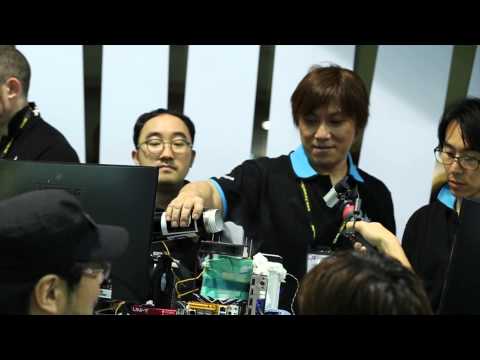
Overclocking at Computex 2015

This transcript is an event announcement with no technical substance: the speaker says "I'll explain later" and notes that "Master Kindergarten" has a demo today. Contestants from different countries have been invited to attend at the venue (the invitation is repeated). Evidence is the repeated invitation lines; outcome/limitation is that no system, data, metrics, or evaluation details are provided and a follow-up explanation is required.

  • Speaker explicitly defers technical explanation: "I'll explain later."
  • A demo by an entity named "Master Kindergarten" is scheduled for today (explicit).
  • Contestants have been invited from different countries (explicit).
Read full briefing

Key technical points

  • Speaker explicitly defers technical explanation: "I'll explain later."
  • A demo by an entity named "Master Kindergarten" is scheduled for today (explicit).
  • Contestants have been invited from different countries (explicit).
  • Invited contestants are expected to come to a physical venue (explicit: "to the venue").
  • The invitation statement is repeated multiple times in the transcript (explicit repetition).
  • The transcript provides only logistical/announcement content, not technical content (explicit absence).
  • No information is provided about the demo's system architecture (explicit absence).
  • No inputs, outputs, datasets, or data collection procedures are mentioned (explicit absence).
  • No evaluation methods, metrics, or success criteria for the demo are provided (explicit absence).
  • No production guardrails, safety constraints, or deployment plans are described (explicit absence).
  • No details about models, algorithms, implementations, or tooling are included (explicit absence).
  • The only actionable indication is the speaker's promise to provide an explanation later (explicit).
  • Repetition in the transcript emphasizes coordination of international participants rather than technical exposition (inference grounded in repeated lines).
Engineering relevance

For engineers, the transcript has negligible technical value: it is an announcement of a demo and international participants with no specifications to act on. You cannot derive architecture, inputs/outputs, evaluation criteria, metrics, guardrails, or deployment procedures from this text. The immediate engineering need is to obtain the promised follow-up explanation or detailed documentation before any design, integration, or evaluation work can proceed.

Shaping the Future of Work With Agentic AI

Aentic AI demonstrates a retrieval-augmented workflow that turns sales planning from days into minutes. VAS built a sales research AI agent in three days using the NVIDIA IQ blueprint and an accelerated AI data platform. The pipeline uses Nemo Retriever to continuously extract, embed, and index data for fast semantic search, then an agent drafts an outline, queries CRM/multimodal knowledge bases and internal tools, and Llama Nematron converts the outline into a step-by-step sales plan. Outcome: rapid, production-oriented agent creation and per-employee specialization enabled by Vast's accelerated AI data platform.

  • Aentic AI positions AI to change how businesses use data to make decisions.
  • VAS developed a sales research AI agent in three days, indicating rapid prototyping capability.
  • The implementation used the NVIDIA IQ blueprint as an architectural/implementation reference.
Read full briefing

Key technical points

  • Aentic AI positions AI to change how businesses use data to make decisions.
  • VAS developed a sales research AI agent in three days, indicating rapid prototyping capability.
  • The implementation used the NVIDIA IQ blueprint as an architectural/implementation reference.
  • Deployment ran on an accelerated AI data platform (referred to as Vast's accelerated AI data platform).
  • The platform uses Nemo Retriever as the retrieval component.
  • The data platform continuously extracts, embeds, and indexes data to support fast semantic search.
  • The agent's workflow begins by drafting an outline before detailed plan generation.
  • The agent integrates with CRM systems, multimodal knowledge bases, and internal tools as data sources.
  • After outline generation, Llama Nematron is used to transform the outline into a step-by-step sales plan.
  • The end-to-end workflow reduces sales planning time from days to minutes, starting with an AI prompt and finishing with a plan.
  • The platform is presented as enabling creation of specialized agents for every employee, implying scalable per-user agent instances.
  • The architecture sequence described: continuous data ingestion and embedding -> semantic retrieval (Nemo Retriever) -> outline drafting -> final plan generation (Llama Nematron).
Engineering relevance

Use the NVIDIA IQ blueprint and an accelerated AI data platform as an architectural template when building retrieval-augmented agents (explicit in the source). Implement a continuous data pipeline that extracts, embeds, and indexes enterprise data to enable fast semantic search (explicit). Select a retrieval component compatible with the pipeline—source uses Nemo Retriever for semantic retrieval (explicit). Design agent logic to first produce an outline, then perform targeted retrieval from CRM, multimodal knowledge bases, and internal tools before final generation (explicit sequence). Choose a generation model to convert structured outlines into executable step-by-step plans—source uses Llama Nematron for this role (explicit). Plan for rapid prototyping and iteration: the example demonstrates a three-day build for a working sales research agent (explicit). Anticipate operational scaling to support specialized agents per employee, which implies per-user data access, indexing, and model invocation patterns (implied by source's claim of per-employee agents). Measure outcome in task latency and business time savings: the source reports shifting sales planning from days to minutes using the end-to-end flow (explicit).

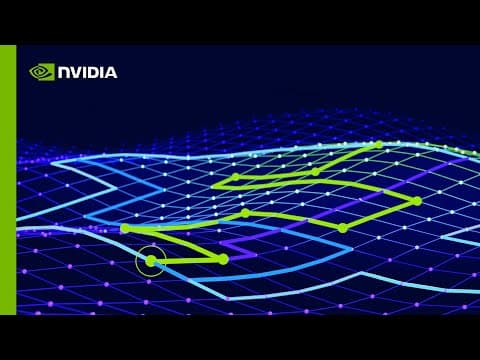
Talk to Your Supply Chain Data Using NIM

Nvidia faces extremely large, interdependent supply-chain decision problems (a single Hopper DGX can contain ~40,000 parts from 150+ suppliers across many factories) that require fast replanning when disruptions occur. Their business operations team built an AI planner assembled from NIMs (Nvidia Inference Microservices): an LLM Nim for intent, a Nemo retriever RAG Nim for proprietary data access, and a Nvidia coop Nim for GPU-accelerated combinatorial optimization. Nvidia coop (a GPU-accelerated operations-research library with 23 world-record benchmarks) computes optimal routes in seconds and dynamically recalculates when constraints or requirements change. The result is real-time, natural-language driven scenario analysis and product reallocation that reduces replanning from overnight to seconds, enabling faster operational response to supply changes.

  • Scale and complexity: a single Nvidia Hopper DGX contains nearly 40,000 parts from over 150 suppliers and weighs ~350 lb; Nvidia products and supercomputers involve tens of thousands of GPUs and hundreds of miles of optical cable.
  • Supply-chain fragility: hundreds of partners, thousands of components, and multiple factories create a system where a single disruption can materially impact delivery commitments.
  • AI planner concept: an agent built from NIMs (Nvidia Inference Microservices) enables users to 'talk to' supply-chain data via natural language.
Read full briefing

Key technical points

  • Scale and complexity: a single Nvidia Hopper DGX contains nearly 40,000 parts from over 150 suppliers and weighs ~350 lb; Nvidia products and supercomputers involve tens of thousands of GPUs and hundreds of miles of optical cable.
  • Supply-chain fragility: hundreds of partners, thousands of components, and multiple factories create a system where a single disruption can materially impact delivery commitments.
  • AI planner concept: an agent built from NIMs (Nvidia Inference Microservices) enables users to 'talk to' supply-chain data via natural language.
  • NIM definition and deployment: a NIM is a containerized package with pre-trained models and CUDA acceleration libraries that is easy to download, deploy, and operate on premises or in the cloud.
  • Modular assembly: the AI planner composes multiple NIMs — an LLM Nim to interpret planner intent, a Nemo retriever RAG Nim to link the LLM to proprietary data, and a Nvidia coop Nim for logistics optimization.
  • Nvidia coop description: a GPU-accelerated combinatorial optimization library for operations research that holds 23 world-record benchmarks.
  • Operations-research scope: coop targets classic hard problems (traveling salesman, vehicle routing, supply-chain optimization) characterized by many variables, constraints, and interdependencies.
  • Search-space difficulty: realistic logistics/search spaces are extremely large and change in real time, making accurate modeling and optimization very complex.
  • Optimization methods: coop leverages GPU acceleration with heuristics and evolutionary algorithms to act as a supercomputer for decision-making.
  • Latency and dynamism: coop can calculate optimal routes in seconds and dynamically recalculate when requirements or constraints change.
  • Natural-language control: the planner allows real-time analysis of thousands of scenarios driven by natural language inputs.
  • Example scenario: the planner can reallocate an RTX 6000 product to customers given changes such as a 40% increase in Taiwan supply, production decreases in Hong Kong, and a 20% increase in global demand while acknowledging constraints.
  • Outcome vs. legacy process: replanning this scale of supply-chain optimization would normally take at least overnight; the coop-powered AI planner completes it in seconds.
  • Integration pattern: intent understanding (LLM) → retrieval of proprietary data (RAG/Nemo) → combinatorial optimization (coop NIM) is the described production pipeline.
Engineering relevance

The talk describes a modular, containerized architecture for supply-chain automation: NIMs provide packaged, CUDA-accelerated model services that can be deployed on-premises or in cloud environments. Key engineering elements are LLMs for intent parsing, a retrieval-augmented Nemo Nim to connect to proprietary datasets, and Nvidia coop as a GPU-accelerated combinatorial optimizer that runs heuristics/evolutionary algorithms to produce near-real-time optimal routes. Performance claims include computing optimal routes in seconds and holding 23 world-record benchmarks for operations-research tasks; the system supports dynamic recalculation when constraints change. Engineers should note the pipeline pattern (intent → data retrieval → optimization), the need for low-latency GPU resources for coop, and integration points between natural-language interfaces and deterministic optimization components.

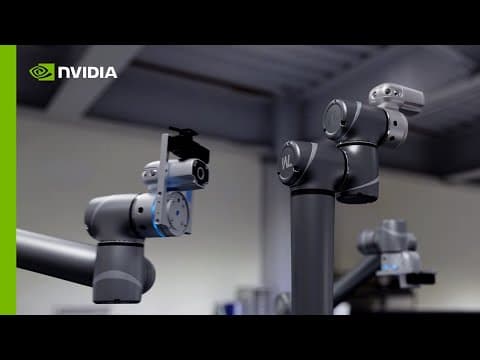
Techman AI Robot for Quality Inspection | Developed in Isaac Sim and powered by Omniverse

Automated Optical Inspection (AOI) often needs access to product areas unreachable by fixed cameras, but programming articulated robot arms to capture hundreds of images is time-consuming and combinatorially complex. Techman built a digital twin in NVIDIA Omniverse using Isaac Sim to simulate and optimize robot poses and inspection sequences, and used Omniverse Replicator to synthesize training data for ML models. Simulation-driven optimization cut programming time by over 70% and reduced per-inspection cycle time by 20%; synthetic data dramatically improved model performance. The solution is deployed at the edge to run dozens of low-latency AI models during inspection, enabling faster, higher-quality AOI on production lines.

  • Context: AOI is used to find defects and ensure product quality across manufacturing lines.
  • Hardware approach: inspection cameras are mounted directly on articulated robotic arms to access areas fixed cameras cannot reach.
  • Programming challenge: determining precise arm positions and the most efficient sequence to capture potentially hundreds of images requires exploring thousands of possible paths.
Read full briefing

Key technical points

  • Context: AOI is used to find defects and ensure product quality across manufacturing lines.
  • Hardware approach: inspection cameras are mounted directly on articulated robotic arms to access areas fixed cameras cannot reach.
  • Programming challenge: determining precise arm positions and the most efficient sequence to capture potentially hundreds of images requires exploring thousands of possible paths.
  • Digital twin solution: Techman created a digital twin of the robot using NVIDIA Omniverse and Isaac Sim to emulate the physical system for development.
  • Simulation-based optimization: Isaac Sim’s optimization tools were used to explore all possible path options in simulation to find efficient inspection sequences.
  • Measured impact (development): using the Omniverse/Isaac Sim digital twin reduced programming time by over 70% versus manual operation of the real robot.
  • Measured impact (throughput): optimizing paths in simulation streamlined the cycle time of each inspection by 20%.
  • Synthetic data generation: Omniverse Replicator was used to produce high-quality synthetic datasets for training machine learning models.
  • Model improvement: models trained with the synthetic datasets showed dramatic performance improvements (as reported by Techman).
  • Edge deployment: the inspection stack is run at the edge, enabling dozens of AI models to execute efficiently with low latency during inspections.
  • Inputs (explicit): camera images captured by robot-mounted cameras, potentially hundreds per inspection session.
  • Outputs (explicit): optimized robotic paths and sequences, synthetic training datasets, and trained ML inspection models used during production inspections.
  • Evaluation methods (explicit): comparative metrics reported are programming-time reduction (>70%) and inspection cycle-time reduction (20%), obtained by simulation-driven optimization versus manual operation.
  • Workflow loop (implicit in source): simulate robot and paths in Omniverse → optimize sequences in Isaac Sim → generate synthetic data with Replicator to train models → deploy models and optimized paths to edge for live inspection.
Engineering relevance

For software and AI engineers, this demonstrates a simulation-first development loop: build a digital twin in Omniverse/Isaac Sim to accelerate robot path programming and explore large combinatorial path spaces with optimization tools rather than manual tuning on hardware. Use Omniverse Replicator to produce labeled synthetic datasets that significantly boost ML model performance, then deploy trained models and optimized motion plans to edge devices to run many low-latency inference pipelines in parallel. Key measurable outcomes to track are reductions in developer programming time (>70%) and per-inspection cycle time (20%), plus model accuracy improvements from synthetic data.

The AI Factory: How NVIDIA Builds the Engine for the New Industrial Revolution

The supplied transcript is a short, fragmentary stage intro with heavy vocal repetitions and a music cue. The speaker utters an ambiguous performance-style phrase that appears to reference improved speed and efficiency (“made faster than a speed a light efficient”), but provides no technical context, metrics, or system description. Evidence in the snippet is limited to raw audio-text artifacts and a few unclear phrases, so no concrete engineering conclusions can be drawn from this source alone. The primary limitation is that the fragmentary, noisy transcript prevents reconstruction of any substantive technical content.

  • Transcript contains repeated exclamations and filler words (e.g., “go go go,” “yeah yeah yeah”), indicating a live or performance-oriented segment rather than a technical exposition.
  • A music cue is explicitly present ([Music]), confirming non-speech audio that can interfere with speech recognition and content extraction.
  • A quoted fragment reads: “the more you back the more you sa,” which is ambiguous in meaning and lacks clarifying context in the transcript.
Read full briefing

Key technical points

  • Transcript contains repeated exclamations and filler words (e.g., “go go go,” “yeah yeah yeah”), indicating a live or performance-oriented segment rather than a technical exposition.
  • A music cue is explicitly present ([Music]), confirming non-speech audio that can interfere with speech recognition and content extraction.
  • A quoted fragment reads: “the more you back the more you sa,” which is ambiguous in meaning and lacks clarifying context in the transcript.
  • Another literal fragment reads: “with top eye taor made faster than a speed a light efficient,” suggesting a claim about improved speed/efficiency but lacking definitional or quantitative detail.
  • Overall the snippet contains only noisy, partial phrases and no explicit mention of system architecture, inputs/outputs, evaluation methods, metrics, guardrails, trade-offs, failure modes, or deployment practices.
  • The transcript’s brevity and corruption make it unsuitable as a standalone source for engineering decisions or technical analysis.
  • Presence of overlapping speech and nonverbal cues is implied by the repetitive, exclamatory text and music tag, which are known to degrade automated transcript quality.
  • No concrete artifacts (code, diagrams, benchmarks, or configuration details) are present in the supplied text.
Engineering relevance

For engineers, this fragment signals a need to obtain higher-fidelity source material before any technical work. The presence of music and repeated interjections indicates the audio-to-text pipeline will require robust pre-processing (noise/music filtering, speaker diarization) and manual verification to recover any substantive content. Because no concrete system descriptions or metrics are present, teams should treat this transcript as unusable for design, benchmarking, or implementation planning until a full, clean transcript or original recording is obtained.

The Taipei 101 Tribute to NVIDIA GTC

The supplied transcript contains a single phrase: "Europe is coming." There are no technical details, speaker attributions, architecture descriptions, inputs/outputs, evaluation methods, metrics, guardrails, deployment instructions, or evidence to analyze. Because the source contains only that short statement, no engineering conclusions about systems, performance, or trade-offs can be drawn. Outcome: further analysis requires the complete transcript or technical materials from the Taipei 101 tribute talk.

  • Transcript content available: a single sentence — "Europe is coming."
  • No speaker names, roles, or affiliations are present in the transcript excerpt.
  • No system or architecture descriptions are provided in the source material.
Read full briefing

Key technical points

  • Transcript content available: a single sentence — "Europe is coming."
  • No speaker names, roles, or affiliations are present in the transcript excerpt.
  • No system or architecture descriptions are provided in the source material.
  • There are no inputs, outputs, data formats, or examples described.
  • No evaluation methods, benchmarks, or quantitative metrics are included.
  • No production guardrails, safety measures, or compliance constraints are mentioned.
  • No trade-offs, limitations, or failure modes are described.
  • No deployment, iteration loops, or operational/monitoring practices are present.
  • No timestamps, slide references, code snippets, or experimental details are included.
  • No claims, announcements, or benchmark numbers are present to verify or validate.
  • The source is insufficient to extract architecture-level or implementation-level insights.
  • To perform technical analysis, a full transcript or additional materials (slides, recordings, code, datasets, metrics) are required.
Engineering relevance

There is no engineering-relevant content in the supplied source beyond the single phrase. You cannot derive architecture, inputs/outputs, evaluation criteria, metrics, guardrails, trade-offs, failure modes, or deployment guidance from this text. For an engineering briefing, provide the full transcript or technical artifacts (detailed transcript, slides, code, datasets, benchmarks, and production constraints) so that system design, evaluation, and productionization items can be extracted and assessed.

This is NVIDIA Alpamayo Thinking Out Loud

The transcript lists a set of low-level driving decisions triggered by immediate roadway events: stationary lead vehicle blocking the lane, stop sign at an intersection, pedestrian occupying our lane, a vehicle cutting in from the left, and a stopped vehicle blocking on the right. The system response repertoire is limited to lateral nudges, slowing, stopping, and yielding mapped directly to these triggers. Evidence in the transcript shows clear input-to-action mappings (e.g., stationary lead vehicle -> nudge left; pedestrian in lane -> stop to yield). Outcome: these rules resolve short-range conflicts by lateral and longitudinal adjustments but do not describe sensing, timing, or higher-level planning context.

  • If a stationary lead vehicle ahead blocks our lane, perform a left nudge to avoid the blocker.
  • When approaching a stop sign that controls the intersection, slow down to a full stop.
  • If a pedestrian is present in our lane, stop to yield to the pedestrian.
Read full briefing

Key technical points

  • If a stationary lead vehicle ahead blocks our lane, perform a left nudge to avoid the blocker.
  • When approaching a stop sign that controls the intersection, slow down to a full stop.
  • If a pedestrian is present in our lane, stop to yield to the pedestrian.
  • If another vehicle cuts in from the left, yield to that cutting vehicle.
  • If a stopped vehicle is blocking on the right, nudge left to clear around it.
  • Described maneuvers include both lateral adjustments (nudge left) and longitudinal actions (slow down, stop, yield).
  • Triggers are specified by relative position and type: 'ahead' stationary vehicle, 'in our lane' pedestrian, 'from the left' cutting vehicle, 'on the right' stopped vehicle, and a regulatory 'stop sign controlling the intersection.'
  • The transcript presents direct input-to-action mappings suitable for deterministic decision rules (specific observed condition -> specific maneuver).
  • Priority behavior is explicit where stated: yield to a pedestrian in our lane and yield to a vehicle cutting from the left; stop at a stop sign.
  • Actions are focused on short-range, immediate conflict resolution rather than route-level decisions or long-horizon planning.
  • The narrative implies a small action set (nudge left, slow down, stop, yield) that must be selected based on the observed trigger.
  • Each described response assumes the detection of a specific actor or control element (lead vehicle, pedestrian, cutting vehicle, stopped vehicle, stop sign) as the input signal.
  • The transcript does not provide sensor, timing, or control parameter details—only the conditional actions tied to observed events.
  • These mappings can serve as ground-truth labels or oracle behaviors for testing local behavior modules under the listed scenarios.
  • Failure modes implied by the transcript are limited to the listed triggers not being detected or misclassified, leading to omission of the prescribed nudge/stop/yield actions.
Engineering relevance

The transcript gives concrete conditional rules mapping observed roadway entities to immediate vehicle maneuvers (nudge left, slow, stop, yield). Engineers can use these explicit mappings as test cases or behavioral specifications for local decision and control components, ensuring correct lateral and longitudinal actions when specific triggers appear. Because the actions are short-range conflict-resolution maneuvers, they are directly relevant for validating short-horizon planners and collision-avoidance logic. The source does not specify sensing modalities, timing thresholds, or parameter values, so those engineering details must be defined separately.

Tokens Turn Data Into Knowledge | Official Keynote Intro | GTC Taipei at COMPUTEX 2026

The talk frames the core problem as large, complex data sets that hide actionable patterns. The proposed system-level approach is a 'new kind of factory' that generates tokens—the building blocks of AI—to turn raw data into knowledge, reasoning, and action. Evidence in the talk is descriptive: tokens reveal previously unseen patterns, enable digital mirrors of cities, help robots learn from humans, and support health and safety outcomes. The outcome is an industrialized, scalable path to intelligence, with the caveat that this is presented as the beginning of a large effort (here starting in Taipei) rather than a completed deployment.

  • Tokens are presented as the fundamental building blocks of AI.
  • The process of token creation is described metaphorically as a 'new kind of factory' and a 'generator of tokens'.
  • The core data flow: raw data -> tokens -> knowledge -> reasoning -> action (tokens transform inputs into actionable outputs).
Read full briefing

Key technical points

  • Tokens are presented as the fundamental building blocks of AI.
  • The process of token creation is described metaphorically as a 'new kind of factory' and a 'generator of tokens'.
  • The core data flow: raw data -> tokens -> knowledge -> reasoning -> action (tokens transform inputs into actionable outputs).
  • Tokens uncover patterns in complex data that were previously invisible ('They reveal patterns in complexity. We could never see.').
  • Tokens enable digital mirroring of cities ('Mirror our cities') to support safety and situational awareness.
  • Tokens help robots learn from humans, facilitating human-robot collaboration and operations in environments humans cannot access ('They go where we cannot').
  • Tokens are positioned as enablers for assistive and healthcare outcomes ('closing the gap between hope and healing', 'so that we breathe easier', 'the smallest hearts beat stronger').
  • The narrative emphasizes scaling—tokens are 'helping us break new ground on a scale never attempted'.
  • The factory/generator metaphor implies an industrialized, repeatable production pipeline for intelligence (repeatable token generation and application).
  • Tokens are framed as the enabler for ambitious, large-scale missions and exploration ('Star Cloud 1 separation confirmed', 'to infinity and beyond').
  • The presentation locates the launch/starting point of this initiative in Taipei, signalling a regional kickoff or focal point for early deployment.
Engineering relevance

For engineering teams, the talk foregrounds building robust token-generation pipelines as the system's core component: ingest diverse data, produce consistent token representations, and map those tokens to downstream reasoning and action systems. Design work should include integration paths for city-scale digital twins and robotic platforms so that token outputs can feed situational models and control loops. Healthcare and safety use cases cited imply close coupling between token-derived knowledge and human-facing interventions, requiring validation and domain-specific data pipelines. The scale emphasis suggests planning for industrial-grade infrastructure and repeatable production processes rather than one-off experiments. Finally, the 'factory' metaphor highlights the value of operationalizing token production with clear interfaces for downstream consumers and iterative deployment starting at regional launch points.

WPP & NVIDIA Partner to Build Generative AI-Enabled Content Engine on Omniverse Cloud

NVIDIA and WPP are building a generative AI–enabled content engine on NVIDIA AI and Omniverse Cloud to speed production of product-accurate, brand-compliant digital advertising assets. The pipeline begins by constructing a physically accurate digital twin of a product from industry-standard design data in Omniverse Cloud, then WPP artists compose virtual sets augmented by generative AI tools (e.g., Adobe, Getty Images) trained on fully licensed data via NVIDIA Picasso. The resulting outputs are photorealistic visual content and e-commerce experiences delivered at scale; the source does not provide numeric metrics, failure modes, or operational details for evaluation or iteration loops.

  • Partnership: NVIDIA and WPP are jointly building a generative AI–enabled content engine targeted at the digital advertising industry.
  • Platform stack: The engine is built on NVIDIA AI technologies and the Omniverse platform and Omniverse Cloud.
  • Primary goal: Enable brands to build and deploy product-accurate and brand-compliant content faster and more efficiently.
Read full briefing

Key technical points

  • Partnership: NVIDIA and WPP are jointly building a generative AI–enabled content engine targeted at the digital advertising industry.
  • Platform stack: The engine is built on NVIDIA AI technologies and the Omniverse platform and Omniverse Cloud.
  • Primary goal: Enable brands to build and deploy product-accurate and brand-compliant content faster and more efficiently.
  • Digital twin input: The process starts by building a physically accurate digital twin of a product using Omniverse Cloud.
  • Data integration: Omniverse Cloud connects product design data from industry-standard tools into the digital twin workflow.
  • Virtual set creation: WPP artists create customized and diverse virtual sets using a combination of digitized environments and generative AI tools.
  • Generative components: Generative AI tools from organizations such as Adobe and Getty Images are used to generate scene components and variations.
  • Model training and data governance: Generative tools are trained on fully licensed data using NVIDIA Picasso, presented as a guardrail to ensure licensed content.
  • Brand compliance: The workflow emphasizes keeping generated content accurate and on-brand as an explicit constraint.
  • Outputs: The system produces photorealistic visual content and e-commerce experiences intended to increase realism and scale.
  • Industry impact claim: The engine aims to enable the next evolution of the $700 billion digital advertising industry.
  • Efficiency claim: The combined approach of manufacturing data (digital twins) and generative AI is presented as delivering faster and more efficient content production.
  • Integration emphasis: The pipeline relies on connecting existing product design pipelines and artist workflows rather than replacing them.
  • Evidence stated: The source asserts that this unique combination allows WPP to build accurate photorealistic content and scaled e-commerce experiences.
Engineering relevance

Key engineering considerations in the described system include integrating Omniverse Cloud with industry-standard product design tools to construct physically accurate digital twins; orchestrating a pipeline that passes digital-twin geometry and metadata to artist workflows and generative AI components; incorporating generative models from third-party providers (Adobe, Getty Images) and managing their training/usage via NVIDIA Picasso with fully licensed data as a compliance mechanism; and producing photorealistic rendered outputs suitable for e-commerce and advertising. The source emphasizes brand-compliance constraints and licensed-data guardrails but does not provide implementation details for evaluation metrics, runtime orchestration, model versioning, failure modes, or CI/CD/deployment loops.